Category Archives: North America

2011 ➤ The on-off brotherly rivalry that drove John and Scott Walker apart

Walker Brothers,

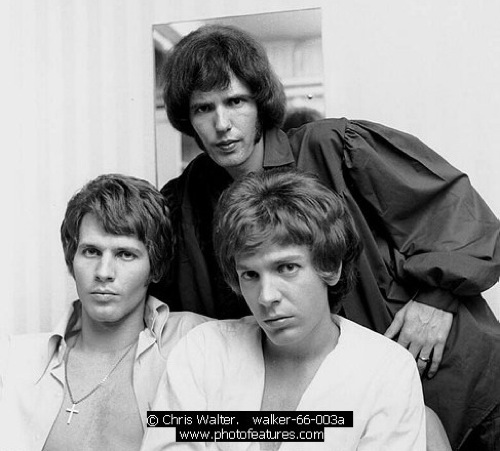
Frost is in the air at the height of their success in 1966: Walker Brothers John and Scott at front, with drummer Gary playing peacemaker

◼ IN 1966 JOHN WALKER was one of the biggest heart-throbs on the British pop scene as joint vocalist in a trio of sexy American dudes called The Walker Brothers. Their No 1 UK chart hits were the Bacharach and David song Make It Easy on Yourself and six months later, The Sun Ain’t Gonna Shine (Anymore) by Crewe and Gaudio. When John Walker died from cancer this weekend (Saturday May 7, 2011) at the age of 67, his former bandmate, the drummer Gary paid tribute to John as founder of the group and its original lead singer: “He was also a fantastic guitarist which a lot of people didn’t realise. He was a compassionate song-writer and a gentleman with lots of style.”

Sadly, as far as Google search can reveal, the third Brother, Scott, has apparently chosen to remain silent in the wake of John’s death.

Having relocated to Swinging London in 1965 when the UK ruled pop music, the soft-crooning Walkers were quickly besieged by frenzied female fans, whose adulation increased pressures emerging within the band. Scott’s soaring baritone voice established him as the lead singer, and the management persuaded both vocalists to abandon instruments onstage, leaving John stripped of a major aspect of his live performance. The band split awkwardly after a miserable farewell UK tour in 1967 which itself was hijacked by the “obscene and vulgar” supporting act, the Jimi Hendrix Experience (Jimi’s own quote). Scott’s disgust is vividly described in the 1994 biography Scott Walker, A Deep Shade of Blue.


+++
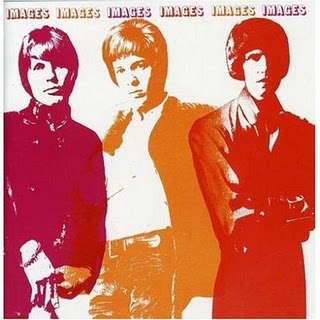
Walker Brothers, ImagesIn his 2009 book The Walker Brothers: No Regrets, co-authored with Gary, John Walker wrote: “Most people don’t realise that it was I who chose the songs that would become The Walker Brothers’ biggest-selling singles… I was aware that things had changed a lot: Scott had become the lead singer of the group… Now that he was singing lead, I enjoyed the opportunity to create some unusual harmonies.” Yet the new pecking order wrankled.

The charismatic frontman Scott Walker embarked on a solo career, putting out five albums between 1967 and 1969 with much commercial success, despite his confused mission to shake off the trappings of pop stardom. He had settled in Europe and during the ensuing decades adopted the lifestyle of a recluse, while his broody, inspirational voice and commitment to “serious” post-pop music has yielded further landmark albums and sustained a cult following worthy of a guru.
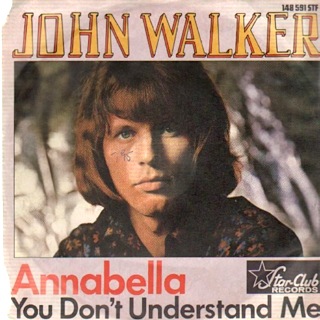
John Walker, Annabella, musicstack,60s popAfter the split, John released a single, Annabella, co-written by Graham Nash, which was a Top 30 hit in the UK, and an album, If You Go Away. Itchy feet and eager media reunited The Walker Brothers in 1975, and the hot comeback group released No Regrets, a single and album which proved hits for the fledgling GTO label. Two more albums followed in London to bring the band’s studio total to seven. But Scott’s legendary stage-fright resulted in lucrative tour offers being turned down, much to John’s exasperation.

Over the next couple of years, Scott says, “Everybody got sick of each other again”, while according to John the trio “just drifted apart”, after which he returned to the States and Gary Walker settled in England, both to assume lower profiles as musicians and producers. John Walker became a publisher and ran a recording studio in California, and in recent years resumed touring Britain as part of an annual Silver 60s show. His last appearance was at Croydon’s Fairfield Halls in May 2010, ending a 12-date sprint only months before his cancer was diagnosed.
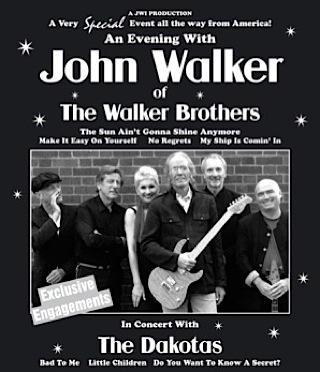
John Walker, UK tour 2010, Dakotas,Just for the record, the Walkers were of course not really brothers but the stage name is how the world will remember John Maus, Scott Engel, and Gary Leeds. As a teenager John had worked with greats such Ritchie Valens, Glen Campbell and Phil Spector. As 21-year-olds in 1964, the three Californians came together in response to the feverish mid-60s pop scene where moptop hair and cheekbones to die for cast them as readymade pop idols. Their effortless balladeering backed by a huge lush orchestra brought to the UK pop charts much-needed sophistication, of the kind the US had in abundance, so success was less marked in their homeland.

There isn’t much good footage of The Walker Brothers live, but the Land Of 1000 Dances clip [above] from German TV in 1966 is sensational evidence of John’s own onstage talents as he emulates Jaggeresque gyrations (Gary on drums). Likewise, in the rarely seen clip from the California TV show Hollywood A Go Go in 1965 [V-0759, below, from 17 minutes in, with “Tiny” Rogers on drums], the rendering of Cottonfields displays Scott’s breathtaking insouciance on bass. He and John could easily pass for brothers and their simmering appeal is self-evident. Great moves by the studio audience, too.

In the end the tensions were always between John’s country instincts and Scott’s idiosyncratic wish not to be typecast as a popstar. (In an interview with me in 1967 for Britain’s “first teenage newspaper”, titled Cue and published by IPC, Scott confessed that he drank a bottle of Scotch and a bottle of wine a day with the sole purpose, he claimed, of wanting to coarsen the baritone voice he thought sounded too sweet.)

Mojo’s verdict on the Brothers’ 1967 album Images: “The swansong of America’s British chart crashers, too square for the freaks and too loose for the straights.” And of the second reunion album Lines (1976), AllMusic says: “Still uncertain of their true role in the exciting world of mid-1970s pop, the Walkers remained torn between the big balladeering which had served them so well in the past, and the more experimental (or, at least, new) stylings which Scott, at least, was imbibing elsewhere.” The Walkers made some great pop in their heyday, but were oh so vulnerable to the famously destructive power of “creative differences”.

+++
➢ Scott Walker has composed the music for a recital in music, dance and voice based on a Jean Cocteau monologue at the Royal Opera House’s Linbury Studio, June 17–25, 2011… The ROH preview says: “Jean Cocteau’s monologues provide the inspiration behind an evening of opera and dance from ROH Associate Artist Aletta Collins and director Tom Cairns. They explore the inspirational synergy of music, dance and voice along with Cocteau’s themes of possession and abandonment. In Duet for One Voice, a world-premiere, Collins re-imagines Cocteau’s monologue Duet for One Voice for dancers, with a newly composed score by composer Scott Walker.”

➢ 2019, Elsewhere at Shapers of the 80s: Tributes on the death of Scott Walker

FRONT PAGE

1981 ➤ Ballet on Broadway, leading the British invasion of America, spring 1981

On this day 30 years ago, 21 Blitz Kids, average age 21, took Manhattan by storm. Spandau Ballet provided the new British electropop, the Axiom design collective provided the radical London fashion show, while Tina Turner and Robert de Niro joined the coolest audience in New York City to witness the new sounds and new styles of Swinging London…

 Spandau Ballet, Blitz Kids, Jim Fourratt, Axiom fashion,Sade Adu,British invasion,

First published in the first issue of New Sounds New Styles in July 1981

Click here to read what happened for seven days in May
when the Ballet hit Broadway

FRONT PAGE

➤ Bin Laden raid becomes Twitter’s CNN moment

Osama Bin Laden’s compound,Pakistan, Google maps
➢ Search for “Osama Bin Laden’s compound, Pakistan”
on Google maps

Sohaib Athar, ReallyVirtual, Bin Laden raid, Tech Crunch, Twitter

Sohaib Athar aka ReallyVirtual

➢ BBC NEWS REPORTS: The raid that killed Osama Bin Laden was revealed first on Twitter. An IT consultant, living in Abbottabad, unknowingly tweeted details of the US-led operation as it happened last night. Sohaib Athar, 33, wrote that a helicopter was hovering overhead shortly before the assault began and said that it might not be a Pakistani aircraft.

He only became aware of the significance of his tweets after President Obama announced details of Bin Laden’s death. Mr Athar’s first posting on the subject came at around 1am local time (9pm BST). He wrote: “Helicopter hovering above Abbottabad at 1AM (is a rare event).” Minutes later he was tweeting: “Go away helicopter — before I take out my giant swatter :-/ ”

Osama Bin Laden ,helicopter raid,Tweet,Sohaib Athar,
➢ Rory Cellan-Jones, Technology correspondent, BBC News: I turned on the radio at 0700 this morning and heard the news that Osama Bin Laden had been killed. I immediately picked up my phone and tweeted this fact — only to be bombarded with messages saying this was now very old news. In the age of Twitter you have to be online all night to keep up with events.

“Twitter just had its CNN moment,” as one American website put it, comparing this event with the first Gulf War, where millions suddenly woke up to the fact that cable news was the place to observe a war unfold in real-time. Such is the power of this network that it has become the key resource for older media trying to stay ahead of events.

➢ Tech Crunch reports on the man who for two hours unwittingly live-tweeted the raid on Bin Laden — and reveals a local claim that it was “training accident scenario”

Barack Obama, situation room, White House, Bin Laden raid,Hillary Clinton

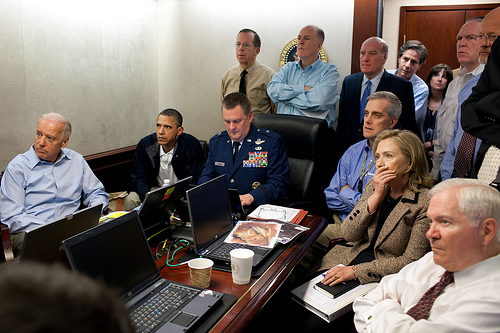
Straight out of Sorkin’s West Wing — Barack Obama and his national security team watch the mission against Osama Bin Laden unfold in real time in the Situation Room of the White House, May 1, 2011. Vice President Joe Biden far left, Hillary Clinton seated right. (Official White House photo by Pete Souza)

➢ Bin Laden raid video ‘sent from helmets’ to Obama

FRONT PAGE

➤ When digital downloads mean lost income for stars like Eminem

THIS OPINION PIECE IN TODAY’S GUARDIAN may be weighted with legalistic argument, but it reveals the chaos that digital media — downloads and ringtones, for example — have brought upon the music industry. It also confirms the pitiful rates musicians and performers have been paid for their work in the past…

“At the centre of [recent lawsuits involving Eminem and the late Rick James] is the question of whether a download is a licence or a sale. A normal record deal today would usually give an artist 12–20% of revenue from sales depending on how successful they are at the point of signing (only the bigger artists get anything close to 20%). But if a song is licensed to be played in, say, a TV show or a film, they receive 50% of revenue. Buying a download on iTunes may make you feel like you own it, but the fact is that you’ve just bought the rights to play it. And so the court agreed that the Eminem downloads counted as licences.

“Universal argues that it was simply the wording of Eminem’s specific contract that resulted in them losing the case, and it’s true that standard contracts have changed since the advent of iTunes and now clearly state that download sales count as sales. But thousands of artists signed their deals way before iTunes. If they did so before 1980, chances are they’re on a sales royalty rate that is lower than 10% — some artists from the 60s and 70s were on 4%, minus packaging deductions — which means they can up their digital royalty rate more than tenfold.”

➢ Continue reading Why Eminem could spell major trouble for the major labels — by Helienne Lindvall in The Guardian, April 29, 2011

FRONT PAGE

2011 ➤ Rutter’s anthem affirms romance of the royal wedding

royal wedding, anthem, John Rutter, This is the day,

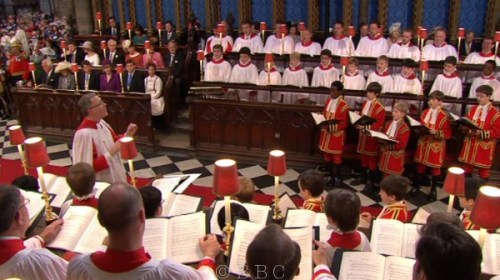
Choirs of Westminster Abbey and Her Majesty’s Chapel Royal, during today’s wedding of Prince William and Catherine Middleton

❚ VYING WITH MANY VISUAL TREATS TODAY at the wedding of Prince William and Catherine Middleton in Westminster Abbey was the well chosen and home-grown music. Three pieces were drawn from every Sloane’s wedding favourite, Hubert Parry, the 19th-century composer who knows how to tug at toff heartstrings. Despite which, he does rank among England’s finest and is best known for his rousing hymn Jerusalem, which inevitably followed the prayers today.

John Rutter, composer,

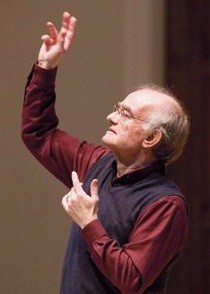
Spiritual: John Rutter

But to modern ears, the musical highlight was a soaringly beautiful choral anthem that followed the bride and groom’s marriage vows and preceded the Bishop of London’s address. Titled This is the day which the Lord hath made, the romantic three-minute piece was specially commissioned by the Dean and Chapter of Westminster for this service. Its uplifting theme wove together words from four Psalms (as published in The Book of Common Prayer) including these from Psalm 121 — “the sun shall not burn thee by day: neither the moon by night”.

The music was written by the English composer John Rutter (b 1945) who is also a conductor, editor, arranger and record producer with his own label, Collegium Records. The past day has seen reaction to the new anthem cause an immediate surge of hits at Google. Dr Rutter is said not to see himself as predominantly a composer of sacred music though he has set many psalms and carols and much of his work has a spiritual dimension. Most of his choral work has been subsequently transformed with an orchestral accompaniment so with luck this elegant piece too might be released in this way.
Listen here to the new anthem, as sung at the wedding by the choirs of Westminster Abbey and Her Majesty’s Chapel Royal, St James’s Palace, conducted by Mr James O’Donnell, organist and master of the choristers, Westminster Abbey. The organ is played by Mr Robert Quinney, sub-organist, Westminster Abbey.

➢ Among the music choices for the royal wedding, one was a stroke of genius — Chris Chivers singles out Parry’s Blest Pair of Sirens in The Guardian

APRIL 30 SOCIAL MEDIA UPDATE

❚ WHETHER YOU’RE A MONARCHIST OR NOT, the rest of the world went ape for the royal family yesterday. By 11am BST, 10 of the top 20 Google searches in the US related to the royal wedding. Likewise on Facebook, the top 10 keywords trending as public status updates in the US and UK were all wedding-related, led by Royal Wedding, Prince William, Prince Harry, Kate Middleton.

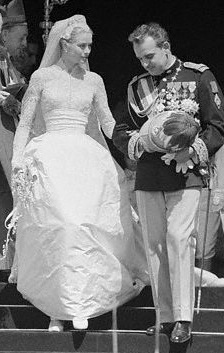
Grace Kelly , Prince Rainier

1956: Grace Kelly and HSH Prince Rainier of Monaco © Corbis

The royal wedding swept Twitter’s worldwide trending topics Friday morning. During the bishop’s address, all ten were related to the wedding: royalwedding, rw11, casamentoreal, William & Kate, QILF, Sarah Burton, Grace Kelly, Westminster Abbey, Rutter, Abadia.

By way of translation — “casamentoreal” and “abadia” mean “royalwedding” and “abbey,” respectively, in Spanish. QILF is a play on the acronym “MILF,” where “mother” is replaced with “queen.” Sarah Burton, number six, is the designer of Kate’s dress, and the creative director of British label Alexander McQueen. Kate’s dress and look were likened to those of the Hollywood actress Grace Kelly, who married the Prince of Monaco in April 1956. Number nine, Rutter, refers to John Rutter, who composed the anthem played during the wedding.

➢ The Official Royal Wedding photographs

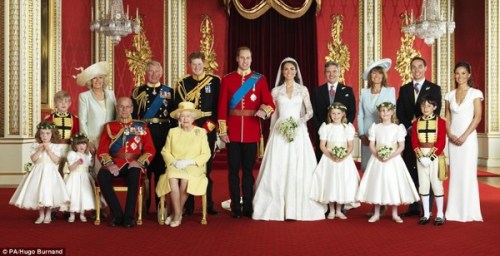
Official Royal Wedding photographs,2011,Hugo Burnand,William & Kate,

The royal wedding group in the throne room at Buckingham Palace, April 29, 2011. The Duke and Duchess of Cambridge are flanked by their respective family members and attendants. Front row (left to right): Grace van Cutsem, Eliza Lopes, HRH the Duke of Edinburgh, HM the Queen, Margarita Armstrong-Jones, Lady Louise Windsor, William Lowther-Pinkerton. Back row (left to right): Tom Pettifer, HRH the Duchess of Cornwall, HRH the Prince of Wales, HRH Prince Henry of Wales, Michael Middleton, Carole Middleton, James Middleton and Philippa Middleton. Photograph: Hugo Burnand

FOURTH HIGHEST ‘KETTLE EFFECT’ EVER IN UK

INTERNATIONALLY, the advance estimate predicted two billion people would tune in to Friday’s TV coverage of the Royal Wedding between Prince William and Kate Middleton, though this figure has yet to be confirmed. About 8,500 journalists were in London for the event.

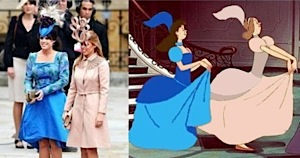
Princess Eugenie, Princess Beatrice , royal wedding ➢ IN THE UK, across the whole BBC, 34.7m viewers tuned in to watch some part of the wedding, including a million people online using BBC iPlayer. There was a peak of 6.1m viewers watching the coverage on ITV1 as the service began, the commercial broadcaster reported. Sky News had a peak of 661,000 viewers at 11am, with roughly one million people using its website.

➢ YouTube’s live feed brought the BBC’s pictures to a global online audience through its Royal Channel — which was the 23rd most-visited YT channel of the day, but trailed behind America’s Next Top Model and Top Gear.

➢ Surge in electricity demand suggests record television ratings — Daily Telegraph report
The surge in demand for electricity in the UK at the end of the royal wedding was the fourth-highest ever caused by a televised event. National Grid said that, when the couple reached Buckingham Palace after the ceremony at 12.40pm, demand for electricity increased by 2,400MW — the equivalent of nearly a million kettles being turned on at the same time. The surge was a third higher than that recorded after the wedding of Prince Charles and Lady Diana Spencer in 1981, which registered 1,800MW when 28m people had been watching in the UK.

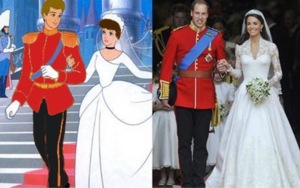
Prince William, Kate Middleton, royal weddingThat dazzling dress effect: National Grid also registered a 1,500MW drop in demand when viewers had their first glimpse of Catherine Middleton’s wedding dress as she got into her car to the abbey — with such a drop (rather than a surge) indicating that people were flocking to their televisions rather than carrying on with more electricity-hungry activities.

Electricity demand surges do not directly correlate with TV ratings, because they indicate how many people got up to switch their kettles on to make a cuppa — rather than the total number of people watching to begin with.

FRONT PAGE