Reckless by Mark Wallinger. Thanks to Jed Butterfield and Bob Pain at Omni Colour http://www.omnicolour.com and Nicholas Penny at the National Gallery
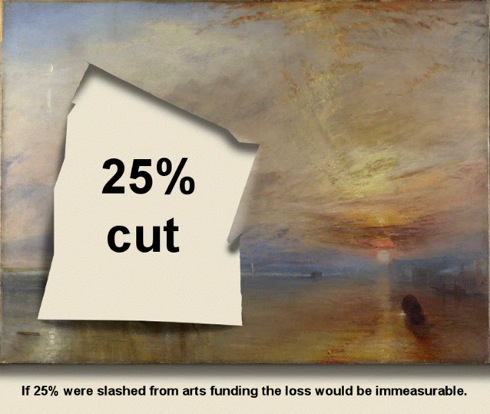
❚ A NEW WORK BY TURNER PRIZE-WINNING ARTIST Mark Wallinger is released today as part of a campaign supported by more than 100 leading British artists against the government’s proposed funding cuts of the arts.
Mark Wallinger’s work shows a copy of the masterpiece, The Fighting Temeraire, 1839 by Joseph Mallord William Turner, in the collection of the National Gallery in London. A slash in the painting carries a notice “25% cut” and beneath it a caption reads: “If 25% were slashed from arts funding the loss would be immeasurable.”
Turner refused ever to sell The Fighting Temeraire — depicting the final journey of the 98-gun ship which played a distinguished role in Nelson’s victory at the Battle of Trafalgar in 1805 — until he finally donated it to the National Gallery. When the BBC asked the nation to nominate the greatest painting on show in UK museums and galleries, this came first with 25% of the votes. Turner’s concern was to evoke a sense of loss as the great battleship was towed to the breaker’s yard.
The title of Mark Wallinger’s new work is Reckless. He explains: “I describe the cuts as a reckless adventure. In fact temeraire means reckless in French and by removing the obsolete ship from the scene I am rendering the painting wreckless.”
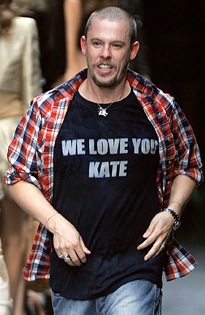
❚ WITH LONDON FASHION WEEK IN FULL SWING, hundreds of leading fashionistas gathered in St Paul’s Cathedral today for a ceremony in memory of Alexander McQueen. A taxi driver’s son who grew up in London’s East End, he became Britain’s most confrontational, unfettered and theatrical designer. He died in February aged 40, having been appointed a CBE and named British Designer of the Year four times by the British Fashion Council.
Alexander McQueen: enfant terrible of the runway
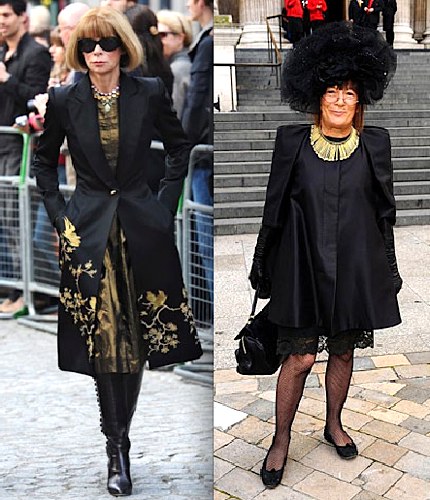
The world’s most powerful arbiter of fashion, Vogue editor Anna Wintour, led today’s tributes. Models Kate Moss and Naomi Campbell, actress Sarah Jessica Parker, muse Daphne Guinness and designer Stella McCartney were among the congregation, which also included relatives and former colleagues of McQueen.
Anna Wintour is the English-born daughter of Charles — editor of the Evening Standard during the Swinging 60s when his London paper achieved international acclaim. After removing her sunglasses, something she rarely does in public, Anna paid a moving tribute to McQueen: “He was a complex and gifted young man who, as a child, liked nothing more than watching the birds from the roof of his east London tower block.
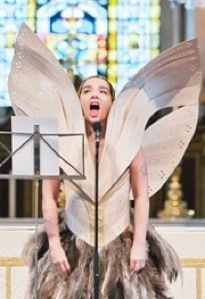
Bjork performing Gloomy Sunday
“He had an 18-year-long career of pioneering his dreams and dramas. He cared what people thought of his clothes but not of him. He never appeared at ease with himself and hated to travel away from his beloved London.”
Björk sang the haunting hymn Gloomy Sunday, which reflects on the horrors of modern culture, and there were also addresses from jeweller Shaun Leane, model Annabelle Neilson, McQueen’s nephew Gary Hulyer and milliner Philip Treacy. Composer and pianist Michael Nyman and the London Community Gospel Choir gave musical performances.
❚ “MORE CHANGE AND MORE CONFLICT were crammed into the 1980s than any other decade in the second half of the twentieth century. Out of political chaos, Britain arrived at a settlement that lasted, for better or worse. The way we live now follows directly from the tumultuous events of the 1980s.”
In his new book, No Such Thing As Society, Andy McSmith, chief reporter and former political correspondent of the Independent newspaper, argues this was the conflict decade, defined by strikes, war and riots. He examines Britain in the decade of Thatcher and the City’s ‘big bang’, from the Falklands war and the miners’ strike to Bobby Sands and the Guildford Four, from Diana and the New Romantics to the Brixton riots and Band Aid, from the Rubik’s cube to the ZX Spectrum. He talks about the legacy of the 1980s and how this decade of extremes shaped contemporary Britain.
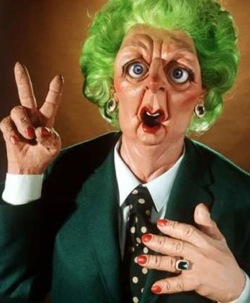
Spitting Image's suited version of prime minister Margaret Thatcher gives a Churchillian V for Victory
“You know, there is no such thing as society. There are individual men and women, and there are families. And no government can do anything except through people, and people must look to themselves first.” — Margaret Thatcher, talking to Woman’s Own magazine, October 31, 1987
McSmith maintains that “the 1980s was the revolutionary decade of the twentieth century. To look back in 1990 at the Britain of ten years earlier was to look into another country. The changes were not superficial, like the revolution in fashion and music that enlivened the 1960s; nor were they quite as unsettling and joyless as the troubles of the 1970s. And yet they were irreversible. By the end of the decade, society as a whole was wealthier, money was easier to borrow, there was less social upheaval, less uncertainty about the future.
“Perhaps the greatest transformation of the decade was that by 1990, the British lived in a new ideological universe where the defining conflict of the twentieth century, between capitalism and socialism, was over. Thatcherism took the politics out of politics and created vast differences between rich and poor, but no expectation that the existence of such gross inequalities was a problem that society or government could solve – because as Mrs Thatcher said, ‘There is no such thing as society … people must look to themselves first’.”
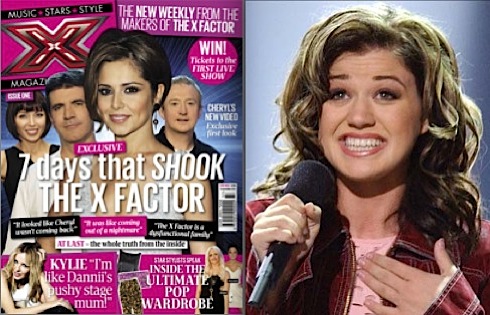
From the makers of The X Factor: a new magazine, edited by the man who toyed with Kelly Clarkson like a cat with a mouse
❚ WE LOVE HIM, THEY LOATHE HIM, the worst of them. One of the most influential and passionate commentors on the pop scene appears to have jumped ship in the direction of Simon Cowell’s entertainment goldmine. Peter Robinson, the 30-something wag and one-man Girls Aloud fanclub, has made his Popjustice blog a compelling read for fans who favour his surreal version of the truth, but a gunk tank for stars who imagine there’s any such thing as an even break.
Yet this morning’s Media Guardian unequivocally describes him as “formerly” the editor of PJ, while announcing the launch of X magazine, whose own website gives him the title of Senior Editor there. Sounds like a golden-handshake welcome to X which is to be the weekly print offshoot of the Cowell TV franchise, The X Factor. A 100-page launch issue appears tomorrow to coincide with series seven of the ITV talent show, and distribution is initially through Tesco supermarkets, price £1.95, even when the show is off-air.
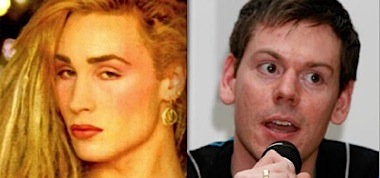
"Senior Editor" of X magazine: no, not the Peter Robinson who dresses as Marilyn, the other Peter Robinson
A “surprising” level of access to contestants is promised, though Robinson is reported to have feared that X would be “pretty much a glorified fan magazine”. The big cheese at its publisher, Haymarket Media Group, convinced him that the owners were happy for X to “not always toe the party line”. Some might think this a risky ploy. Is the cheese actually familiar with the Robinson technique? Does the cheese know how often his notoriously cringe-making interviews must have turned a star to jelly? In fact, has the cheese read the all-time car-crash sofa-chat Robinson conducted with American Idol winner Kelly Clarkson? In which he provoked her to confess: “I’m not a man and I don’t claim to be.”
There hasn’t been a decent mag purely about pop since the upstart Smash Hits doled out respect and ridicule in equal measure. It ran for almost three decades as a fortnightly, shuffling off-stage only in 2006. Channel 4’s Popworld spin-off died after two issues in 2007. Nevertheless, according to another Haymarket cheese, women’s weeklies are reckoned to be on “vibrant” form, and Robinson is talking up his new title: “Our editorial team is the strongest of any British pop magazine in almost 20 years and this certainly feels like the biggest pop magazine launch in Justin Bieber’s lifetime.”
Robinson was working as a freelance in 2000 when, for the love of it, he founded Popjustice as a music site with attitude. He has overseen its successful monetisation in cahoots with w00tmedia, and bolted on a record label called Popjustice Hi-Fi. The Times reckons PR is one of the music industry’s Top 20 star makers while The Observer rated Popjustice the world’s most powerful music blog. So has he truly relinquished the crown after 10 years? No, of course not! What? Give up the most powerful throne in pop? That was just “a mistake/assumption on Media Guardian’s part” PR assures us. Not for nothing have hacks long dubbed it the good old “Grauniad”! So rest assured that a familiar bum stills sits in the PJ hotseat, while steering the pop universe with his left hand.
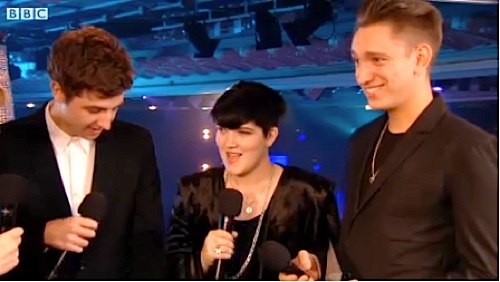
Tongue-tied winners, The xx tonight: very rare smiles from the ultra-cool Jamie Smith, Romy Madley Croft and Oliver Sim
❚ TONGUE-TIED, GANGLY, GAWKY and utterly lacking in stage presence — that’s the face of cool London in the 20-tens presented by The xx. This year’s £20,000 Mercury Music Prize was won tonight by the band of the moment, whose eponymous first album, xx, on the Young Turks label evokes a soulful yet haunting dreamworld of urban alienation. So musically spare are their songs — such as Islands, which instantly became Single of the Week on iTunes (UK) — that you can almost count the individual notes picked on guitar and synth. Their dark, hushed sound has been called “post-coital” yet they strenuously deny the lyrics are about sex. Which they are.
The Modfather Paul Weller was bookie’s favourite among the shortlisted best albums of the year which represent a dozen impressive strata of British musical tastes. Yet every web designer in Shoreditch, the creative media quarter of London, has been rooting for The xx since their album raised understated murmurs of approval in August 2009. By year’s end, Brick Lane habitués were declaring them “The Greatest Band of All Time”. No maybes, note.
This year, Karl Lagerfeld chose their track VCR for his Fall/Winter fashion show, then The xx were chosen by Matt Groening to headline two nights at All Tomorrow’s Parties, one of the annual unsponsored festivals in England which was curated by the Simpsons creator in May. The BBC made them the sound-track to its general election coverage, so well do The xx capture the 20-ten zeitgeist.
Arch is one word for the band’s style. Absorbing is another. It’s their artfully choreographed videos which can intensify the music’s emotional effect considerably more than the live performance, notably Saam’s black-and-white take on Islands [view below]. In public the trio are uniformly clad in nihilist black, but this is neither 70s Goth, nor 50s Left-Bank. Nor 30s Fascism, though redolent of it. Their merchandising comes in similar colourways from Ts to tote bags to skateboard decks to a £150 light box, all in black emblazoned with a bold white X. The motif is insistently present. Does it signify a vote? A negative verdict? The chromosome that determines gender? Or love, as in kisses after a lover’s signature?
The ubiquitous X is on all merchandising, here a lightbox for £150
A low-key Generation Y ethos underpins the band’s rise, from Romy Madley Croft and Oliver Sim polishing lyrics over IM, Jamie Smith improvising on an Akai MPC beat synthesiser that was a birthday present, recording in a garage the size of a bathroom, and doing their own production, to headlining their own international tour which continues through October in North America.
Both onstage at the Grosvenor House receiving the prize from musician Jools Holland and later being interrogated on TV by deejay Lauren Laverne, the trio of 20-year-olds who went to school together in south-west London were visibly in shock, lost for words, their heads bowed in painful shyness. Frontman and guitarist Sim said “Wow”. Twice. Vocalist and guitarist Madley Croft said “Aaah… erm” while keyboardist Smith couldn’t get a word in edgeways through the gauche silences. Romy eventually managed: “I genuinely wasn’t expecting to hear our name, genuinely, genuinely.”
Simon Frith, chairing the Mercury judging panel, declared the winning album to be “a record of its time” that “captures a sense of the uneasy times we live in” and has “an astonishingly coherent sense of itself”. He nailed it: “They have that urban soundscape where they are not exactly secure… That late-night feeling where you like the city and it’s exhilarating, but you don’t know what’s going to happen.”
Spookily they said much the same about Burial, the dubstep hero who attended the same comprehensive, the Elliott School in Putney, and was a Mercury Prize nominee in 2008. He too called himself “a low-key person”. Perhaps there’s something in the local water.
➢ Choose “View full site” – then in the blue bar atop your mobile page, click the three horizontal lines linking to many blue themed pages with background article
MORE INTERESTING THAN MOST PEOPLE’S FANTASIES — THE SWINGING EIGHTIES 1978-1984
They didn’t call themselves New Romantics, or the Blitz Kids – but other people did.
“I’d find people at the Blitz who were possible only in my imagination. But they were real” — Stephen Jones, hatmaker, 1983. (Illustration courtesy Iain R Webb, 1983)
“The truth about those Blitz club people was more interesting than most people’s fantasies” — Steve Dagger, pop group manager, 1983
PRAISE INDEED!
“See David Johnson’s fabulously detailed website Shapers of the 80s to which I am hugely indebted” – Political historian Dominic Sandbrook, in his book Who Dares Wins, 2019
“The (velvet) goldmine that is Shapers of the 80s” – Verdict of Chris O’Leary, respected author and blogger who analyses Bowie song by song at Pushing Ahead of the Dame
“The rather brilliant Shapers of the 80s website” – Dylan Jones in his Sweet Dreams paperback, 2021
A UNIQUE HISTORY
➢ WELCOME to the Swinging 80s ➢ THE BLOG POSTS on this front page report topical updates ➢ ROLL OVER THE MENU at page top to go deeper into the past ➢ FOR NEWS & MONTH BY MONTH SEARCH scroll down this sidebar
❏ Header artwork by Kat Starchild shows Blitz Kids Darla Jane Gilroy, Elise Brazier, Judi Frankland and Steve Strange, with David Bowie at centre in his 1980 video for Ashes to Ashes
VINCENT ON AIR 2026
✱ Deejay legend Robbie Vincent has returned to JazzFM on Sundays 1-3pm… Catch up on Robbie’s JazzFM August Bank Holiday 2020 session thanks to AhhhhhSoul with four hours of “nothing but essential rhythms of soul, jazz and funk”.
TOLD FOR THE FIRST TIME
◆ Who was who in Spandau’s break-out year of 1980? The Invisible Hand of Shapersofthe80s draws a selective timeline for The unprecedented rise and rise of Spandau Ballet –– Turn to our inside page
SEARCH our 925 posts or ZOOM DOWN TO THE ARCHIVE INDEX
UNTOLD BLITZ STORIES
✱ If you thought there was no more to know about the birth of Blitz culture in 1980 then get your hands on a sensational book by an obsessive music fan called David Barrat. It is gripping, original and epic – a spooky tale of coincidence and parallel lives as mind-tingling as a Sherlock Holmes yarn. Titled both New Romantics Who Never Were and The Untold Story of Spandau Ballet! Sample this initial taster here at Shapers of the 80s
CHEWING THE FAT
✱ Jawing at Soho Radio on the 80s clubland revolution (from 32 mins) and on art (@55 mins) is probably the most influential shaper of the 80s, former Wag-club director Chris Sullivan (pictured) with editor of this website David Johnson
LANDMARK FAREWELLS. . . HIT THE INDEX TAB UP TOP FOR EVERYTHING ELSE









 ➢➢ Shapers of the 80s ➣➣