Category Archives: Media

1981 ➤ New Romantics have their day — rearranging the deck-chairs at the posers’ ball

People’s Palace, Valentine Ball, New Romantics

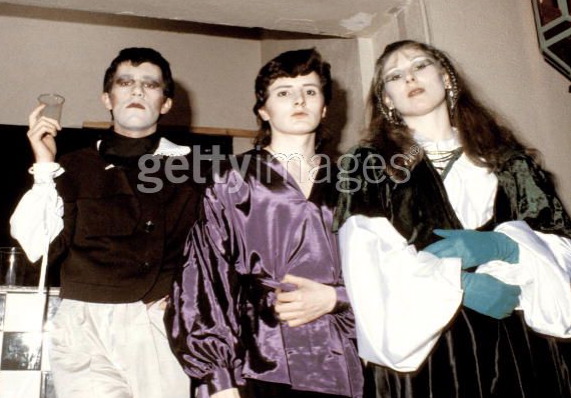
Valentine ball, 1981: last gasp for the New Romantics. Photographed © by Caroline Greville-Morris

❚ VALENTINE’S DAY 1981 was not so much the Woodstock of the New Romantics movement, but more akin to a Scouts and Guides jamboree in a giant ornamental wigwam in north London. Instead of boasting proficiency in camping and camouflage, a few hundred suburban Romantics fluffed up their frills and plastered on the Pan Stik to parade their skills in masquerade and maquillage. The “People of Romance”, as the tickets described them, paid £3.50 for a long evening starting at 5pm. They were expected to hold their own as stars alongside the cult’s budding bands at a venue renamed for a day The People’s Palace.
Astoria Finsbury Park, church, cinema, London

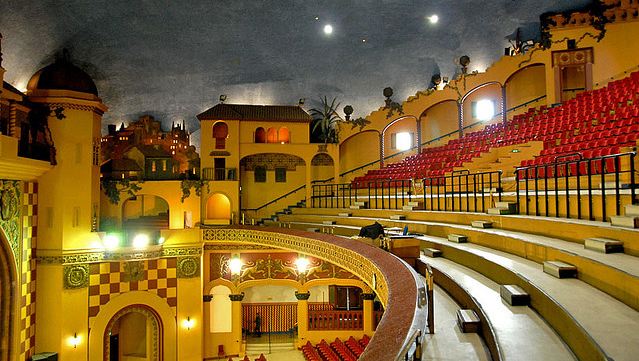
Andalusian fantasy: balcony view of the 1930 Astoria Finsbury Park, now restored. Photographed 2008 © hjuk/Flickr

An auditorium in Finsbury Park made the perfect backdrop. When it opened in 1930, the Astoria was one of Europe’s flagship cinemas seating 3,000 people. Its gloriously kitsch interior architecture depicted an Andalusian village whose rooftops and twisted barley-sugar pillars climbed towards a horizon and the starlit indigo ceiling way above balcony level. For a decade from 1971 the theatre had become a live rock venue, hippily renamed the Rainbow, where finally the stalls had been deprived of seats in favour of dancing audiences. Later the very year it hosted the People’s Palace, the place was to fall into disuse for a decade and a half, before being rescued and restored by a Pentecostal church.
People’s Palace, Valentine Ball, New Romantics, Steve Strange

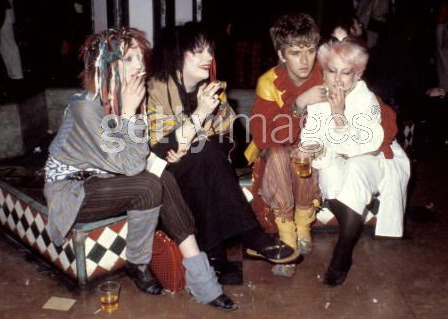
Steve Strange at the People’s Palace, 1981: plus loyal acolytes Myra, Judi and Mandy. In a fleeting fashion show, Judi showed six outfits which along with others for Strange’s videos helped shape the New Romantics silhouette. Photographed © by Caroline Greville-Morris

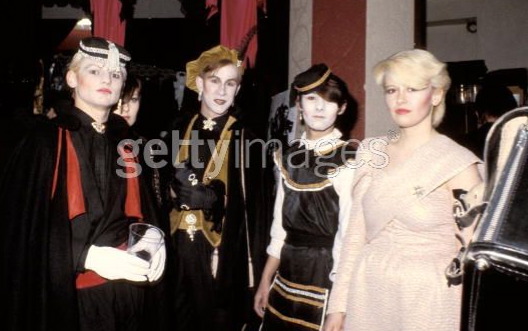
Thirty years ago today, posses of over-the-top Romantics incongruously wandered its vast auditorium and bars and cavernous Moorish lobby in search of photo opportunities. It seemed at times as if photographers outnumbered the cast. Richard Young, king of London’s celebrity snapperazzi, had arranged two sheets to create an impromptu studio where he was immortalising the generation who relished calling themselves posers, garbed from top to toe in bejewelled, befeathered lace and velvet and ridiculous hats.
People’s Palace, Valentine Ball, New Romantics

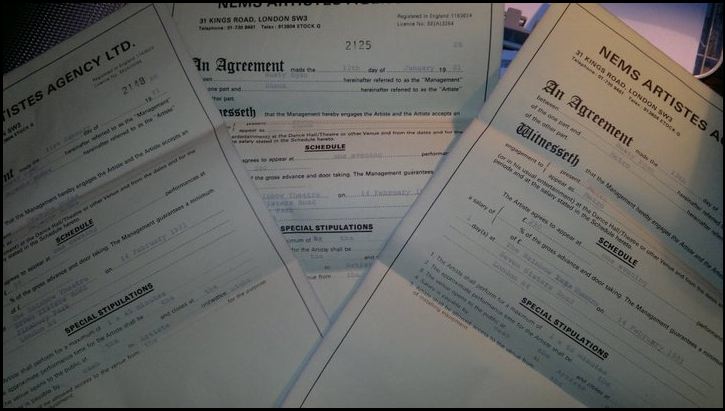
Performance contracts for the People’s Palace, 1981: Shock were paid £500, Metro £250 and Depeche Mode £50. Source: Rusty Egan archive

The soundtrack throughout was the latest electronic pop, spun on Rusty Egan’s turntables as well as played live onstage. On this Saturday Ultravox were arriving at No 2 in the singles chart with Vienna, and here at The People’s Palace they were topping a bill booked by the event’s promoters, Egan and Steve Strange, to capture the zeitgeist, even as the duo planned their next clubbing venture following the closure of their Blitz nights.

Much as Midge Ure protested about his band qualifying as New Romantics, in February ’81 any band toting synths ticked the box. Among supporting acts the then unknown Depeche Mode opened the live sets for a handsome fee of £50 in their first major performance off the clubbing circuit, one week before releasing their debut electro-single Dreaming of Me.
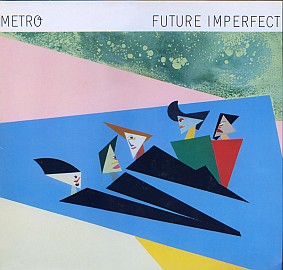
Metro band, pop, Future Imperfect, record sleevesPeter Godwin revived the new-wave band-name Metro, surfing in on the strength of their 1980 album Future Imperfect, followed by the dance troupe Shock, dressed by Birmingham’s Kahn and Bell, as exponents of the robotic dance-style across Britain’s clubland where their single Angel Face was a dancefloor hit.

Steve Strange had hoped to stage a splashy fashion show too, though according to Judi Frankland — who had featured with her outfits in Bowie’s Ashes to Ashes video the previous summer and is visible second from right in the masthead for Shapersofthe80s — “The other designers pulled out at the last minute and as I was still under Steve’s spell he made me carry on and do a ‘show’ alone with a mere six outfits. When he pulled me onto the stage, ohhh that still makes me cringe! However the one good thing I got out of it was being on the same stage as my faves, still to this day, Depeche Mode. I keep bumping into lovely Dave Gahan every few years in the most unexpected places.”

Meanwhile most of the original Blitz Kids — who had animated the Bowie credo that behind a mask you can be anyone you wish — wouldn’t be seen dead at The People’s Palace. In the wake of chart success by Spandau Ballet and Visage, they were competing in a calculated dash towards fame and fortune in clubland, glossy mags and the music biz, whose singles charts by the summer of 1981 welcomed Landscape, Depeche Mode, Soft Cell, The Human League, OMD, Level42, Duran Duran, Heaven 17, Altered Images and Imagination.

Like Midge, we can argue ad finitum whether these acts all technically counted as the New Romantics bandwagon, but they did play dance music, not rock — which defines the reformation that fundamentally vanquished rock to change the sound of the 80s charts — and all benefited from the momentum, as ABC’s Martin Fry later acknowledged. Most of them would, however, set about shaking off the hollow Romantics label in favour of their own musical tastes as soon it had served its purpose. For the moment, like the Titanic heading unwittingly towards its iceberg, the preening Lord Foppingtons and Lady Buxoms at the Rainbow were unaware that theirs was the last real gasp of The Cult That Had Gone Too Far. By Valentine’s Day 1982, there were so many new fashion factions that they would never have turned up for the same ball.
People’s Palace, Valentine Ball, New Romantics, Astoria Finsbury Park

Frills, tassels and hats: Arrivals at the New Romantics ball, 1981. Photographed © by Caroline Greville-Morris

FRONT PAGE

➤ The Kemp Brothers cook up a mystical morsel

Karma Magnet, Gary Kemp, Martin Kemp, Raj Ghatak

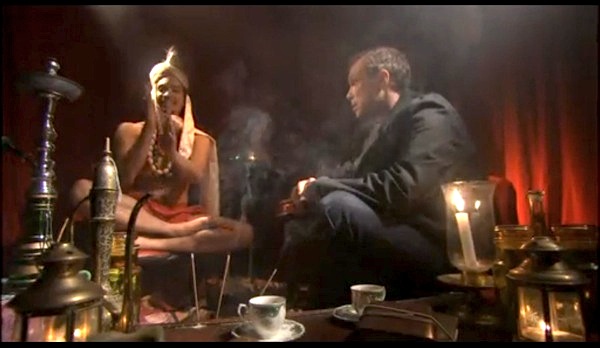
Fatal consultation over a nice cup of tea: celebrity chef Joel Manners (Gary Kemp) meets his guru (Raj Ghatak) in Karma Magnet

➢ Click to view Karma Magnet at Daily Motion

❚ HERE’S A 17-MINUTE SHORT FILM called Karma Magnet, directed by Martin Kemp of Black and Blue Films (also Spandau Ballet bass player) and featuring his brother Gary and Adele Silva. It tells why the luckiest man in the world wants to kill himself for the good of humanity.

No prizes for seeing how many other members of the Kemp family you can spot in this low-budget thriller.

FRONT PAGE

➤ EMI chief confirms record company sale highly likely

Tinie Tempah, EMI, RayBan,

Tinie Tempah, south London star on the troubled EMI label: the 22-year-old rapper keeps his cool in RayBan Wayfarers

❚ AN INTERNAL STAFF MEMO from EMI chief executive Roger Faxon confirms that the historic record label of the Beatles, Pink Floyd and Queen is up for sale. Last Tuesday ownership of EMI, Britain’s oldest record company, passed to Citigroup, the US banking giant, after 114 years of British ownership. The takeover ended speculation that has marred the label’s future ever since 2007 when Guy Hands and his Terra Firma private equity firm bought the British music major for £4.2bn, widely believed to be a massive overpayment. Terra Firma was unable to keep up interest payments on the loans.

In the note sent to music staff last Tuesday, and published today by Guardian online, Faxon confirmed that “there is no doubt that in due course EMI will be up for sale – just like it has been from the day Terra Firma bought it.” But he emphasised: “Regardless of the country of origin of our owner, EMI remains a British company – both legally and spiritually.” Faxon insists that “EMI itself was never in administration”.

➢ Read Roger Faxon’s memo at Guardian online

➢ More on Shapersofthe80s: After Queen quits, who can save EMI?

“The takeover in 2007 of EMI by Guy Hands’s Terra Firma — just as the bubble in financial markets was going pop — will go down in British corporate history as one of the worst ever deals”
Robert Peston, Business editor, BBC News

Further analysis in today’s Guardian by Dan Sabbagh, head of media, is headlined: Is the music company going to go for a song? He writes: “Hands’s instincts at EMI often failed to serve him and the business well. Three-and-a-half years later, after an overambitious acquisition that left the company unable to handle £3bn of debt Hands had taken on, the barbarian at the gates was forced out by his bankers Citigroup.

“Now that Citigroup has written off £2.2bn of loans, EMI, with a manageable £1.2bn debt load, is likely to be sold within months. Out of politeness, Citigroup sources prefer to say predictably that the process is ‘not a fire sale’ and that it is possible – if unlikely – that it will be theirs in a year’s time. The rhetoric is only there to protect the bank in case something goes awry again with a company that counts Katy Perry, Swedish House Mafia and Tinie Tempah among its latter-day artists.”

Warners and BMG are tipped as potential purchasers of EMI.

➢ Read: Is the music company going to go for a song?
at Guardian online

FRONT PAGE

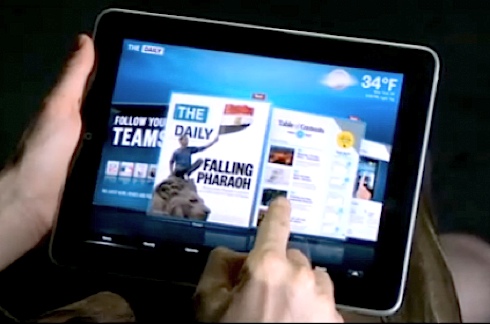
➤ Rivals sniffy about Murdoch’s Daily — more an iPad magazine than a newspaper

The Daily, Jemima Kiss, The Guardian, review

Jemima Kiss on The Daily: “First impressions are that this looks quite Microsoft to me which is probably not exactly what Apple were hoping for — the navigation is like a not-quite-so-good version of Cover Flow, which is how you navigate albums in the iTunes store”

➢ View video of Guardian’s Jemima Kiss scrolling us through
The Daily’s first edition (above, 3min 42sec)

❚ WITH A HUGE ROLL OF THE DICE, Rupert Murdoch has sought to put a seal on his reputation as a visionary media tycoon by launching The Daily, a digital-only news operation created from scratch and designed specifically for the iPad. Much is riding on it, not just Murdoch’s personal legacy in the twilight of his career, but, in his own description, the future of how people produce and consume journalism…

➢ Read more at Guardian online: Rupert Murdoch unveils
next step in media empire — the iPad ‘newspaper’

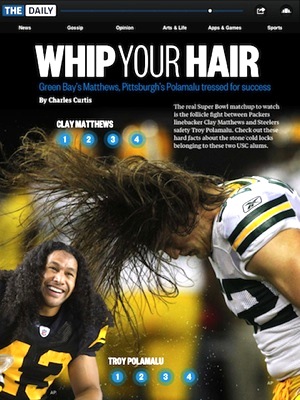
The Daily❚ SO WHAT DOES AN iPAD NEWSPAPER FEEL LIKE? The answer is “not much like a newspaper”. Instead, The Daily feels much more like one of the better examples of an iPad magazine, along the lines of Wired or Virgin’s Project. Despite the fact that both publications are ultimately owned by the same company, The Daily is nothing like The Times’s iPad app, as there’s little attempt to replicate much of the look, feel or tone of a traditional print newspaper. There’s plenty of video, both in stories and the ads that are strewn through The Daily. In some cases, rather than use ordinary photographs, there are 360-degree panoramic shots…

➢ Read Ian Betteridge’s review at Guardian online: The Daily offers glitzy graphics, video and live updates at low cost

❚ IT’S NOT A ‘NATIVE’ iPAD EXPERIENCE AT ALL, it’s a news magazine torn up and stuffed, page-by-page onto the iPad screen… If this is the best that journalism’s brightest brains can do, given a huge budget and input from Apple itself, then we’re in worse trouble than I thought.

➢ Read Shane Richmond at The Telegraph online:
A complete failure of imagination

Rupert Murdoch

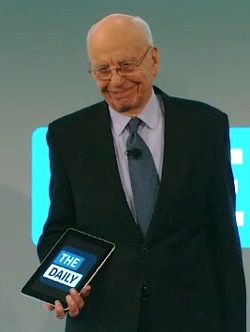
“Not a legacy brand”: Murdoch shows off The Daily at its launch

❚ RUPERT MURDOCH SPEAKING YESTERDAY: “The iPad demands that we completely reimagine our craft… The magic of newspapers — and great blogs — lies in their serendipity and surprise, and the deft touch of a good editor. We’re going to bring that magic to The Daily. Similarly, we can and we must make the business of newsgathering and editing viable again. In the tablet era there’s room for a fresh and robust new voice.

“No paper, no multimillion dollar presses, no trucks — we’re passing on these savings to the reader for just 14 cents a day… Our target audience is the 50m Americans who are expected to own tablets next year. Success will be determined by utility and originality. The Daily is not a legacy brand moving from the print to the digital world.”

➢ Launch of The Daily — Video of live presentation at the Guggenheim Museum, presented by Rupert Murdoch, chairman and CEO of News Corporation, and his editorial team (42 minutes)
➢ View demo of The Daily in action at thedaily.com

❚ TECHNOLOGY BLOGGER JOHN GRUBER: “Nothing groundbreaking, but better than most such efforts to date. The carousel feature is incredibly laggy. I can’t believe they shipped it like this. Maybe they’ve hired a good staff of writers and editors, but they sure need better designers and engineers. The experience just isn’t good enough.”

➢ John Gruber’s review at Daring Fireball

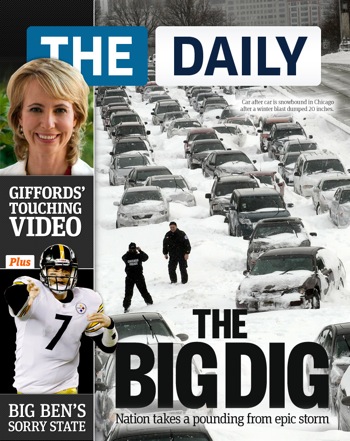
The Daily❚ THE NEWS SECTION IS EXTREMELY WEAK. The first edition contains precisely two real news articles, one of which (a story about Egyptian president Hosni Mubarak’s global address) had been thoroughly covered by all the major news outlets the previous day; the other, about the snow storm currently hitting the US, was borrowed from the AP.

➢ Read Lauren Indvik at Mashable: It’s a second-rate iPad magazine, not a newspaper

❚ THE DAILY IS PARTNERING with the Associated Press for its content… [although] it’s been selling itself as a place to go for original content. As its website puts it: The Daily is “a tablet-native national news brand built from the ground up to publish original content exclusively for the iPad”. Apparently “original” here means “not aggregated.” Which is fair enough. But “original content” also implies “special content.” The kind of content you can’t get anywhere else.

➢ Read Megan Garber at The Nieman Journalism Lab

FRONT PAGE

➤ George Michael celebrates his golden years of Faith


❚ NEWLY RELEASED JAN 31, 2011: A remastered version of George Michael’s debut solo album, Faith, from November 1987, is out on Epic/Legacy in the UK and tomorrow the US. There is also a DVD featuring a TV special from 1987, George Michael and Jonathan Ross Have Words, a 25-minute Music Money Love Faith EPK, plus seven remastered promo videos. All available through Michael’s international online retail store.

Faith won a Grammy Award as album of its year, for which Michael wrote and produced every track except one, among them six top-five singles. The first released, I Want Your Sex, went to No 3 in the chart and not unexpectedly caused censorship problems around the world. The daddy of US pop radio hosts, Casey Kasem, refused to say the full song title on air, referring to it only as “the new single from George Michael”. Having gone solo, Michael was after all trying to lay the ghost of his teenybopper image so successully established in Wham! at the age of 20 with his best friend Andrew Ridgeley. Sample their first Top of The Pops appearance as Young Guns, which hit No 3 in 1982, below.

Michael had of course already enjoyed  two UK chart-toppers, Careless Whispers in 1984 and A Different Corner in 1986, and in all has achieved eight No 1 singles in the US, his last in 1991. Before all that stuff happened.

FRONT PAGE