Category Archives: Media

➤ 40 years of Ziggy + another feast of Bowie

Ziggy Stardust, Spiders from Mars, David Bowie, Top of the Pops,✱ Who needs reminding it’s 40 years since “I picked on you-oo-oo”? June 1972 saw the release of one of the most influential albums ever recorded — David Bowie’s The Rise and Fall of Ziggy Stardust and The Spiders from Mars

➢ Bowie evening on BBC4, Friday June 22

9:00 BST David Bowie and The Story of Ziggy Stardust — exhilaratingly observant new TV doc narrated by Jarvis Cocker, 2012, directed by James Hale and exec-produced by Paul Bullock who brought us the brilliant Prince, A Purple Reign last year. Tight, total and definitive (in everything but an Angie contribution), it has contemporary rivals queueing to heap on the respect while nailing the genius with several gasp-out-loud revelations (you will sit up when Mike Garson hits the piano!). Quote of the era: “I can’t stand the premise of going on in jeans and being real.” A landmark. Repeated June 23, 25 and on iPlayer

10:00 The Genius of David Bowie — energised compilation of best archive performances, 2012, with breathtaking mature renderings of Heroes, Ashes and Fashion, plus magnificent Lou Reed and Iggy Pop as guests among others you’d rather ignore. Also June 23, 25

11:00 Ziggy Stardust & the Spiders from Mars — D A Pennebaker’s plodding, murky and utterly amateur film might as well have been bootlegged going by its appalling camerawork, shoddy editing, fudge sound (relieved only by its backstage footage revealing Bowie as the angst-ridden artiste). It was shot live at Hammersmith Odeon in 1973, the night Ziggy made his last stand even with Mick Ronson at peak power. “The first we knew we were unemployed was onstage,” the drummer Woody admitted at the Ziggy plaque unveiling in March. Historical curio worth a first watch just so you can feel the heat of real fan worship. If only the evident genius of Bowie himself could have been more watchably captured! But luckily I saw the whole wowie spectacle from Row C so the Standard was the first paper to break the news next morning. (This was the world pre-Twitter, remember – indeed, pre-rolling news of any kind.)

12:30 David Bowie at the BBC — live concert at the Radio Theatre, 2000, brilliant mix of classic songs (Fame, Man Who Sold The World, Always Crashing, Wild is the Wind) plus Gail Ann Dorsey on bass guitar. Also June 23, 25.

++++++++++++

Where to draw a line between glitter and glam
— at Shapersofthe80s

If David Jones hadn’t become Bowie — at Shapersofthe80s

Behind Bowie’s “lost” Jean Genie video — at Shapersofthe80s

++++++++++++

Birth of Glam , Gary Kemp , Marc Bolan,Radio 2, documentary, glitter✱ TONIGHT — Another brilliant radio doc on The Birth of Glam presented by Gary Kemp goes out June 13 at 10pm BST on Radio 2 … Two years ago under its original title The Glory of Glam it prompted a major assessment of the difference between glitter and glam here at Shapersofthe80s. At that time we said “If this documentary doesn’t win a Sony radio award, there’s no justice.”

FRONT PAGE

➤ Six rewrites punk history with an outlandish claim about the Not-Really-From-Bromley Contingent

Simon Barker, Six, Punks Dead, Jordan, photography, exhibition

Reunited: a plonker from Six for Jordan at Divus Gallery © Shapersofthe80s

❚ OLD HABITS, EH? A day in the spotlight and Simon Barker, aka Six, starts rewriting history! There we were last night in a Spitalfields gallery, chatting for the first time in 20 years at Punk’s Dead, his new show of early photographs of the now fabled Bromley Contingent, the posse of a dozen fashionistas who helped put the Sex Pistols on the map back in 1976. Having staked his claim to fame as the only person clapping at the end of the Pistols’ sixth gig (Dec 9, 1975, at Ravensbourne College) and being one of four fans with the band during the infamous “Filth & Fury” TV interview (Dec 1, 1976), Simon today works as a photographer in Prague.

Why Prague, I ask, as a big fan of the Bohemian medieval city? He groans: “Oh no! Why Prague? Why does everyone ask me the same question?” You’d never guess Simon and I used to natter away as if we liked each other back in the 80s when I’d pop into Viv’s Worlds End shop after going for a haircut next door at Smile. OK then, Six, why *Bromley*? As in Bromley Contingent. What was in the water in Bromley that produced his posse of poser punks?

“Ah, excellent question!” he replies. “We hated the name. It was created by the media — that woman Caroline Coon.” This is a double-edged dig at both the middle-class, ex-hippy Melody Maker writer who coined the phrase after seeing the “very striking” posse at three Pistols gigs in a row and asking where they came from (Bromley is a town in the south London commuter belt)… and also at me for being another member of the despised legion of journalists.

His Always-a-Punk gene is really kicking in now. “In actual fact, only two of us — me and Steve [Bailey, aka Severin] — came from Bromley. Siouxsie [Susan Ballion, later singer with the Banshees] was from Chislehurst. Billy [Broad, later Idol] lived in Bickley. And Jordan [born Pamela Rooke] came up from Seaford.

“For me and Steve, living in that bit of suburbia, Bromley had the best connection into London — 20 minutes by train. Any further away and it wouldn’t have been so easy to visit for gigs, sex, Louise’s…”

Aha, the location-location transport solution! A recurring theme, because in a surprisingly cooperative interview in 2002 Six did admit that his reason for moving to the Czech Republic “was its location. It is the heart of Europe and a great base to travel from.”

Six was either being pure-punk cussed by splitting hairs about his posse, or possibly was having a bit of a hashtag_Senior_Moment. Bickley is after all the next stop down the line from Bromley, only 2,000 metres away, and Chislehurst another 1,000 metres further on. But fair enough, he’s got a point. Even if you include Sioux and Idol and Bertie “Berlin” Marshall, who lived three doors away from Bowie’s mum in Bromley, five out of a posse of 12 does not a “Bromley” Contingent make. So last night, we witnessed history being rewritten.

WHO waS WHO in the “Bromley” Contingent

Bromley Contingent, Soo Catwoman, Jordan, punks

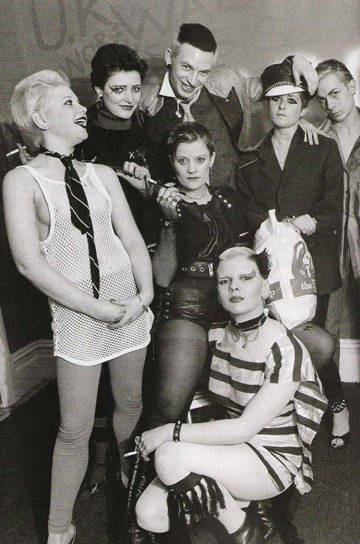
Ray Stevenson’s classic 1976 pic of some of the Bromley Contingent, plus Soo Catwoman who came from Ealing

According to Wikipedia: Siouxsie Sioux, Jordan, Soo Catwoman, Simon “Boy” Barker, Debbie Juvenile (née Wilson), Linda Ashby, Philip Sallon, Alan Salisbury, Simone Thomas, Bertie “Berlin” Marshall, Tracie O’Keefe, Steve Severin, Billy Idol and Sharon Hayman.

Caroline Coon’s 1977 book The New Wave Punk Rock Explosion remains a fresh and pro-fan account of the movement’s origins, less prone to mythologising than later histories

➢ Fresh pix from the “14 months” of punk and the last word on what it all meant

➢ Simon Barker chats to Dazed about the anarchic punk era

➢ Another epic Stevenson picture of the Bromley Contingent, 1976

Simon Barker, Six, Punks Dead, Jordan, photography, exhibition

Jordan then and now: the Queen of Punks with Simon Barker’s 1977 photo showing for a month at Divus Temporary Gallery, London E1 6QF © Shapersofthe80s

❏ Mind you, the true superstar present in the Spitalfields gallery was Jordan herself, Queen of Punks, artfully positioned in front of Six’s truly iconic portrait of her on the wall, priced at £300 a pop. There wasn’t a moment all evening when she wasn’t surrounded by a buzz of fans and old stars of punk and she was such easy company, chatting away without airs or graces. She said: “I’m a veterinary nurse now and I breed Burmese cats. Look at the number of photos here of me and Siouxsie with cats.”

She has returned to live in Seaford but loves telling the 70s stories about travelling up to London from the south coast resort, being harangued by commuters for her spiky hair and outrageous bondage clothes from McLaren and Westwood’s Chelsea shops Sex and Seditionaries. To keep her out of trouble, one British Rail guard told her to go sit in first class. “The day I came up to apply for a job at Sex, it was shut, so I wandered over to Harrods and applied there in my blonde spikes and green face foundation. They gave me a part-time job in Way In” (their trendy top-floor fashion department).

As the single most inventive pioneer of definitive punk looks, Jordan soon joined Sex, however, becoming their totemic house model and honorary fifth member of the Sex Pistols, all too willing to flash her tits for the press at their ninth gig in Andrew Logan’s loft. In 1977 she briefly managed Adam & The Ants in their hardcore phase, but most notoriously starred in Derek Jarman’s dystopian fantasy movie, Jubilee, singing a raunchy version of Rule Britannia.

➢ Punk’s Dead by Simon Barker is an exhibition of his intimate punk photographs, open for a month from June 7, at Divus Temporary Gallery, 4 Wilkes Street, London E1 6QF.

➢ Punk’s Dead the book by Simon Barker is published by Divus

Click any pic below to launch slideshow

The Year Of Punk 19/12/77

Six, Simon Barker, Punk 1977, LWT, Janet Street-Porter, video

“You don’t have to be a fantastic musician”: Six explains the magic at 7:15 in Janet Street-Porter’s LWT documentary, The Year of Punk, 1977 … Click pic to view video at YouTube

FRONT PAGE

➤ Fresh pix from the “14 months” of punk and the last word on what it all meant

Punk’s Dead , Derek Dunbar ,, Jordan,

Jordan the queen of punk: pantone matched first samples fresh from the printers on Derek Dunbar’s Facebook page today

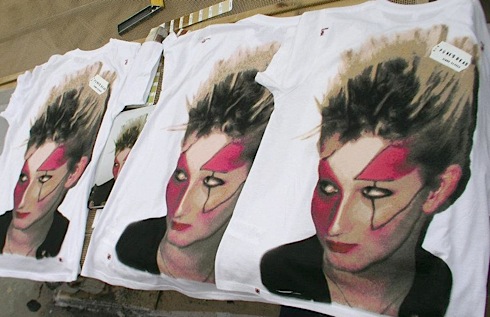
❚ HOW MUCH MORE IS THERE TO KNOW ABOUT PUNK? Not much, you might think. Yet today Derek Dunbar — the King’s Road fixer, model, singer, Jarmanite and McLaren acolyte, now styling himself as project manager — announced on Facebook that he is producing some T-shirts emblazoned with Jordan’s image (Jordan the queen of punk, immortalised in Derek Jarman’s movie Jubilee). “These are the first samples we will produce once Six has finished at his exhibition in London so I hope to start in 3 weeks or 4 weeks.”

Exhibition? Six? Who? Those in the know know that Six is aka Simon and Simon was the quiet one in among Susan Dallion (later Siouxsie Sioux), Steve Severin, Debbie Juvenile and Soo Catwoman in those seminal 1976 snaps of the Bromley Contingent — first followers of the Sex Pistols and the Chelsea retail outlets of Malcolm McLaren and Vivienne Westwood. Some of the Contingent became headliners in the punk explosion, Simon playing his part by appearing with the Pistols on the infamous teatime TV show that lost television journalist Bill Grundy his job. More discreetly, as a resident of the St James’s Hotel in Westminster, Simon provided a refuge for punk’s suburban protagonists.

Punk’s Dead , books,photography, Simon Barker , Jordan

1976: Jordan and Simon Barker aka Six (from Derek Dunbar’s Facebook album)

Under his pseudonym Six, he now reveals: “In 1976, I bought myself one of the cheapest pocket cameras available. Fully automatic, with no controls or settings… Subconsciously I concentrated on the women and artists at the heart of what would later be known as punk in London. The photos you see were spur-of-the-moment shots taken by myself for myself and, up until now, I used to think they weren’t good enough to show people.”

Far from it. A quick google reveals these early snapshots to be “a rare and intimate account of punk’s ability to mint newness” and they evince “the cool stillness of seeming to live beyond the end of history.” Ohhhhh!!! Orgasmic! And you’re asking, Who said THAT?

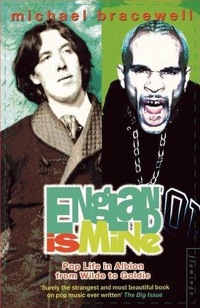
Michael Bracewell,books,England is Mine, Pop LifeGoogle, please tell. The verdict comes from Michael Bracewell (author of England is Mine: Pop Life in Albion from Wilde to Goldie, 2009), one of those writers whose cultural observations you know are worth the effort to read, wrapped though they are in ripely purple prose. And in a recent article about Six, he announces what these days is the official line, that “Punk lasted in the UK for little more than 14 months, between 1976 and the Jubilee summer of 1977.” Anything later was accounted an offshoot of punk, or dubbed simply New Wave!!!

You raise an eyebrow, salivating for more. And more is delivered in his Independent piece from last March…

➢ Beneath the headline Anarchy in the UK, Bracewell declares
these FIVE PRINCIPLES OF PUNK:

  • 1 To some, punk was primarily political in its energy, carrying class war or a reclamation of the Situationist desire to ‘wreck culture’ to the brutalist Britain of the pre-Thatcher 1970s.
  • 2 To others, it was an avant-garde fashion parade: a damply British reclamation of the Zurich Dada or the Ballets Russes.
  • 3 And to yet others it was the gleeful desecration of rock music’s Church of Authenticity, in which had been worshipped the sanctity of the Blues.
  • 4 Speaking with Malcolm McLaren – arguably punk’s architect – shortly before his death in 2010, the case was put more simply: if punk could lay any claim on historic status, he said, it would best be remembered as ‘like doing the Twist in a ruin’.

Sensational, whichever way you take your pick! But he’s warming to his own conclusion:

  • 5 Punk … appeared to confront the stagnation of cultural consumerism – by describing, in a language of self-parody, the notion of modernity itself reaching critical mass and unsurprisingly imploding. Hence, perhaps, the slogan above the door of the SEX boutique at 430 King’s Road in Chelsea: ‘Modernity Killed Every Night’.

Divine! We can go to our graves sure about the meaning of punk, once and for all. Or rather, five times and for all.

Punk’s Dead , books,photography, Simon Barker,Little Nell, Adam Ant

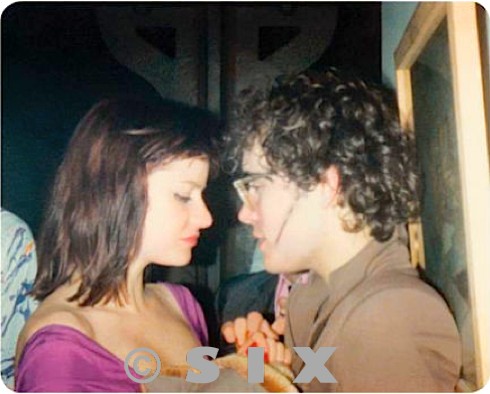
1977: Little Nell with Adam Ant at a Butler’s Wharf party. Photographed by Six

Punk’s Dead , books,photography, Simon Barker , Siouxsie Sioux

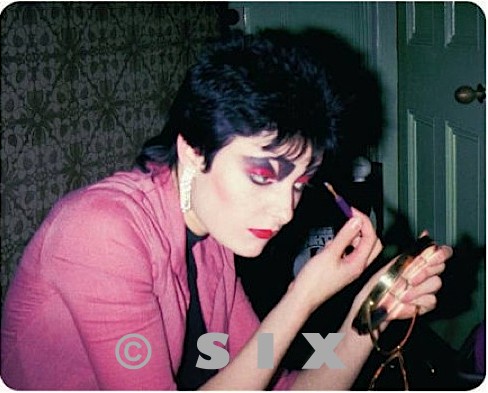
1977: Siouxsie Sioux at the St James hotel. Photographed by Six

➢ Punk’s Dead by Simon Barker is an exhibition of his intimate punk photographs, open for a month from June 7, at Divus Temporary Gallery, 4 Wilkes Street, London E1 6QF.

➢ Punk’s Dead the book by Simon Barker is published by Divus

Punk’s Dead , books,photography, Simon Barker

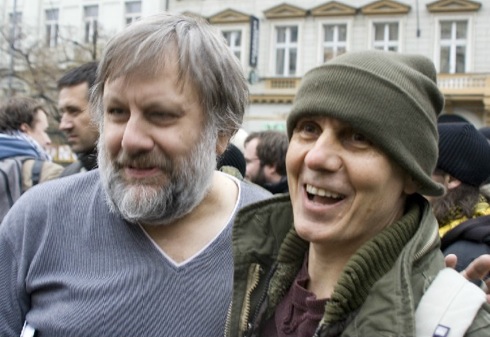
Six in Prague: Barker demonstrating with Slovenian philosopher Slavoj Žižek who has become the zeitgeist interpreter of social phenomena in the 20-tweens

The Year Of Punk 19/12/77

Six, Simon Barker, Punk 1977, LWT, Janet Street-Porter, video

“You don’t have to be a fantastic musician”: Six explains the magic at 7:15 in Janet Street-Porter’s LWT documentary, The Year of Punk, 1977 … Click pic to view video at YouTube

FRONT PAGE

➤ Ziggy’s 40 fabulous years of being not alone, cos you’re won-der-ful

Ziggy Stardust,Spiders from Mars,David Bowie,albums,anniversary,

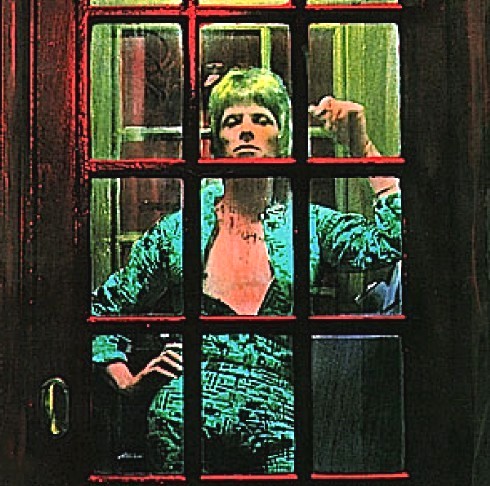
Backside of the album that inspired generations: Bowie as the alien Ziggy about to call home from a phone box in Heddon Street, London. (Photography © Brian Ward)

❚ THE KING OF UK POP HITS HIS 40th ANNIVERSARY, just as HM The Queen completes her sixth decade on the throne, but we don’t imagine she planned it that way. The most famous Martian in history landed on Earth on June 6 1972 with the release of his album, The Rise and Fall of Ziggy Stardust and The Spiders from Mars. He created a new breed of quintessentially British pop star and expanded the realm of rock-and-roll by injecting melodrama, fantasy and glitz.

A wistful older generation was yearning for the energy of the 60s. A teen generation faced a paranoid future threatened by nuclear apocalypse. The playfully androgynous Ziggy Stardust astonished both audiences by introducing a knowing sense of decadence rooted in individual style and a repertoire of life-skills to see us through whatever adversity. Laying down a bunch of wonderful melodies, the vocals enunciate the manifesto with clarity throughout — Five Years, Moonage Daydream, Suffragette City especially.

It was a bravura, theatrical strategy for pursuing what you wanted to get out of life, and capitalised on the iconoclasm of the 60s which had subverted society’s traditions of role play and “knowing your place”.

Ziggy himself was an entirely invented persona, an outsider rock-star created by the not-then-famous David Bowie who expressed through Ziggy a grand vision and through the Spiders consummate musicianship — not a note out of place, and Mick Ronson at his most snarlingly brilliant. The album is a pinnacle of arch originality like few others, and its fierce riffs and hooks have influenced almost every innovative performer since.

➢ Review of the album The Rise And Fall Of Ziggy Stardust etc at BBC Music — “It sounds like a cliché, but to an entire generation this album has become a yardstick by which to measure all others. Why the hyperbole?

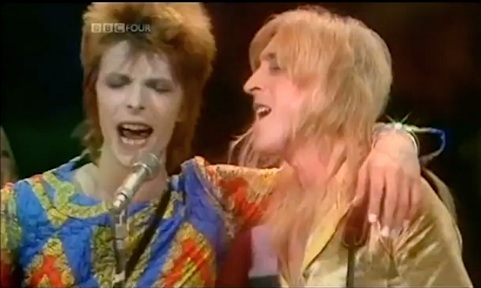
David Bowie, Starman, 1972, Top of the Pops, tipping point, BBC

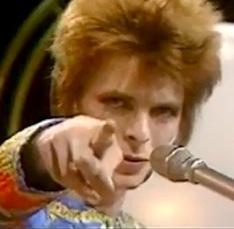
The moment the earth tilted July 6, 1972: During Starman on Top of the Pops, David Bowie drapes his arm around the shoulder of Mick Ronson. Video © BBC

The 40th-anniversary celebrations and media activity are not entirely industry hype, but genuine tributes to an artist of undoubted genius. None the less, EMI is releasing a compilation of brilliantly remastered tracks on Monday June 4 on both CD and vinyl, and all are available to stream free at the NME which is trailing special features in next week’s issue…

♫ LISTEN at the NME — David Bowie streams a remastered
Rise and Fall of Ziggy Stardust in full

ONLINE AND ON THE AIRWAVES
Nick Rhodes, Gary Kemp,  Ziggy Changed My Life, 6Music, Radio2,

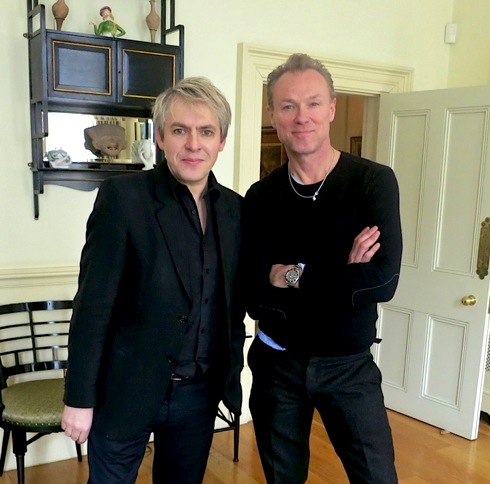
A picture they once said could never be taken: Nick Rhodes of Duran Duran at the home of Gary Kemp of Spandau Ballet, brought together by the radio documentary Ziggy Changed My Life

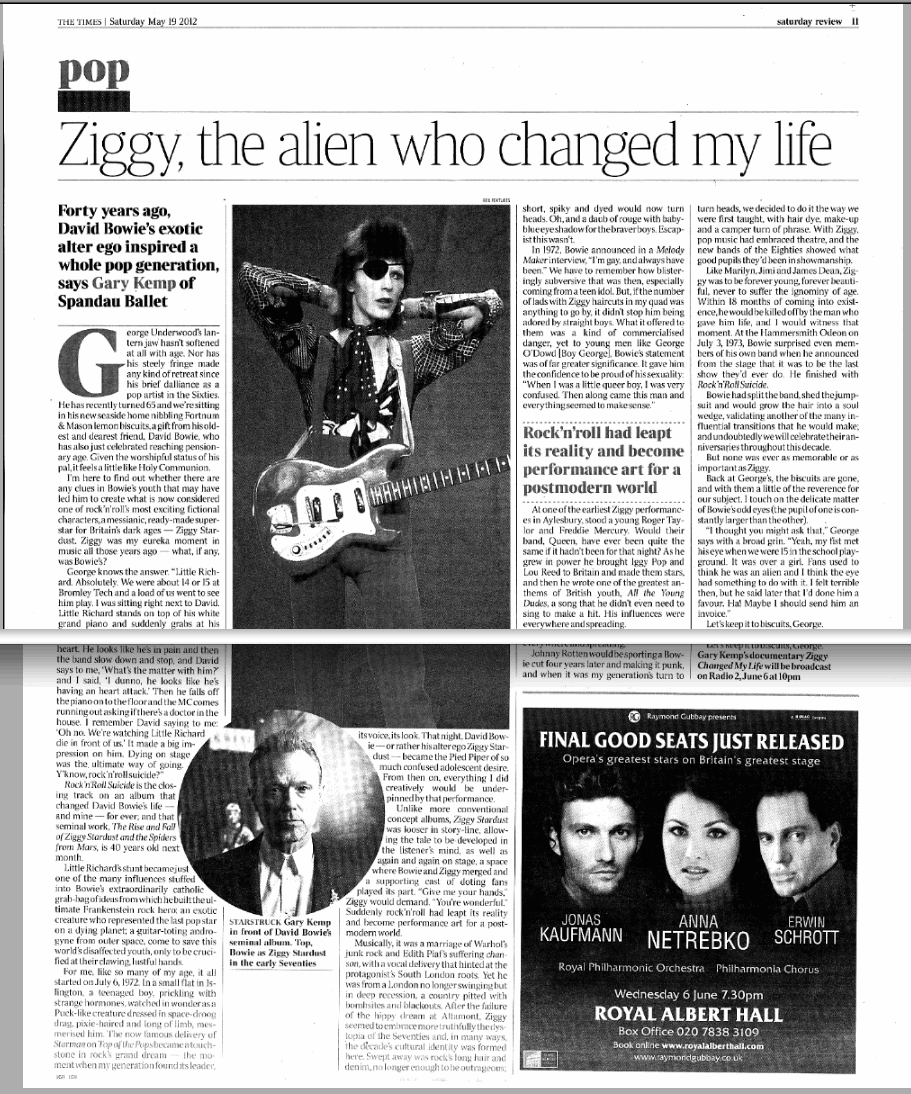
❏ Not for nothing do the next week’s highlights come from the Ten Alps stable, one of the UK’s leading factual programme-makers. From midnight tomorrow BBC 6 Music kicks off with a two-hour assessment of Ziggy as the Pied Piper who shaped the dreams of Gary Kemp, Nick Rhodes and others. This thoroughly researched doc tells tales from a host of their peers and is recycled in a couple of other slots of more manageable duration…
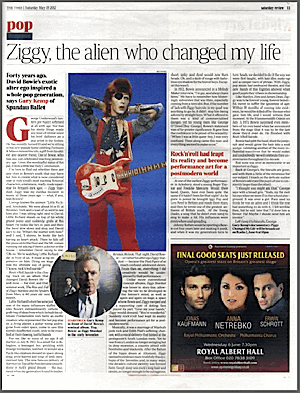
Click to read Kemp’s article in The Times

➢ Ziggy Changed My Life: full two-hour radio documentary on BBC 6 Music, midnight BST June 2–3 — Songwriter Gary Kemp explains how David Bowie created Ziggy, how the album changed his life and influenced a generation of performers. Guests include: Trevor Bolder, bass player for The Spiders from Mars; Woody Woodmansey, drummer for The Spiders from Mars, Nick Rhodes from Duran Duran, Suzi Ronson, Leee Black Childers, Lindsay Kemp, Kevin Cann, Kris Needs, Ken Scott, Terry Pastor, George Underwood and Anya Wilson.

➢ Ziggy Played Guitar on BBC Radio 2, at 10pm June 6 — Reduced one-hour version of Ziggy Changed My Life

➢ Ziggy Changed My Life — Abridged 23-minute version broadcast last month on BBC World Service and available online at iPlayer “until 1 Jan, 2099”

➢ Inspirational Bowie: clip from 65th birthday broadcast last January on Radio 2 — His influences on Boy George, Peter Hook, Marc Almond, Annie Lennox, Debbie Harry, Guy Garvey, Jarvis Cocker

➢ David Bowie Archive concert (2000) on BBC radio iPlayer — Live in concert at Glastonbury in 2000.

ZIGGY DISSECTED FROM TOP TO TOE
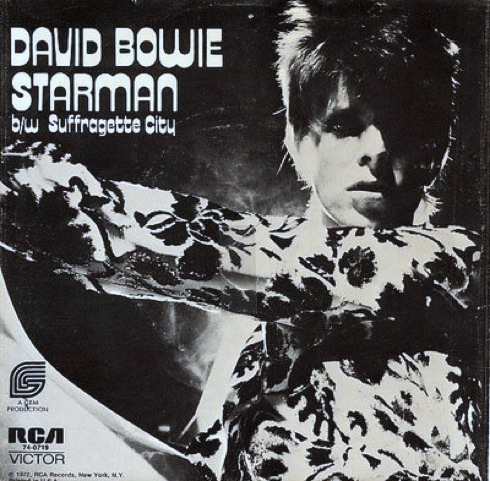
David Bowie, Starman,

“After Starman, everything changed” — Woody Woodmansey, drummer and Spider

➢ Pushing Ahead of the Dame: David Bowie, song by song — incomparable blog by Chris O’Leary

FOUR ESSENTIAL BOOKS ABOUT BOWIE
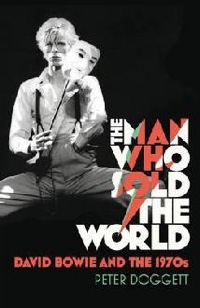
Man Who Sold the World,David Bowie ,Peter Doggett,books ➢ The Man Who Sold the World: David Bowie and the 1970s by Peter Doggett (Bodley Head 2011)

A song-by-song analysis shows how David Bowie embodied a decade. A work of impeccable scholarly exegesis, The Man Who Sold the World is about as far removed from conventional biography as its subject is from run-of-the-mill rock’n’roll. Still, it is hard to imagine another book telling you more of what really matters about David Bowie than this one … / Continued online

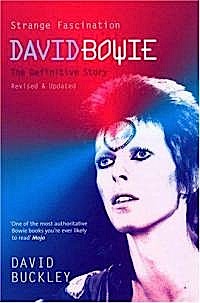
Strange Fascination,David Bowie, David Buckley, books ➢ Strange Fascination: David Bowie, The Definitive Story by David Buckley (Virgin 2005)

Written by the only biographer to get his PhD with a thesis on David Bowie, Strange Fascination is an exhaustive chronicle of Bowie’s career as one of rock’s most influential stars. In a combination of interviews, exclusive photographic material and academic analysis, Buckley examines Bowie’s life and music with an unparalleled level of detail. It’s a book written by an unapologetic fan. Buckley is a better writer than any of those to have tackled Bowie to date. If you read only one Bowie book ever, this should be it … / Continued online

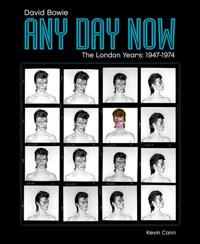
Any Day Now, David Bowie,books, Kevin Cann ➢ Any Day Now: David Bowie The London Years (1947–1974) by Kevin Cann (Adelita 2010)

A feast of Bowie-ana served up like La Grande Bouffe, in ever more tempting waffeur-thin slices… It is impossible adequately to acknowledge the trainspotterish, yet deeply rewarding scope of this sheer labour of love that has amassed 850 pictures — friends, lovers, costumes, contracts, doodles, laundry bills, performances, candid snaps — on 336 pages … / Continued at Shapersofthe80s

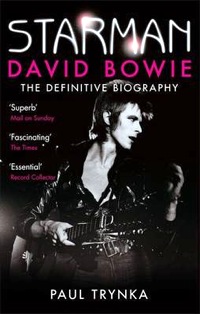
Starman, David Bowie , Paul Trynka ,books ➢ Starman: David Bowie by Paul Trynka (Sphere 2011)

As befits an erstwhile editor of Mojo, Trynka is good on the musical development of a pop star whose early albums, David Bowie (1967) and Space Oddity (1969), were both little more than confused collections of ill-matched songs, and showed little hint of the confidence and brilliance that was to follow. Beginning with Bowie’s childhood as plain David Jones in post-war Brixton, Trynka tells a tale that has perhaps been told too often to surprise any more, but that nevertheless intrigues in its mixture of ruthlessness, shifting loyalties, monumental drug taking, decadent behaviour and, for a while, undiminished musical invention … / Continued online

JUST FOR TRAINSPOTTERS

➢ 65 crazy facts and bizarre myths about Bowie at the Daily Mirror — Did Bowie help start the credit crunch? He certainly says he was moonwalking years before Michael Jackson…
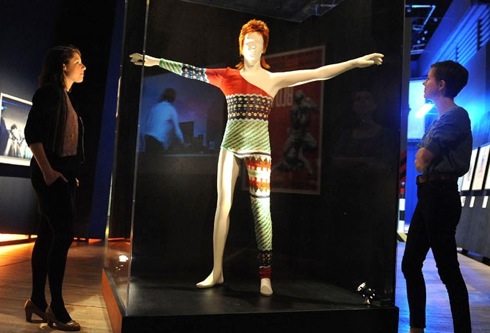
 Kansai Yamamoto ,V&A ,exhibition, British Design, Ziggy Stardust, David Bowie,costumes

Ziggy stage costume: the Japanese fashion designer Kansai Yamamoto described Bowie in 1972 as “neither man nor woman”. This outfit, similar to one worn with a boa in Ziggy’s last performance at Hammersmith Odeon, is currently on show until August 12 in the V&A exhibition, British Design 1948–2012

MORE BOWIE AT SHAPERSOFTHE80S

➢ Where to draw a line between glitter and glam

➢ If David Jones hadn’t become Bowie what would have become of the rest of us?

➢ Behind Bowie’s “lost” Jean Genie video

FRONT PAGE

➤ Edison’s wax cylinder throws beatboxer Singh back to the age of acoustic recording

Aleks Kolkowski ,beatboxer, Jason Singh,wax recording,phonograph

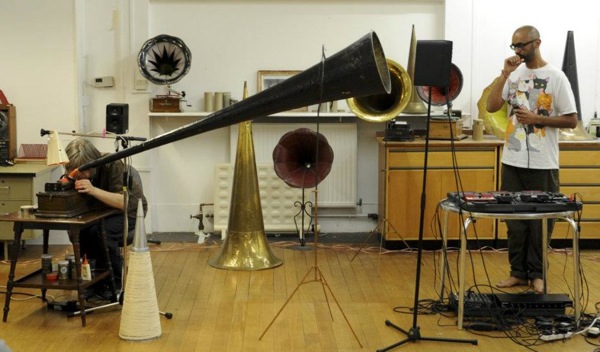
Wax recording at the Science Museum: Aleks Kolkowski tending his Fireside phonograph from 1909, while beatboxer Jason Singh improvises his mix of electronic samples and vocal sculpture through a speaker. (Photographed © by Marizu Okereke)

❚ SOUND ARTISTS IN RESIDENCE ARE, it seems, all the rage. Not only has London’s Victoria & Albert Museum got one (that’s him, the cool barefoot dude, above right), but so too has the Science Museum (the less cool dude from another planet, above left). And this week they got together to make some wax recordings on the kind of two-minute cylinders our great grandparents used to dance to. The big diff is the kind of beatbox sounds Jason Singh makes — scratchity screechity hoppity whack rhythms made using nothing but his mouth, lips and tongue. He styles himself a “vocal sculptor” since essentially it’s his voice making sinuously textured percussive music, the role of a microphone being simply to help amplify it.
The reverse diff for him was not using a mic, but instead sticking his head deep inside a 7ft-long acoustic horn that channelled his voice down to a Mica membrane pressing on a flat-edged sapphire stylus, the vibrations from which cut a hill-and-dale spiral groove on a wax cylinder revolving at 160 rpm on a wind-up clockwork Edison phonograph Fireside model A, made in about 1909. His recording engineer was the shaggy professional musician, Aleks Kolkowski, who is running a series of experimental demonstrations during the next month on the art of acoustic recording. Each lunchtime session features a distinguished guest musician, artist or writer who will record acoustically by speaking or playing sounds without the aid electricity.

wax recording,phonograph

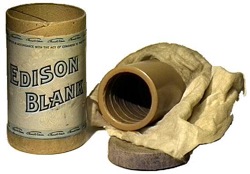
Edison cylinders: the earliest blanks were beeswax brown

In Jason Singh’s case, his performance was a piece of magic before the recording began. His sound test had you looking round the room for an orchestra and a chorus of jungle animals. It was unbelievable that everything we heard came from inside this lanky young man himself. Aleks warmed the cylinder with a red lamp to soften its ceresin and stearic wax mix. Jason’s head vanished inside the horn while his extremities twitched to his turntablist rhythms and the stylus cut the acoustic recording. It was unexpectedly thrilling to witness, with swarf flying off the recorder, though Jason’s voice was slightly too muffled inside the horn for the audience to judge the quality, so it was agony to have to wait to hear the outcome while the cylinder was set aside to cool.

A second session saw Jason mixing samples and loops at a console, these more complex sounds then feeding out through a regular loudspeaker which faced into the same acoustic horn. This utterly different sonic landscape was nearer to musique concrète which treats pre-recorded sound as raw material.

Aleks Kolkowski ,beatboxer, Jason Singh,wax recording,phonograph

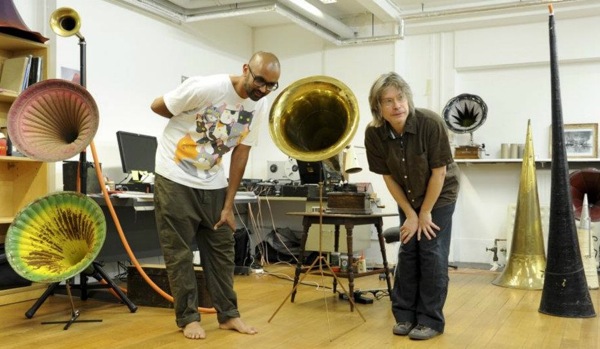
Playback at the Science Museum: Jason Singh and Aleks Kolkowski are as keen as the audience to know if the wax recording has worked. (Photographed © by Marizu Okereke)

Playback time arrived. Jason and Aleks positioned their ears on either side of the phonograph, now equipped with a pick-up stylus and a huge antique brass concert horn. From a low register, Jason’s human beatboxing slowly grew into distinct and intricate musical patterns, but suffused and somehow wonderfully other-wordly. He was rewarded with rapturous applause. His own verdict: “Wicked!” Aleks wondered whether the second more experimental recording would prove as successful, and indeed moments did give the effect of wind howling across the Arctic tundra. Jason’s verdict: “Exorcist!”

The best recording will soon be posted on Aleks’s archive website Phonographies where you can hear digital transfers of his many other recordings made on contemporary wax cylinders.

Aleks Kolkowski ,wax recording,phonograph

Armed with a brush: Aleks Kolkowski clears his Fireside phonograph of flying swarf during the recording process on to wax. (Photographed © by Marizu Okereke)

➢ The series of Phonographies, Wax Cylinder Recording Demonstrations, continues through June at the Science Museum, London SW7 2DD. They will feature an author, a wildlife sounds curator and a thereminist. Events are free but booking is advised through the museum line 0870 870 4868

➢ Jason Singh is Sound Artist-in-Residence at the V&A

➢ Introduction to Standard Beatbox Notation

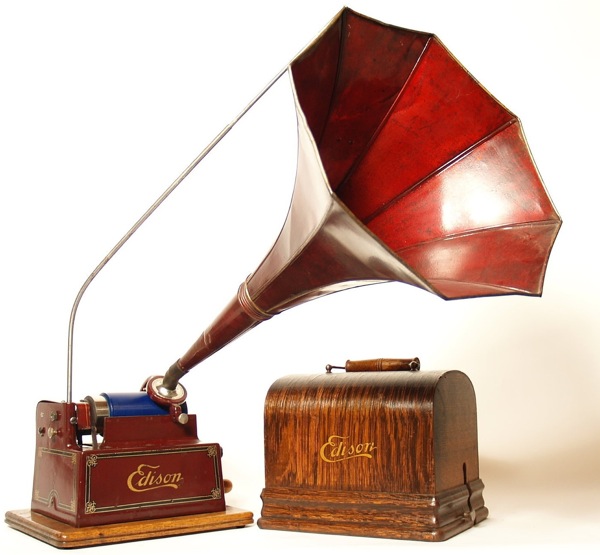
Batteries not needed: This 1909 Edison Gem D cylinder phonograph, better known as the Maroon Gem, was auctioned for $4,305 in May 2012

FOOTNOTES TO PHONOGRAPHIC HISTORY

❏ Above: Edison Home Phonograph model A, No 825 made in 1879, playing a comic song by Scottish music-hall star Harry Lauder

➢ The Edison Speaking Phonograph Company was established on January 1878 to exploit the inventor Thomas Edison’s new machine by exhibiting it. He received $10,000 for the manufacturing and sales rights and 20% of the profits.

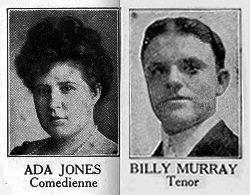
Ada Jones,Billy Murray, wax recording, phonographIn the late 1890s Edison began mass-producing cylinder phonographs though by 1905 flat-disc 78rpm machines began to outsell their cylinder rivals. Columbia, one of Edison’s chief competitors, abandoned the cylinder market in 1912. However, the Edison Company continued to make Blue Amberol cylinders until the demise of the company in 1929.

❏ Listen to Ada Jones & Billy Murray sing Come Josephine in My Flying Machine on an Edison Blue Amberol cylinder from 1911 (© Linda C. Joseph)

FRONT PAGE