Category Archives: Media

➤ Magic! A million views up for Commander Chris sitting in his tin can singing Bowie

❚ SEE HOW PLANET EARTH IS BLUE! Wow how the stars look very different today, rising in the black void! Thrill to the International Space Station whizzing over clouds in a most spectacular way! Here’s a video made by a station commander, sitting in his tin can singing the defining Bowie hit from 1969, the year man went to the Moon. What a way to inspire new generations of would-be space explorers, sung 230 miles above the earth by one of the latest successors to Major Tom.

Last night, this wondrous HD video cover version of David Bowie’s Space Oddity was posted on YouTube by Commander Chris Hadfield on board the space station, which is the largest artificial body in orbit. Viewed at full-screen, its pin-sharp photography combines poetry and awe and speed and perspective and human scale more honestly than any special-effects movie. Seeing stars rise over a black horizon fixed in their constellations itself fixes the vehicle firmly in the firmament of space, while beneath the Great Big World Keeps On Turning. This alone is a magical moment of unparalleled apprehension.

“With deference to the genius of David Bowie, here is Space Oddity, recorded on Station,” he tweeted. “A last glimpse of the World.” 
Overnight his personal post has clocked a million views, quite apart from scores of other media postings. It was Hadfield’s parting act for the digital media on the eve of his return to Earth today after nearly five months in zero-gravity. And Bowie replied with the tweet “Hallo spaceboy”.

Commander Chris, a former Royal Canadian Air Force fighter pilot, was the first Canadian astronaut to walk in space. On December 19, he took off for a long-duration stay on board the ISS as part of Expedition 35. He is the first Canadian to command the space station and its six staff. And now, as the song goes, it’s time to leave the capsule …

CLICK ANY PIC TO LAUNCH CAROUSEL:

➢ British astronaut Piers Sellers recalls the unique smell of space

➢ Technology made simple – 18 TED talks from astronauts, including Chris Hadfield
FRONT PAGE

➤ Reborn Alison Moyet lets herself off the mainstream leash

Robert Elms ,interview,album, Alison Moyet

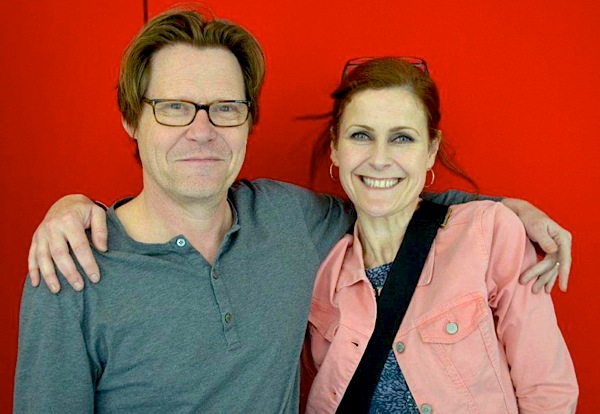
No longer “a cheap date”: Robert Elms with Alison Moyet today

❚ ALISON MOYET HAS COMPLETED her eighth solo album, The Minutes, with Guy Sigsworth on production creating a whole new synthesised sound. It is released on May 6 on the Cooking Vinyl label. Today she talked to Robert Elms on his BBC London show about slipping into “electro-jazz” and being able to say No to merely doing more cover versions. “I wanted to play a bit.”

She surprises Robert by saying, yes she is a mainstream artist, but regards herself as an instrumentalist, that her first instrument is “a voice – I love chanson, like Brel or Michel Legrand. But as well as being a voice, I’m an artist where voice is not the main thing, it can be about the lyric or the melody. I don’t always want the voice to be the focus!”

Alison Moyet, the Basildon punk, high priestess of electronic pop and peerless soul singer, set out as Genevieve Alison Jane. An Essex girl born to a French father and English mother, she left school at 16, became famous at 21 as singer in Yazoo, and released her triple-platinum solo debut, Alf, at 23. She found fame hard to handle at such a young age, but hindsight has helped her appreciate those experiences. “For a while in the mid-80s, it was amusing to be a pop bitch, but that changed, and it stopped being enough. Now I am able to put my early work into context and find pleasure in the innocence of it.” Between 1984 and 1987, Moyet was Britain’s biggest female solo star.

➢ Robert Elms interviews Alison Moyet on BBC London 94.9 and plays two singles, 4 May 2013 (last half hour) – on iPlayer for seven days

➢ On video, May 15: Alison Moyet talks to Absolute 80s Martyn Lee about her new album The Minutes

♫ Preview clips from Alison Moyet’s The Minutes, out May 6. The first single When I Was Your Girl is on sale already

➢ The Minutes tour starts Sep 30 in Cork and hits London’s Royal Festival Hall on Oct 15, ends Oct 31

➢ Moyet’s comeback single – ‘my happiest studio experience’

FRONT PAGE

➤ 20 years ago today the free world wide web was born

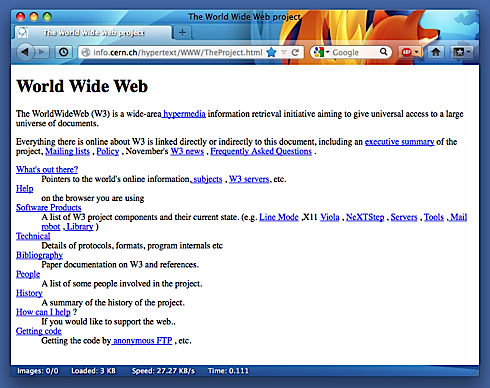
❚ TO COMMEMORATE THE 20TH ANNIVERSARY of the web being made available free to all, the international physics laboratory CERN has recreated the world’s first website and posted it today, at its original address and this is it – http://info.cern.ch/hypertext/WWW/TheProject.html The home page provided an explanation of what the world wide web was, and how to use a browser and set up a web server.

The British computer scientist Tim Berners-Lee proposed an information management system in 1989 and had a working version of the web in Dec 1990. The first website built was at CERN within the borders of France and went online on August 6, 1991, but by 1993 some user groups were positioning themselves to try to monopolise the web as a commercial platform. So on April 30, 1993, CERN announced that the world wide web would be free to anyone, with no fees due.

CERN, firsts, website, worldwideweb,

The web’s first home page: click on the image to visit the site at CERN

➢ The World Wide Web Became Free 20 Years Ago Today – By Mark Fischetti, senior editor at Scientific American:
You and I can access billions of web pages, post blogs, write code for our own killer apps – in short, do anything we want on the web – all free! And we’ve enjoyed free reign because 20 years ago, today, web inventor Tim Berners-Lee and his employer, the CERN physics lab in Geneva, published a statement that made the nascent “world wide web” technology available to every person, company and institution without royalty or restriction …  / Continued online

➢ Long live the web: Tim Berners-Lee wrote a treatise for Scientific American in 2010 explaining why the web must remain for ever free:  “The web is critical not merely to the digital revolution but to our continued prosperity – and even our liberty. Like democracy itself, it needs defending.”

INTERNET VERSUS WEB

www13,OEDdefinition

Tim Berners-Lee at the Olympics opening ceremony (Photo: Getty)

Tim Berners-Lee at the Olympics opening ceremony (Photo: Getty)

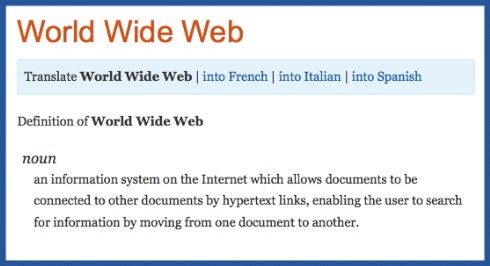
❏ The internet is a global computer system that provides information and communication facilities, consisting of interconnected networks using standardised communication protocols. In contrast, the web is one of the services that runs on the internet. It is a collection of text documents and other resources, linked by hyperlinks and URLs (addresses), usually accessed through web browsers from web servers. A browser is a so-called “graphical user interface” which simply means an accessible visual entry point into the arcane world of computer coding. Mosaic is the web browser credited with popularising the world wide web and today most popular browsers (Google Chrome, Internet Explorer, Mozilla Firefox) retain the characteristics of the original Mosaic.

In July 2012 Tim Berners-Lee was honoured as the “Inventor of the world wide web” during the Olympics opening ceremony in London where he appeared in person, working at a NeXT computer, the model on which he worked at CERN in 1989. He tweeted the message: “This is for everyone.”

The mighty tweet: Tim Berners-Lee’s message to the world at the Olympics

The mighty tweet: Tim Berners-Lee’s message to the world at the Olympics

➢ EFF asks, How safe is your privacy? CISPA passes out of the House without any fixes to core concerns

➢ CERN’s original Public Domain document of April 30, 1993: “CERN’s decision to make the web foundations and protocols available on a royalty free basis, and without additional impediments, was crucial to the web’s existence. Without this commitment, the enormous individual and corporate investment in web technology simply would never have happened, and we wouldn’t have the web today.” – Tim Berners-Lee, Director, WWW Consortium

FRONT PAGE

2013 ➤ A ‘blistering’ picture hoard from punk’s formative years

The Clash,book, exhibition,Photography, Sheila Rock

The Clash in 1976. Photographed by Sheila Rock

❚ FOR THOSE WHO SURVIVED the mid-70s, punk was the anti-fashion UK phenomenon that transformed contemporary culture. Now “a blistering 1976-80 photo-hoard” of mostly unseen pictures has been published as a 272-page photobook. Punk+ by Sheila Rock – an American in London – chronicles both designer and street styles that impacted on fashion, society and politics, including Vivienne Westwood’s shop SEX as well as BOY, Robot and Acme Attractions. The collection, which had been stored in a box in Rock’s garden shed, includes formative images of The Clash, Chrissie Hynde, Paul Weller, The Jam, Generation X, Siouxsie & the Banshees and The Sex Pistols.

Paul Simonon of The Clash says: “This book is a great photographic record of a major shift in British street fashion.”

Sheila Rock arrived in London in 1970 to join the David Bowie circle, and it was her friend and Patti Smith guitarist, Lenny Kaye, who took her to a gig by the then-unknown Clash. “That was the first time I was introduced to the punk scene,” she says. “I decided to take my Nikon camera with me and my photography career began.” Her photographs of showbiz performers and musicians have been published in titles from Vogue to The Sunday Times and can also be found in London’s National Portrait Gallery. This month her pix will also be showing in the Punk: Chaos to Couture exhibition at The Metropolitan Museum of Art in New York.

Mick Jones,,book, exhibition,Photography, Sheila Rock

At the Brown’s party tonight: Sheila Rock with Clash guitarist and vocalist Mick Jones. Photograph © by Beki Cowey

Rock’s career took off in 1980 in The Face, the 80s style bible published by Nick Logan, who describes Rock as “self-effacing but sweetly persuasive” in the preface to PUNK+. He notes how she refined her images to capture a style that portrayed what her subjects wanted to personify. She often achieved this better than they understood themselves.

Tonight the book was launched with a two-week exhibition of Rock’s photographs at Brown’s high fashion store in London, and a further show runs for a month from May 28 at Rough Trade East, where there’s also a book signing.

Mojo Magazine reports: “Sheila Rock’s PUNK+ book presents a blistering 1976-80 photo-hoard. The striking and fascinating photo-book collects almost 200 images of groups including The Subway Sect, Eater, Buzzcocks, The Clash and the Sex Pistols, plus documentation of the rapidly changing fashions of the late 70s. She estimates 90 per cent of the shots have never been seen, and that 85 per cent were self-motivated experiments rather than work commissions. Those enthralled by shifts in vintage youth styles will also delight in the images of unselfconscious punks, such as the young Jam fans who mixed the Weller look with the safety-pin aesthetic.”

➢ PUNK+ is published by First Third Books Ltd (London and Paris): 272 pages, size 20 x 27cm, limited edition of 300 copies signed and numbered, £99; standard edition of 1,700 copies, £49. The book includes illuminating conversations with Chrissie Hynde, Tony James, Don Letts, Jeanette Lee, Glen Matlock, Chris Salewicz, Jon Savage, Steven Severin, Paul Simonon, Jah Wobble and more.

➢ Sheila Rock celebrates punk at Brown’s Men’s dept,
London W1K 5QG, April 25–May 7, Vogue preview

➢ Another exhibition of photos by Sheila Rock runs May 28–June 30 at Rough Trade East, 91 Brick Lane, London E1 6QL. On May 29 at 7pm Sheila will be joined by Don Letts and Jeanette Lee plus special guests for a Q&A event and afterwards a signing session for her book Punk+.

FRONT PAGE

➤ Glenda Jackson silences Tories in Commons tirade against Thatcher

Glenda Jackson ,video, Commons ,debate, Thatcher

Glenda Jackson lets rip: click on image to run video in a new window

By far the most heinous demonstration of Thatcherism was across the whole country in metropolitan areas where every shop doorway became the bedroom, the living room, the bathroom for the homeless. They grew in their thousands, and many of those homeless people had been thrown out onto the streets from the closure of the longterm mental hospitals. It was called care in the community. What it effectively was was no care at all in the community.

During her era London became a city Hogarth would have recognised. Everything I had been taught to regard as a vice was under Thatcherism in fact a virtue: greed, selfishness, no care for the weaker. Sharp elbows, sharp knees, they were the way forward.” – Glenda Jackson MP, in today’s Parliamentary debate which “considered the matter of tributes to the Baroness Thatcher”

London, Gin Lane, Hogarth, prints

Gin Lane (1751) by English artist William Hogarth: shocking scenes of infanticide, starvation, madness, decay and suicide in London

➢ “If the measure of a great political leader is the extent to which they leave a footprint on those that follow, Margaret Thatcher, for better or worse, was a great leader,” writes Patrick Wintour in The Guardian – “David Cameron has never been able quite to embrace or reject her politics. He, like many of his contemporaries, has almost internalised the trauma of her premiership and ejection from Downing Street in 1990… / Continued online

➢ The politicised argument over how to remember the former prime minister is not about the past,” writes Jonathan Freedland in The Guardian – “The wider Tory tribe seems determined to use the nine-day limbo between her passing and her funeral to define Thatcher in death in a way that would have seemed impossible, if not outright absurd, in life…” / Continued online

FRONT PAGE