Category Archives: Culture

➤ Edison’s wax cylinder throws beatboxer Singh back to the age of acoustic recording

Aleks Kolkowski ,beatboxer, Jason Singh,wax recording,phonograph

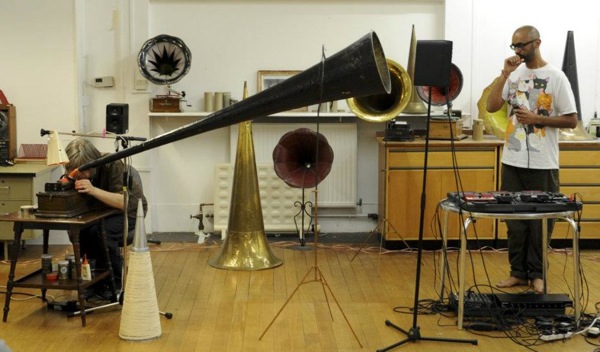
Wax recording at the Science Museum: Aleks Kolkowski tending his Fireside phonograph from 1909, while beatboxer Jason Singh improvises his mix of electronic samples and vocal sculpture through a speaker. (Photographed © by Marizu Okereke)

❚ SOUND ARTISTS IN RESIDENCE ARE, it seems, all the rage. Not only has London’s Victoria & Albert Museum got one (that’s him, the cool barefoot dude, above right), but so too has the Science Museum (the less cool dude from another planet, above left). And this week they got together to make some wax recordings on the kind of two-minute cylinders our great grandparents used to dance to. The big diff is the kind of beatbox sounds Jason Singh makes — scratchity screechity hoppity whack rhythms made using nothing but his mouth, lips and tongue. He styles himself a “vocal sculptor” since essentially it’s his voice making sinuously textured percussive music, the role of a microphone being simply to help amplify it.

The reverse diff for him was not using a mic, but instead sticking his head deep inside a 7ft-long acoustic horn that channelled his voice down to a Mica membrane pressing on a flat-edged sapphire stylus, the vibrations from which cut a hill-and-dale spiral groove on a wax cylinder revolving at 160 rpm on a wind-up clockwork Edison phonograph Fireside model A, made in about 1909. His recording engineer was the shaggy professional musician, Aleks Kolkowski, who is running a series of experimental demonstrations during the next month on the art of acoustic recording. Each lunchtime session features a distinguished guest musician, artist or writer who will record acoustically by speaking or playing sounds without the aid electricity.
wax recording,phonograph

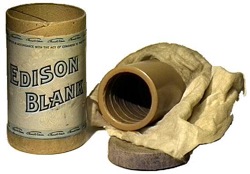
Edison cylinders: the earliest blanks were beeswax brown

In Jason Singh’s case, his performance was a piece of magic before the recording began. His sound test had you looking round the room for an orchestra and a chorus of jungle animals. It was unbelievable that everything we heard came from inside this lanky young man himself. Aleks warmed the cylinder with a red lamp to soften its ceresin and stearic wax mix. Jason’s head vanished inside the horn while his extremities twitched to his turntablist rhythms and the stylus cut the acoustic recording. It was unexpectedly thrilling to witness, with swarf flying off the recorder, though Jason’s voice was slightly too muffled inside the horn for the audience to judge the quality, so it was agony to have to wait to hear the outcome while the cylinder was set aside to cool.

A second session saw Jason mixing samples and loops at a console, these more complex sounds then feeding out through a regular loudspeaker which faced into the same acoustic horn. This utterly different sonic landscape was nearer to musique concrète which treats pre-recorded sound as raw material.
Aleks Kolkowski ,beatboxer, Jason Singh,wax recording,phonograph

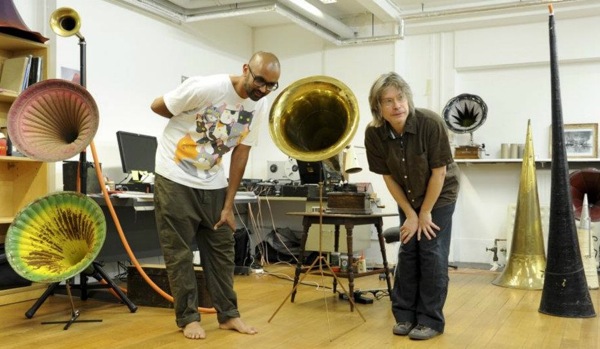
Playback at the Science Museum: Jason Singh and Aleks Kolkowski are as keen as the audience to know if the wax recording has worked. (Photographed © by Marizu Okereke)

Playback time arrived. Jason and Aleks positioned their ears on either side of the phonograph, now equipped with a pick-up stylus and a huge antique brass concert horn. From a low register, Jason’s human beatboxing slowly grew into distinct and intricate musical patterns, but suffused and somehow wonderfully other-wordly. He was rewarded with rapturous applause. His own verdict: “Wicked!” Aleks wondered whether the second more experimental recording would prove as successful, and indeed moments did give the effect of wind howling across the Arctic tundra. Jason’s verdict: “Exorcist!”

The best recording will soon be posted on Aleks’s archive website Phonographies where you can hear digital transfers of his many other recordings made on contemporary wax cylinders.

Aleks Kolkowski ,wax recording,phonograph

Armed with a brush: Aleks Kolkowski clears his Fireside phonograph of flying swarf during the recording process on to wax. (Photographed © by Marizu Okereke)

➢ The series of Phonographies, Wax Cylinder Recording Demonstrations, continues through June at the Science Museum, London SW7 2DD. They will feature an author, a wildlife sounds curator and a thereminist. Events are free but booking is advised through the museum line 0870 870 4868

➢ Jason Singh is Sound Artist-in-Residence at the V&A

➢ Introduction to Standard Beatbox Notation
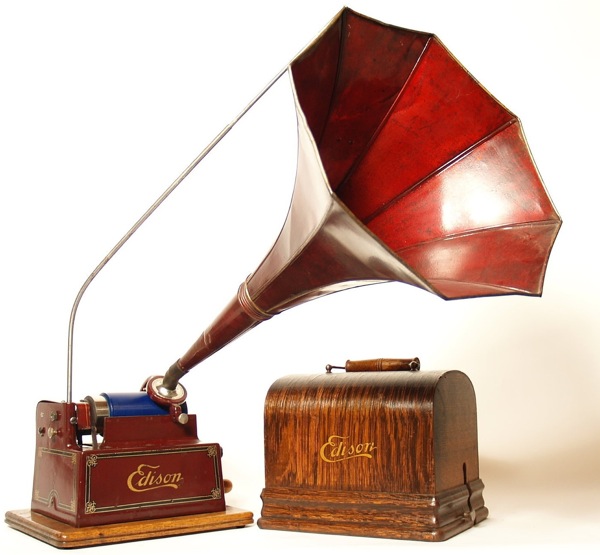
Batteries not needed: This 1909 Edison Gem D cylinder phonograph, better known as the Maroon Gem, was auctioned for $4,305 in May 2012

FOOTNOTES TO PHONOGRAPHIC HISTORY

❏ Above: Edison Home Phonograph model A, No 825 made in 1879, playing a comic song by Scottish music-hall star Harry Lauder

➢ The Edison Speaking Phonograph Company was established on January 1878 to exploit the inventor Thomas Edison’s new machine by exhibiting it. He received $10,000 for the manufacturing and sales rights and 20% of the profits.
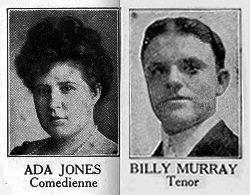
Ada Jones,Billy Murray, wax recording, phonographIn the late 1890s Edison began mass-producing cylinder phonographs though by 1905 flat-disc 78rpm machines began to outsell their cylinder rivals. Columbia, one of Edison’s chief competitors, abandoned the cylinder market in 1912. However, the Edison Company continued to make Blue Amberol cylinders until the demise of the company in 1929.

❏ Listen to Ada Jones & Billy Murray sing Come Josephine in My Flying Machine on an Edison Blue Amberol cylinder from 1911 (© Linda C. Joseph)
FRONT PAGE

➤ Sukita-san’s eye view of the weird world according to Bowie

David Bowie, Masayoshi Sukita,Speed of Life, Genesis Publications,

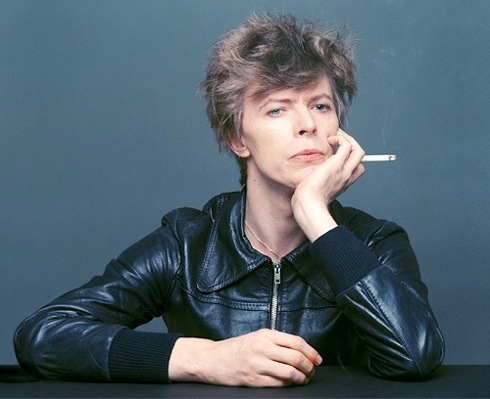
Heroes-era Bowie in 1977 © by Masayoshi Sukita

David Bowie,Yamamoto Sukita, Kansai Yamamoto ,Speed of Life, Genesis Publications

Bowie as Ziggy in 1973 costumed by Kansai Yamamoto and photographed © by Masayoshi Sukita

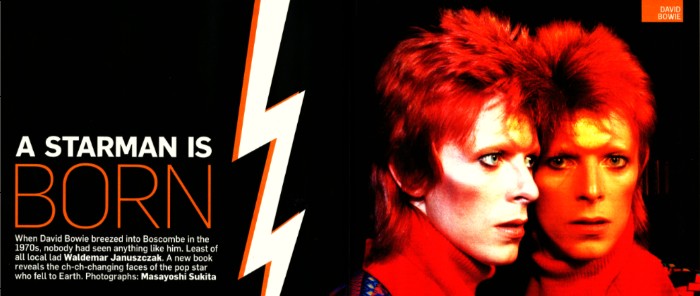
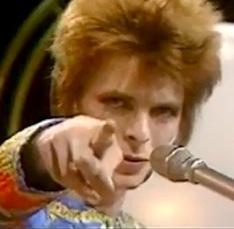
❚ HERE WE SEE CLASSIC PIX of the early glam incarnations that broke the rules of rock and roll and put the gender-bending David Bowie into the headlines. Since 1972 Japanese photographer Masayoshi Sukita has gone on capturing the prolific flow of creations from the ever-inventive Bowie. This week in London his long-awaited book Speed of Life documenting their 40-year collaboration is launched by Genesis Publications in its 2,000-copy limited edition. Signed by both Bowie and Sukita, it is priced at £360 ($581) for 300 pages which they caption with their own recollections and memories. Bowie says: “It’s very hard for me to accept that Sukita-san has been snapping away at me since 1972 but that really is the case… May he click into eternity.”

Meanwhile in today’s Sunday Times Magazine art critic Waldemar Januszczak recalls his teenage outing in 5-inch platforms when he paid 90p on the door of Starkers in Boscombe, Dorset, to discover the eye-popping mystique of Ziggy Stardust in August 1972 — minutes after Sukita the photographer arrived in Britain and caught Bowie’s shock show at London’s Royal Festival Hall. He described it as “like an astronomer finding a new planet”.

David Bowie, Masayoshi Sukita,Speed of Life, Genesis Publications,

Today’s Sunday Times Magazine: Bowie in 1972 © by Masayoshi Sukita

Januszczak writes: “It was Andy Warhol who invented the immensely attractive cultural idea that anyone could be whoever they wanted to be. It became Bowie’s big idea as well. And the tour he set out on in 1972 featured his most determined efforts yet to become lots of people at once: Ziggy Stardust, Aladdin Sane, Major Tom, The Man Who Saved the World. That was just the beginning. The bewildering multi-identitied career photographed for us so sympathtically by Sukita-san in Speed of Life features enough different David Bowies to constitute a football crowd…”

David Bowie, Masayoshi Sukita,Speed of Life, Genesis Publications,

Bowie in 1989 © by Masayoshi Sukita

Above images copyright Masayoshi Sukita, courtesy Genesis Publications

David Bowie, Masayoshi Sukita,Speed of Life, Genesis Publications,

Sukita then and now: left, with Bowie in the 70s

MAY 8: INVETERATE LIGGERS AT THE LONDON
BOOK LAUNCH PARTY

Paul Simper, Steve Norman, Bowie, Sukita, books, Speed of Life,Genesis Publications,Dover Street Arts Club,

Lads insane: The Spand sax-man also known as Spiny Norman ingratiates himself with Ballet biographer Paul “Scoop” Simper at tonight’s Speed of Life book launch. Spandau’s own official photo-book is promised for 2013 from Genesis Publications. Photograph by © Shapersofthe80s

➢ Condé Nast president Nick Coleridge tells book-launch party of his teen obsession with Bowie and his encounter with Angie — Evening Standard Diary, May 9

FRONT PAGE

➤ Shapersofthe80s is declared an “invaluable website” by British historian

“winter of discontent” ,  Leicester Square, strikes,

Britain’s infamous “winter of discontent” that brought down the Labour government in 1979: as public service workers went on strike, rubbish piled-up even in London’s Leicester Square

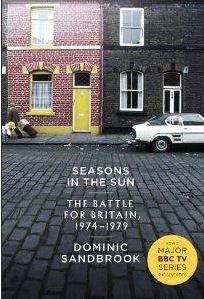
Seasons in the Sun,Battle for Britain, Dominic Sandbrook, books, history, Allen Lane,❚ AN “INVALUABLE WEBSITE” — this is the verdict on Shapersofthe80s by historian Dominic Sandbrook, author of the rich new cultural analysis, Seasons in the Sun: The Battle for Britain, 1974–1979. It’s a doorstep of a book, yet highly readable, which reveals numerous upbeat aspects to the chaotic decade many write off as worthless.

Chapter 31 is especially inspirational! Sandbrook gives generous credit to key characters who Shapersofthe80s has long maintained deserve recognition as movers and shapers pivotal to the energy of the 80s. And, having quoted chunks from our own texts, the historian gives due acknowledgement in his extensive bibliography. Indeed, the scope of his research is more impressive than for much other contemporary history, as Sandbrook not only cites political and economic mandarins, but also sifts fine detail from popular culture and eye-witness reportage across the whole social spectrum.

Sandbrook writes: “Behind the lurid news stories, the late 1970s were the decisive point in our recent history. Across the country, a profound argument about the future of the nation was being played out, not just in families and schools but in everything from episodes of Doctor Who to singles by the Clash. These years marked the peak of trade union power and the apogee of an old working-class Britain – but they also saw the birth of home computers, the rise of the ready meal and the triumph of a Grantham grocer’s daughter who would change our history for ever”

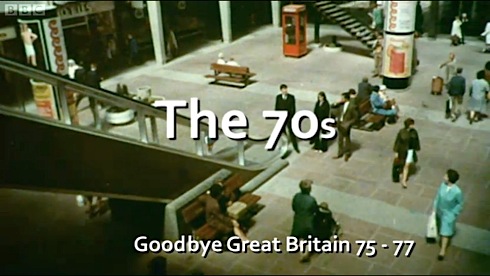
Seasons in the Sun is the fourth title in Sandbrook’s survey of postwar Britain. His unstuffy combination of high and low life is behind the BBC2 series The Seventies currently viewable live and on iPlayer.

BBC2 series The Seventies,Seasons in the Sun ,Dominic Sandbrook

Sandbrook’s Seasons in the Sun forms the basis of the current BBC2 TV series The Seventies

REVIEWS OF SEASONS IN THE SUN

❏ “The first three volumes of Dominic Sandbrook’s epic history of Britain between 1956 and 1979 were exceptionally good. The fourth, Seasons in the Sun, is magnificent … marked by its pace, style, wit, narrative and characterisation as by its exhaustive research.” — Roger Hutchinson, Scotsman

❏ “Sandbrook has created a specific style of narrative history, blending high politics, social change and popular culture … his books are always readable and assured, and Seasons in the Sun is no exception … Anyone who genuinely believes we have never been so badly governed should read this splendid book.” — Stephen Robinson, Sunday Times

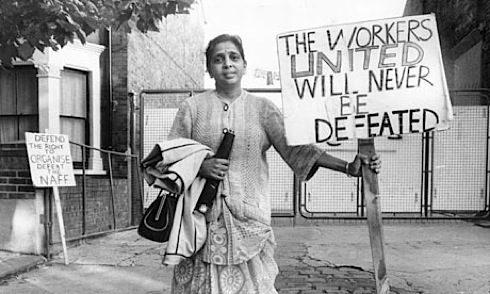
1977, Jayaben Desai, Grunwick, strike, picket

August 1977: Jayaben Desai, treasurer of the strike committee at the Grunwick photo-processing plant, had been picketing for a year, supported by white, male trade unionists while postmen blocked the company’s mail. (Photograph by Graham Wood/Getty)

EVEN WIDER PERSPECTIVE FROM LEADING PLAYWRIGHT

➢ Playwright David Edgar draws together the Sandbrook quartet in The Guardian, May 9, 2012: The 1970s was the moment when our century arrived… As Sandbrook insists, the women’s liberation movement was as much about Hull’s fishermen’s wives and female machinists at Ford Dagenham as feminist activists disrupting Miss World. In 1971, workers campaigning against the closure of Upper Clyde Shipbuilders borrowed the student tactic of the sit-in. As 1970s chronicler Andy Beckett argues, the gay groups who stood shoulder to shoulder with trade unionists outside Grunwick prefigured an alliance which “would become commonplace in the decade to come”. The identity politics that were to become such a satirised feature of the left of the 1970s arose not just out of campus and culture but class war… / continued at Guardian online

FRONT PAGE

➤ Trimphone aside, can you spot the designs that changed the look of Britain over 60 years?

British Design,exhibition ,Innovation, Modern Age, Victoria & Albert Museum,

British Design catalogue collage: road signs, high-rises, Kodak cameras, postage stamps, computers and Henry Moore — all are exhibited here

“Britain has since 1948 sustained an extraordinarily vigorous creative culture, even against a background of manufacturers leaving the stage like the instrumentalists in Haydn’s Farewell Symphony. It’s an inclusive culture, hence tapestries and Jaguars. It’s a culture that swoops artfully between high and low. It’s a culture that could import, with characteristic fairhandedness, both John Betjeman and Nikolaus Pevsner. The one in thrall to the village, the other in thrall to steel and glass. Wonderfully, each was a founder of The Victorian Society. Their contrasting spirits dominate British design in the years before The Beatles’ first LP. Thereafter, the Britain of crumpets-with-vicar became the undisputed global capital of youth culture whose furious organic vitality still invigorates business life.”

➢ Stephen Bayley, former chief executive of the Design Museum, writing in The Independent

Denys Lasdun, University of East Anglia,architecture

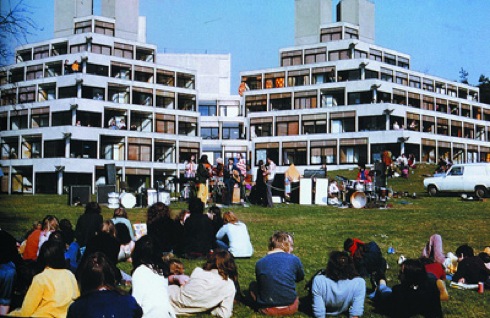
Architect Denys Lasdun’s University of East Anglia, 1962-68: raised walkways, striking ‘ziggurats’ and no building on campus more than five minutes’ walk away

❚ AN EXHIBITION TITLED British Design 1948–2012: Innovation in the Modern Age, is bound to infuriate as much as it excites. The grimly claustrophobic galleries that host temporary shows at the Victoria & Albert Museum abound with iconic and nostalgic everyday objects, rather as a good car-boot sale does. Yet the omission of much imaginative British media is unforgivable — the template for newspaper colour supplements laid out by The Sunday Times plus a serious investment in photo-reportage, for example… the more-British-than-British essence with which the American Joseph Losey propelled a whole chapter of stylish cinema… the sci-fi television fantasies of The Prisoner or Doctor Who…

Twiggy , Mary Quant ,miniskirt,Swinging London, youth culture

Twiggy models the Mary Quant miniskirt, 1965: named after the designer’s favourite car, the mini encapsulated the youth culture of Swinging London — energetic and unconventional

What the V&A show’s three themes propose — under the headings Tradition & Modernity, through the Subversion of pop, to Innovation & Creativity — amounts to a vital module for every art or design student in the education system, whose forebears, thank goodness, benefited from the shake-up imposed in 1960 by the Coldstream Report.

Ignore most dithering reviews of this hot-and-cold exhibition. Instead, do savour the argumentative Stephen Bayley, writing in that onetime model of new newspaper design, The Independent. He nails the paradox of this show in a daydream: “I became drunk on memories of whimsy, charm, gentility, wit and Macmillan-era futurism. My imagination never turned to the ruins of industry, the loss of technological competence, the barrenness of every British city except London and the fact that the economy of our once-busy island workshop is now based on the theory and practice of a dodgy casino.”

Bayley then comes to the nub of the matter: “The tricky thing is ‘design’ itself. It’s often muddled not only with ‘innovation’, but with invention, fashion and taste-making, sometimes even with art. After more than 150 years of promoting design at the V&A, no one seems to have any very clear idea of what it is. If it is a real subject, it must have a discipline. But what discipline connects Spence’s Coventry Cathedral with Damien Hirst’s 1997 Pharmacy restaurant in Notting Hill, west London, each of which features here?

“If, as the design lobby often insists, ‘everything has been designed’, then everyone is a designer. So what special qualities do professional designers bring to any task?”

British Design,exhibition ,Innovation, Modern Age, Festival of Britain, Skylon, Concorde

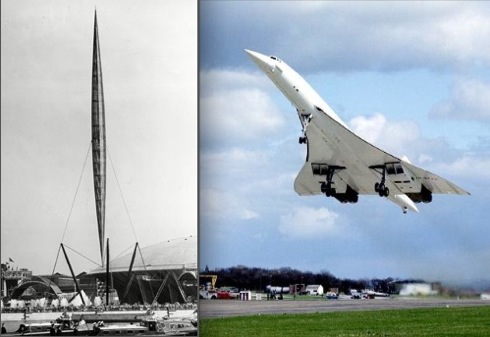
Notions of modernity: at the Festival of Britain, 1951, the Skylon designed by Powell & Moya was rendered by the practice’s junior architect James Gowan as a monumentalised missile, and symbolised the dawning age of science. In 1979, BA’s sixth Concorde took off on its maiden flight

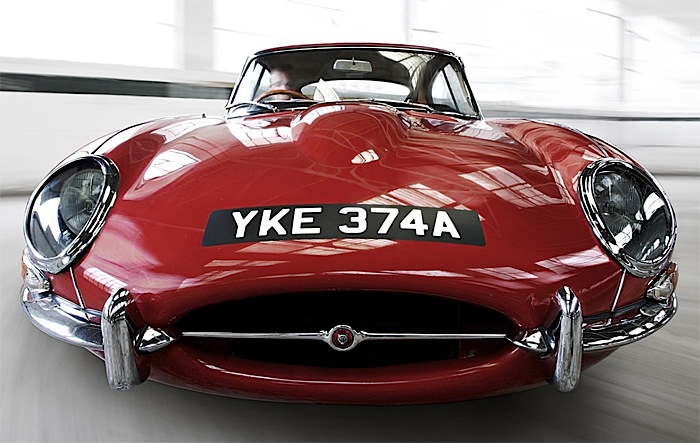
Aim Bayley’s question at three triumphs of design in the V&A show: the kinetic balancing act of the Festival of Britain’s Skylon structure; the bird-wing aerodynamics of Concorde miniaturised at the V&A in a 20-ft model; and the most thrilling artefact in the entire show: the skilfully lit Jaguar E-Type from 1961 which rival manufacturer Enzo Ferrari declared “the most beautiful car ever made”. Drop down to one knee and view the Jag diagonally from any corner and wonder at its lack of straight lines. One curve after another creates changing perspectives that conspire to emulate speed even as it stands motionless before you. Seldom will you hear both men and women purring over such a seductive silhouette! Seldom will you ever see such a thrilling manmade object.

There are a good number of breathtaking moments in this show that beg you to ask why and how an exhibit stopped you in your tracks, though not as many as you would wish.

Malcolm Sayer, Jaguar E-Type,sports car ,

Relish the curves: designed by Malcolm Sayer, the Jaguar E-Type 3.8-litre sports car was launched at the Geneva Motor Show in 1961 as a two-seat coupe or convertible, with a top speed of 150 mph. The car’s shape is the epitome of speed

➢ British Design 1948–2012: Innovation in the Modern Age, runs at the Victoria & Albert Museum, Mar 31 until Aug 12

FRONT PAGE

➤ Proustian frissons aplenty as Derek Ridgers’ photographs revisit three decades

Derek Ridgers, photography, exhibition, Society Club,Morrissey

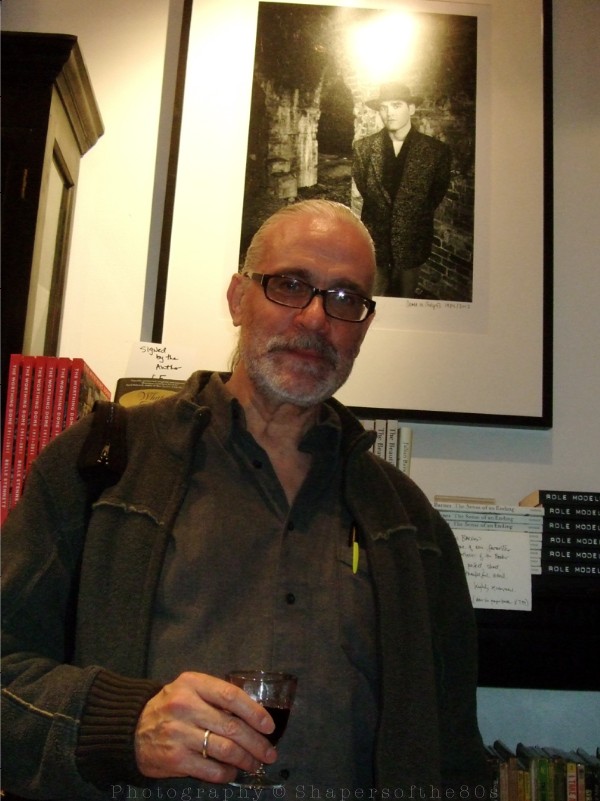
Derek Ridgers in Soho last night: his portrait of Morrissey a bridge between two eras. Photographed by Shapersofthe80s

❚ SOME PHOTOGRAPHERS ARE as extrovert as their famous sitters, but Derek Ridgers has captured the essence of British street style and achieved a uniquely influential status by tip-toeing through the margins of life, feather-footed as the questing vole. Anyone who has followed the Punk and New Romantic scenes recognises the Ridgers types — “transient beings moving across an urban landscape, experimenters, flamboyant souls who cared more than anything about how they looked and whose greatest fear was of being ordinary”, as writer Val Williams noted in the Ridgers photobook of 2004, When We Were Young: Club and Street Portraits. His straight-up photographic style pinned those clubbing butterflies like curios into the display case labelled Swinging 80s. They trigger the involuntary remembrance of the texture of an era as readily as cake did for Marcel Proust: each image has the potential to become the “vase filled with perfumes, sounds, places and climates”.

Throughout April and May we may relish the Ridgers back catalogue in a new exhibition titled Unseen at Soho’s Society Club. The selection documents celebrities and street stylists from 35 years of commissions by music mags and national press. Here is an engaging mix of concert shots and powerfully intimate portraits in which eye-contact is key: Nick Cave, David Lynch, J G Ballard, Boy George, Tom Waits, The Cramps, Mick Jagger, plus the image of Keith Richards which is currently touring in the Sunday Times Magazine 50th anniversary show.

Another exceptionally striking portrait has the singer Morrissey eyeballing the Ridgers lens with an intense gaze that definitely says misunderstood but could just as easily be saying cussed. It was shot in London in 1985, year of The Smiths’ second album, Meat Is Murder, when Moz began raising the temperature with political views about the Thatcher government and the monarchy.

Derek Ridgers, photography, exhibition, Society Club, Keith Richards

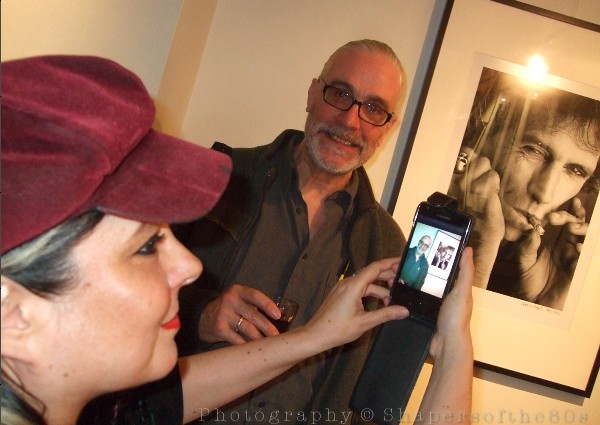
Soho last night: Ridgers, Richards and a new snapper called Tracy Jenkins. Photographed by Shapersothe80s

Ridgers said: “He’s a bit of a strain to photograph in the sense that there is so little of his personality coming back at you. Or at least there wasn’t in those days. Maybe he was very shy but he seemed taciturn in the extreme. The two times we met, he gave the impression of not wanting to say boo to a goose. He honestly hardly said a word to me. Nothing at all like the extremely opinionated personality that comes across in interviews these days.”

The two characteristic Morrisseys of then and now — the one taciturn, the other curmudgeonly — bestride three decades which completely reinvented British notions of youth culture, music, sexuality and success, yet at last night’s preview it was salutory to be pulled up by a 26-year-old illustrator among the guests who had to ask: Who was Morrissey?

All the more reason to buy ourselves a cool black-and-white print as a Proustian trigger, either directly from the Ridgers Archive or from an earlier catalogue viewable at the Society Club. Titled Previously Unpublished, this takes us from an iconic 1982 lineup of the ever-evolving band The Fall, through Culture Club, John Galliano, Roddy Frame, Tim Roth, into the 90s of the Charlatans, Ray Winstone, Lee Scratch Perry and a pensive Kylie Minogue to a raunchy Boo Delicious and more in the new century.

Ridgers has published three books of photographs, has exhibited frequently, and was a judge in How We Are Now, an online photography project launched by Tate Britain in 2007.

➢ Derek Ridgers Unseen runs until May 31 at the Society Club, 12 Ingestre Place, London W1F 0JF

➢ Previously Unpublished can be bought in various formats from Blurb, “a creative publishing service”

➢ 50 Years of The Sunday Times Magazine is viewable in Bristol, Manchester and Birmingham until June

FRONT PAGE