❚ AND YOU WON’T STOP READING THEM! A novelist asked David Bowie to explain his comeback album. In his own way, Bowie uttered his first public words on the subject: 42 of them.
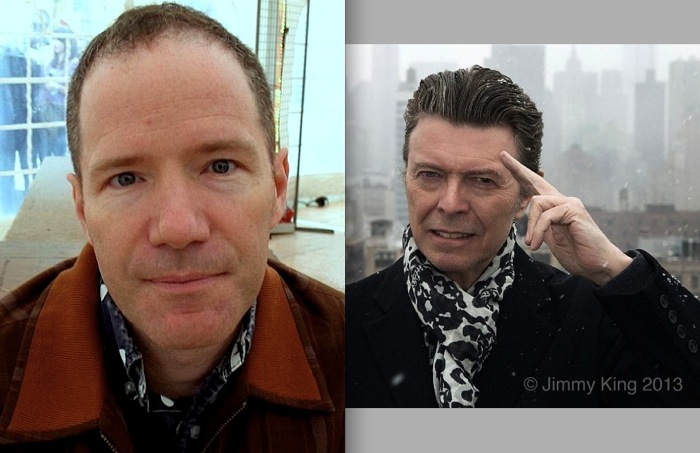
Rick Moody photographed by Seamus Kearney … and a salute from Bowie at 66
“Never has an album been quite as resistant to interpretation as The Next Day,” writes Rick Moody, the 51-year-old American author, tipped by New Yorker magazine as one of its “20 writers for the 21st century”. So he asked Bowie for some clues! We offer a few teasers here to entice you in, but no spoilers. The original piece is so rewarding, you won’t regret setting aside half an hour of your time to devour it… Moody talks of cocktail napkins, albatrosses, a sequence of ghosts and the pressure to be à la mode … of chanson, of papal indulgences, of hatred of rhyme, the ancient temple in Rome, quintessential Britishness, rethinking certainties and the world at war…
SHAPERS OF THE 80S OFFERS AN EXTRACT FROM HIS MONUMENTAL ANALYSIS
BY RICK MOODY: “ I am writing these lines because The Next Day, the album by David Bowie, is the unlikeliest masterpiece of the recent popular song, the best album by an otherwise retired classic rock artist in many, many years. It kicks the shit out of that recent spate of albums by Neil Young and Crazy Horse, it is better than anything the Stones did since Tattoo You … [etc etc etc]
“ It’s a remarkable and completely unpredictable masterpiece by a guy in his later sixties, an album that doesn’t sound like anything else happening in 2013, except that it sounds, in some ways, like a lot of the very best work David Bowie has done … [etc etc etc]
“ In the environment of Taylor Swift and Justin Bieber and One Direction, David Bowie sounds like a titan, like a behemoth of song, but it’s not only because of his context, it’s because he made a great album, which has more passion in each composition than most people manage in entire albums … [etc etc etc]
“ I wanted to understand the lexicon of The Next Day, and so I simply asked if he would provide this list of words about his album… and yet astonishingly the list appeared, and it appeared without further comment, which is really excellent, and exactly in the spirit of this album, and the list is far better than I could ever have hoped. ”
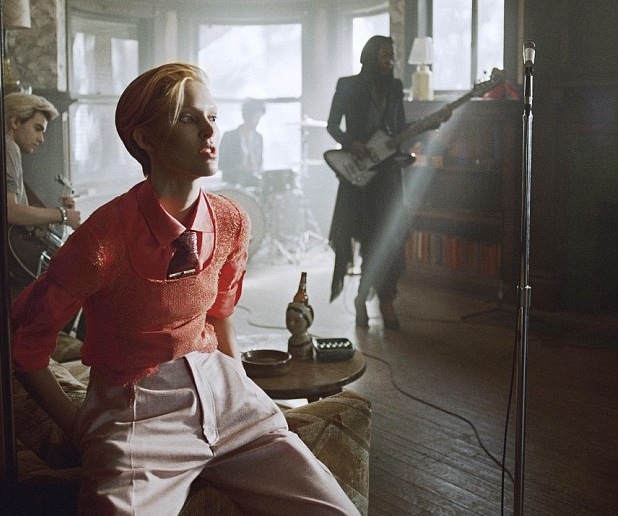
Having asked Where Are We Now? in his first comeback single this year, Bowie’s second posed other enticing questions in a sexually ambiguous video for The Stars (Are Out Tonight) (ISO Records)
BOWIE’S LIST
Effigies
Indulgences
Anarchist
Violence
Chthonic
Intimidation
Vampyric
Pantheon
Succubus
Hostage
Transference
Identity
Mauer
Interface
Flitting
Isolation
Revenge
Osmosis
Crusade
Tyrant
Domination
Indifference
Miasma
Pressgang
Displaced
Flight
Resettlement
Funereal
Glide
Trace
Balkan
Burial
Reverse
Manipulate
Origin
Text
Traitor
Urban
Comeuppance
Tragic
Nerve
Mystification
“ It’s a great list, and it has the word chthonic on it, and this is one of my very favorite words, and you have to admit, additionally, chthonic is a great word, and all art that is chthonic is excellent art, and art that has nothing chthonic about it, like, let’s say, ‘Don’t Worry, Be Happy’, that is art that’s hard to withstand ” … ➢ Rick Moody continues at The Rumpus
POSTSCRIPT VIA IAN HUNTER
+++ ❏ Rick Moody:“ They have no idea how easy it would be to stop. Still, this neglects the loss you would feel about retirement… Ian Hunter, the British singer-songwriter and Bowie’s acquaintance for whom he once wrote All the Young Dudes, had a song on this subject, on his comeback album called Rant (2001), the song being Dead Man Walking (What am I supposed to do now?/ Crawl down the hole of monotony?/ The silence is deafening/ The phone never rings) ”
❚ FOR THOSE WHO SURVIVED the mid-70s, punk was the anti-fashion UK phenomenon that transformed contemporary culture. Now “a blistering 1976-80 photo-hoard” of mostly unseen pictures has been published as a 272-page photobook. Punk+ by Sheila Rock – an American in London – chronicles both designer and street styles that impacted on fashion, society and politics, including Vivienne Westwood’s shop SEX as well as BOY, Robot and Acme Attractions. The collection, which had been stored in a box in Rock’s garden shed, includes formative images of The Clash, Chrissie Hynde, Paul Weller, The Jam, Generation X, Siouxsie & the Banshees and The Sex Pistols.
Paul Simonon of The Clash says: “This book is a great photographic record of a major shift in British street fashion.”
Sheila Rock arrived in London in 1970 to join the David Bowie circle, and it was her friend and Patti Smith guitarist, Lenny Kaye, who took her to a gig by the then-unknown Clash. “That was the first time I was introduced to the punk scene,” she says. “I decided to take my Nikon camera with me and my photography career began.” Her photographs of showbiz performers and musicians have been published in titles from Vogue to The Sunday Times and can also be found in London’s National Portrait Gallery. This month her pix will also be showing in the Punk: Chaos to Couture exhibition at The Metropolitan Museum of Art in New York.
Rock’s career took off in 1980 in The Face, the 80s style bible published by Nick Logan, who describes Rock as “self-effacing but sweetly persuasive” in the preface to PUNK+. He notes how she refined her images to capture a style that portrayed what her subjects wanted to personify. She often achieved this better than they understood themselves.
Tonight the book was launched with a two-week exhibition of Rock’s photographs at Brown’s high fashion store in London, and a further show runs for a month from May 28 at Rough Trade East, where there’s also a book signing.
Mojo Magazine reports: “Sheila Rock’s PUNK+ book presents a blistering 1976-80 photo-hoard. The striking and fascinating photo-book collects almost 200 images of groups including The Subway Sect, Eater, Buzzcocks, The Clash and the Sex Pistols, plus documentation of the rapidly changing fashions of the late 70s. She estimates 90 per cent of the shots have never been seen, and that 85 per cent were self-motivated experiments rather than work commissions. Those enthralled by shifts in vintage youth styles will also delight in the images of unselfconscious punks, such as the young Jam fans who mixed the Weller look with the safety-pin aesthetic.”
➢ PUNK+ is published by First Third Books Ltd (London and Paris): 272 pages, size 20 x 27cm, limited edition of 300 copies signed and numbered, £99; standard edition of 1,700 copies, £49. The book includes illuminating conversations with Chrissie Hynde, Tony James, Don Letts, Jeanette Lee, Glen Matlock, Chris Salewicz, Jon Savage, Steven Severin, Paul Simonon, Jah Wobble and more.
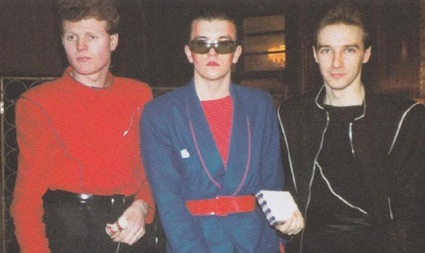
❚ THE STUDIO BAND VISAGE were central to defining the electropop sounds of 1980 thanks to the musical nous of Midge Ure, who had bought his first synthesiser in 1978 because he felt synths “embodied a kind of nostalgia for the future”. He’d been faffing around with Glen Matlock, Steve New and drummer Rusty Egan in the 60s-flavoured one-hit power pop group Rich Kids, and sensed an appetite in the zeitgeist for a more soulful version of Kraftwerk plus a return to melody. Intent on making vibrant dance music for the “visa age”, Ure dreamed up the name Visage, complete with simplified face as its logo, for an new experimental band. Initially Ure rehearsed updating In The Year 2525, using up some spare Rich Kids time booked in an EMI studio. There he played around on synth and drum machine, then asked Egan to take over the drums.
They co-opted Rusty’s flamboyant Welsh pal Steve Strange as face-painted frontman to give visual expression to a range of what were being called “moderne” fashions. Dressing up in the face of a grinding economic recession was the destiny that Bowie’s children were to fulfil. Visage’s songs captured the sidelong humour and knowing irony that came to characterise the 80s, while their explosive backbeats, electronic fills and synth riffs changed the vocabulary of British chart pop. This TV generation dreamed in both sound and vision.
Supercool in ’78: Egan, Strange and Ure establish Visage
What Strange lacked in vocal proficiency he made up for in promotional value, since he soon became a walking advertisement for the cooler-than-cool clothes shop PX in Covent Garden where he was an assistant. Run by Stephane Raynor and Helen Robinson, they more than any other designers in 1980 set the template for New Romantics fashion, favouring oversized chemises, medieval doublets, breeches and frilly lace. The shop’s followers were soon dubbed posers, and the Pose Age was born. Disposable identities, portable events, looks not uniforms – for his disciples, Bowie’s imperatives became the norm.
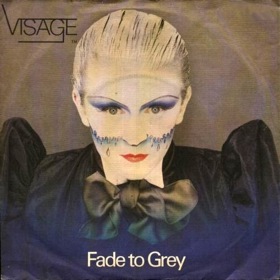
As a studio project the original Visage lineup never played live, and was probably a case of too many cooks. In 1979 it took in four more musicians (Billy Currie, John McGeoch, Dave Formula, Barry Adamson), all of whom had loyalties to existing bands, while the creative drive came from Ure and Currie. Even so, Currie was persuading the restless Ure to help resurrect the synth band Ultravox following John Foxx’s departure. By 1982, when Ure quit Visage in favour of Ultravox, Visage had enjoyed four top-20 singles hits in the UK, two top-twenty albums with Visage and The Anvil, and a smattering of international hits with Fade to Grey.
As we now know, Ure went on to mastermind the Band Aid fundraising hit single in 1984, then the worldwide Live Aid charity concert with Bob Geldof, and duly earned himself an OBE.
In 1984 a Visage lineup comprising Strange and Egan along with newer members Andy Barnett, Steve and Gary Barnacle put out a so-so third album, but when it flopped they soon called it a day. The truth was that Visage failed to invest single-mindedly in themselves as a musical enterprise: their progress simmered rather than blazed as individuals pursued their own favoured goals. Occasional tracks sizzled on the dancefloor – In the Year 2525, Fade to Grey, Mind of a Toy, Night Train – but the band lacked unity and commitment.
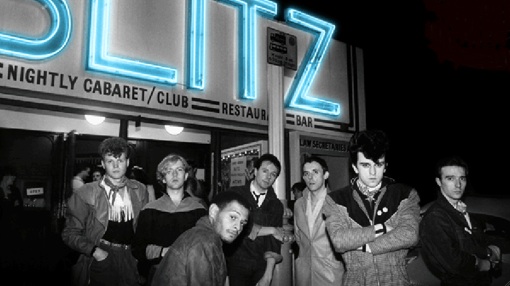
❚ NOBODY CAN DENY STRANGE’S FIZZ and chutzpah which in 1979 coralled a disparate group of post-punk no-wavers and outcast fashionistas when he co-hosted the agenda-setting Neon Night at the Blitz Club in Covent Garden. It lit up London in an explosion of inventive fashion, gender-bending and ridiculous hair. As the club’s stand-out stars suddenly became media celebrities, these exponents of modern dance and stance began forcing the pace of change across the creative industries. Rusty Egan proved to be a mould-breaking deejay who often added his own Syndrum accompaniment at the turntable, and his live mixing did much to change the sound of clubland music. During the early 80s the pair went on to reshape London nightlife at two notable venues, Club for Heroes in Baker Street and the Camden Palace. At the end of the decade, dance music as we knew it was swept aside by the craze for E’s and rave. Egan then set out to make a fine reputation deejaying on London’s boutique nightclub circuit, while Strange can claim a ghosted autobiography as full of fantasy and foggy memories as you’d expect from an arch-poser who’d been out on the town every night for 20 years.
Roll forward to 2010. John Pitcher, who fronts a music services provider called MRC, established a Blitz Club record label and an associated website, and Strange and Egan launched it in January 2011 by throwing a Return to the Blitz party at the site of the former club. The event raised a few media ripples but little groundswell and only three remixes have been released in as many years. With 80s band revivals making waves all around them, that old Blitz magic had lost its charm. Egan said this week: “Pitcher registered everything for us, so he owns everything, including the website and the Visage brand.” Growing personal differences hindered collaboration between the three. These worsened last year when Egan made allegations that Strange had squandered a substantial sum of accrued Visage royalties paid via Strange and that he failed to share them among the original band lineup. This week Egan said: “Try telling John McGeoch’s daughter her dad’s [share] was spent by Strange.”
When Strange proposed reviving the band name of Visage after almost 30 years, neither Ure nor Egan could see the point and they disputed Strange’s right to do so. Ure told an American newspaper in January: “Visage was always something Rusty Egan and I created and controlled. The idea of doing a Visage 2 was never appealing to me so I wasn’t interested. I walked away from Visage when it got ridiculous and supremely hedonistic and I will probably leave it that way.” In response to Strange’s claim on German TV last November that Ure was collaborating on a new album together, Ure tweeted: “He is deluded if he thinks that. He knows that isn’t happening.”
Rusty Egan remains aggrieved that Strange has not resolved recent differences. He is angry that Strange should make any claim to creative input into Visage’s lyrics and music, and maintained this week: “Strange had nothing to do with the music in The Blitz or Visage.” In January Egan said: “There has never been a Visage album without me. It’s my group and Strange is a singer. He is not Visage.”
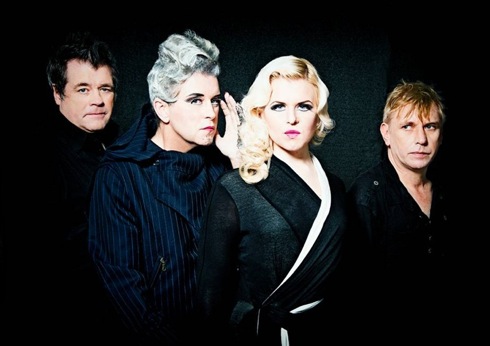
Yet for all this, and Strange’s sad personal saga of ill-health, the vocalist has doggedly set about persuading a new circle of supporters to bring Visage back to life. In the face of widespread disbelief – the garrulous Strange’s little weakness, after all, has always been for exaggeration and melodrama – last year he announced a new “Visage” lineup, with a gorgeous singer called Lauren Duvall, plus Steve Barnacle (fretless bass) and Robin Simon (guitar). Keyboardist Mick MacNeil, from Simple Minds, was enlisted to contribute on a range of vintage analogue synthesisers which include an early Moog Source.
At last, what is being called a fourth “Visage” album titled Hearts and Knives is due to be released on May 27.
“It has been 29 years since the last Visage album and during that period it often seems like we have all lived through several lifetimes,” says Strange. Indeed, “bruised and wounded” declare the rueful lyrics of Shameless Fashion, the new group’s first single, available this week. It isn’t clear whether this refers to the very many contributors we see jostling for credits on the new “Visage” packaging. The Visage 2013 camp is probably keeping fingers crossed.
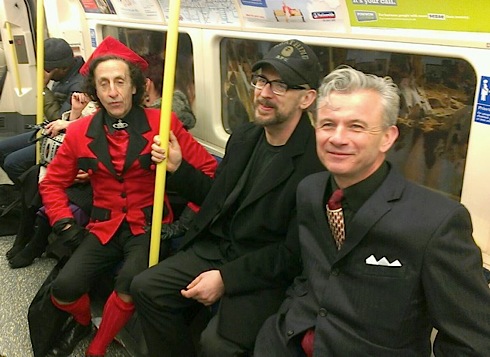
Incognito on the Northern Line: Philip Sallon and popstar Jarvis with mystery man
Bazaar Exclusive
❚ WHO ARE THE TWO DASHING MEN in the life of Philip Sallon, the well-known 80s Mud club host, Dollis Hill socialite and Grade 1 listed National Treasure who doubles as a Different Person Depending On Day of Week? My exclusive sources papped the celebrity eccentric earlier today, dressed as Pinocchio, the Italian woodcarver’s apprentice who was created as a wooden puppet but dreamed of becoming a real boy. Ironic or what?
Despite being a household name on five continents, Pinocchio Sallon does normal things like popping into his local Aldi for cheese slices and hunting down two-for-one bargains. He queues for the bus and commutes into town on the Northern Line, like any other Londoner. The big surprise is to see him travelling in the company of Jarvis, the bearded geek and singer with Britpop group Plop. But a question mark hangs over the identity of the third man, a handsome silver fox of striking aspect and expensively veneered teeth, who Jarvis has clearly taken a shine to.
I wouldn’t be at all surprised to hear tomorrow’s Bazaar column in the Currant Bun speculating on the name of Jarvis’s new squeeze.
Aldi essentials … Most pix by Paul Sturridge
Sallon snapped on the London underground … Pinocchio drawn by Nadir Quinto
➢ Faster two-thumb typing devised by the Max Planck Institute: “ The research team of Antti Oulasvirta at the Max Planck Institute for Informatics has created a new keyboard called KALQ that enables faster thumb-typing on touchscreen devices. They used computational optimization techniques in conjunction with a model of thumb movement to search among millions of potential layouts before identifying one that yields superior performance. A user study confirmed that, after a short amount of practice, users could type 34% faster than they could with a QWERTY layout… ” / Continued at the Max Planck Institute
➢ Choose “View full site” – then in the blue bar atop your mobile page, click the three horizontal lines linking to many blue themed pages with background article
MORE INTERESTING THAN MOST PEOPLE’S FANTASIES — THE SWINGING EIGHTIES 1978-1984
They didn’t call themselves New Romantics, or the Blitz Kids – but other people did.
“I’d find people at the Blitz who were possible only in my imagination. But they were real” — Stephen Jones, hatmaker, 1983. (Illustration courtesy Iain R Webb, 1983)
“The truth about those Blitz club people was more interesting than most people’s fantasies” — Steve Dagger, pop group manager, 1983
PRAISE INDEED!
“See David Johnson’s fabulously detailed website Shapers of the 80s to which I am hugely indebted” – Political historian Dominic Sandbrook, in his book Who Dares Wins, 2019
“The (velvet) goldmine that is Shapers of the 80s” – Verdict of Chris O’Leary, respected author and blogger who analyses Bowie song by song at Pushing Ahead of the Dame
“The rather brilliant Shapers of the 80s website” – Dylan Jones in his Sweet Dreams paperback, 2021
A UNIQUE HISTORY
➢ WELCOME to the Swinging 80s ➢ THE BLOG POSTS on this front page report topical updates ➢ ROLL OVER THE MENU at page top to go deeper into the past ➢ FOR NEWS & MONTH BY MONTH SEARCH scroll down this sidebar
❏ Header artwork by Kat Starchild shows Blitz Kids Darla Jane Gilroy, Elise Brazier, Judi Frankland and Steve Strange, with David Bowie at centre in his 1980 video for Ashes to Ashes
VINCENT ON AIR 2026
✱ Deejay legend Robbie Vincent has returned to JazzFM on Sundays 1-3pm… Catch up on Robbie’s JazzFM August Bank Holiday 2020 session thanks to AhhhhhSoul with four hours of “nothing but essential rhythms of soul, jazz and funk”.
TOLD FOR THE FIRST TIME
◆ Who was who in Spandau’s break-out year of 1980? The Invisible Hand of Shapersofthe80s draws a selective timeline for The unprecedented rise and rise of Spandau Ballet –– Turn to our inside page
SEARCH our 925 posts or ZOOM DOWN TO THE ARCHIVE INDEX
UNTOLD BLITZ STORIES
✱ If you thought there was no more to know about the birth of Blitz culture in 1980 then get your hands on a sensational book by an obsessive music fan called David Barrat. It is gripping, original and epic – a spooky tale of coincidence and parallel lives as mind-tingling as a Sherlock Holmes yarn. Titled both New Romantics Who Never Were and The Untold Story of Spandau Ballet! Sample this initial taster here at Shapers of the 80s
CHEWING THE FAT
✱ Jawing at Soho Radio on the 80s clubland revolution (from 32 mins) and on art (@55 mins) is probably the most influential shaper of the 80s, former Wag-club director Chris Sullivan (pictured) with editor of this website David Johnson
LANDMARK FAREWELLS. . . HIT THE INDEX TAB UP TOP FOR EVERYTHING ELSE











 ➢➢ Shapers of the 80s ➣➣