“I don’t think there’s ever been such a rush towards insignificance in the name of the historical future as we’ve seen in the last 15 years.” — Robert Hughes concluding his TV series The Shock of the New in 1980
1963: Sassoon creates the “bob” on designer Mary Quant. (Photo: Getty)
“He revolutionised not just hair but fashion” — model-turned-Vogue fashion editor Grace Coddington
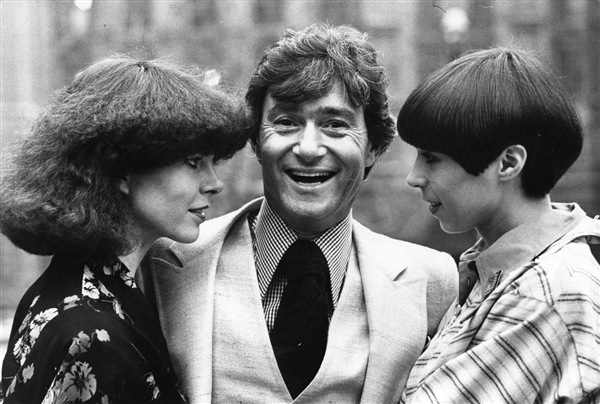
Comeback 1975: Vidal Sassoon between two contrasting examples of his hairdressing for a teach-in at the Albert Hall, where he returned to hairdressing after a five-year break. (Photograph by Tim Graham / Getty)
“ Vidal Sassoon, who was found dead at home on Wednesday, was at the cutting edge – literally and metaphorically – of hairdressing. His sharp, geometric, low-maintenance 1960s hairstyles revolutionised his craft, sounding the death knell for the stiff, set hairdos of the 1950s. An astute businessman, he made a fortune from his salons and products, and became a household name. “I wanted to eliminate the superfluous and get to the basic angles of cut and shape,” he said… ” / continued online
+++ ❏ Craig Teper’s 2010 documentaryVidal Sassoon: The Movie follows the true rags-to-riches tale of how a boy from a London orphanage went on to open his own Bond Street salon in 1958 and — influenced by the Bauhaus designs he had studied — he create the “shape” that became his signature cut, the five-point bob. It revolutionised hairdressing. His geometric wash-and-wear cuts marked the end of the beehive and the bouffant hair styles of the 50s. Admirers included the Duchess of Bedford, model Jean Shrimpton, actor Terence Stamp, and film star Mia Farrow. In 1963 he devised the classic “bob” for fashion designer Mary Quant, who called him the “Chanel of hair”. By 1964 he’d gone international by opening his first salon in New York.
Sassoon The Movie: the London crimper freed women from 50s bouffants by pioneering the low-maintenance hairstyles that defined the 60s
“ Etta James, the legendary singer whose career spanned six decades (and just as many musical genres) and whose voice has influenced everyone from Janis Joplin and Bonnie Raitt to Christina Aguilera and Adele, died today after a lengthy battle with leukemia. She was 73 years old.
Best known for hits like At Last, All I Could Do Was Cry, Tell Mama, Something’s Got a Hold on Me and Good Rockin’ Daddy, James learned to sing in church, and first recorded professionally as a member of the all-girl doo-wop group the Peaches, with whom she’d score a No1 hit (The Wallflower, an answer to Hank Ballard’s Work With Me, Annie). Soon after that song’s success, James left the group and toured with the likes of Little Richard and Johnny “Guitar” Watson. She’d subsequently sign with Chicago’s Chess Records in 1960, where her powerful contralto was featured on a string of crossover classics that spanned R&B, soul, gospel, blues and even rock… ” / continued online
TODAY BEYONCÉ PAID TRIBUTE
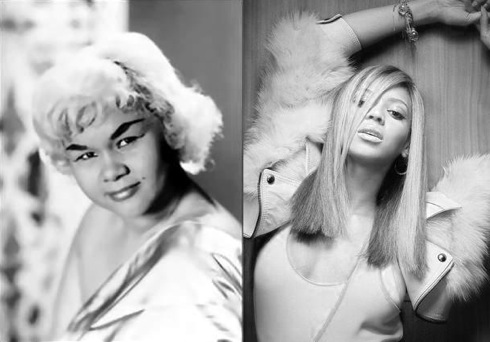
Etta James in the 1960s, and as portrayed in the 2008 musical Cadillac Records by Beyoncé who also produced the film
“ This is a huge loss. Etta James was one of the greatest vocalists of our time. I am so fortunate to have met such a queen. Her musical contributions will last a lifetime. Playing Etta James taught me so much about myself, and singing her music inspired me to be a stronger artist. When she effortlessly opened her mouth, you could hear her pain and triumph. Her deeply emotional way of delivering a song told her story with no filter. She was fearless, and had guts. She will be missed. ”
+++ ❚ IT’S PRETTY CLEAR who is the jazz singer in this much-anticipated video (above), released today. The old croaker Tony Bennett may be the last living legend in the crooner tradition, but he is utterly outclassed by the astonishing retro inflections of Amy Winehouse. She was his fan, so the 1930 standard Body and Soul, written for another showbiz legend Gertrude Lawrence, makes a noble epitaph for Amy. However, look to any number of earlier performances on video to appreciate the full measure of her sinuous, soulful, contralto voice, her body and her soul. She sang, as the Guardian obituary said, “as if her heart were damaged beyond repair”. Watch, as one example, her live acoustic version of Love is a Losing Game in 2007 (below) through to its ineffable conclusion.
Amy Winehouse Foundation launches
on her 28th birthday
➢ From today’s Daily Telegraph: “ The Winehouse family have launched the foundation to mark what would have been the singer’s 28th birthday. Her mother Janis said: “We want to give money to projects that make a direct difference. It is a source of great comfort to know that Amy would be proud of this.”
“ One of the first major sources of income for the Amy Winehouse Foundation will be from her duet with Tony Bennett, which is released today. It was given its first play on the Ken Bruce show on Radio 2 this morning. Winehouse’s father Mitch said: “Amy was very generous and we kept coming back to the thought of how much she loved children. It seemed appropriate that the focus of our work should be with young people, those who are vulnerable either through ill health or circumstance. ”
Amy’s last studio recording
❏ The duet with her 85-year-old hero Tony Bennett, and titled Body and Soul, was Amy’s last recording. Released today by Columbia Records, the song was laid down on March 23 at Abbey Road Studios in London for Bennett’s upcoming Duets II album.
Amy was found dead at her flat in north London on July 23. Her critically acclaimed second album Back to Black, produced by Mark Ronson and Salaam Remi, was much more Motown-flavoured R&B than her jazz-influenced debut, Frank, which won an Ivor Novello Award and prompted Billboard to describe her voice as “astounding”. Released in 2006, Back to Black reached No 1 several times in the UK, No 7 in the US, and yielded five hit singles aching with explicit and heartfelt lyrics, most notably Rehab. Renewed demand during the past month sent it back to No 1 to become the UK’s best-selling album of the 21st century.
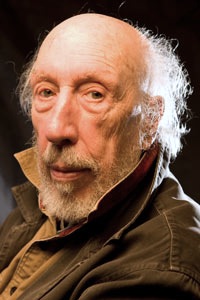
+++ ❚ “ RICHARD HAMILTON, the most influential British artist of the 20th century, has died aged 89. In his long, productive life he created the most important and enduring works of any British modern painter… Hamilton has a serious claim to be the inventor of pop art… Driven by intellect and political belief, Hamilton created undying icons of the modern world.” ➢ Read Jonathan Jones at The Guardian online
IN 1957 HAMILTON DEFINED THE EVERYDAY
COMMONPLACE VALUES OF POP ART…
“ Pop Art is:
Popular (designed for a mass audience)
Transient (short-term solution)
Expendable (easily forgotten)
Low cost
Mass produced
Young (aimed at youth)
Witty
Sexy
Gimmicky
Glamorous
Big Business ”
❏ His definition appeared as part of a long rumination on post-war art in a letter to Peter and Alison Smithson, published online at Warholstars.org, but taken from The Collected Words 1953–1982 by Richard Hamilton (Thames & Hudson 1982)
TUSA:“Your definition hasn’t, as you said, stood the test of time because pop art as we now know it and as it became, has ended up being anything but transient, expendable and commercial. It’s been in a way co-opted by the systems and the commercialism of the fine-art world itself.”
HAMILTON: “When I made that list I thought what are the characteristics of what we call pop art, and then I listed them, big business and so on; the record system, Hollywood and all the other things. Then I looked at this list that I had made, which had nothing to do with fine art or anything that I was painting or doing and said, is there anything in this list which is incompatible with fine art? And my answer was no, except for one thing and I said, Expendable. Now, is fine art expendable? And I thought, no; I can’t quite stomach that. Everything else, OK, but expendability as a throwaway attitude is not something that can be acceptable as pop art, and I was proved wrong. Warhol approached art from the point of view of expendability, so I admire him enormously for having brought my attention to the fact that I was wrong.”
HAMILTON AS COMMENTATOR ON
A FABLED DRUGS BUST
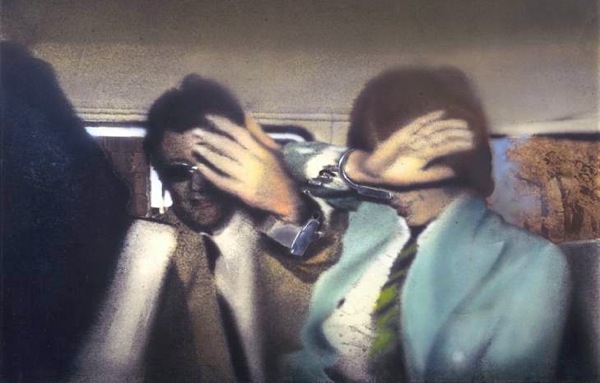
❏ Hamilton’s Swingeing London series of paintings and prints were his response to the arrest of his art dealer Robert Fraser and his imprisonment for the possession of heroin. This followed the now fabled police raid on a party at the Sussex farmhouse of Keith Richards, of the rock group the Rolling Stones, in February 1967. There they found evidence of the consumption of various drugs and in June, Fraser and Mick Jagger (the band’s lead singer) were found guilty of the possession of illegal drugs. This gave rise to the sarcastic newspaper headline “A strong sweet smell of incense” which Hamilton incorporated into a huge collage of the resulting newspaper cuttings which he titled Swingeing London 67 — Poster. ➢ Read Keith Richards’ account of this raid and the truth about the infamous Mars bar
❏ Video above: This Is Tomorrow (1992), clip from a C4 television documentary by Mark James in which the Father of Pop Art Richard Hamilton talks about his time as a tutor to pop star Bryan Ferry at Newcastle University art school
➢ Choose “View full site” – then in the blue bar atop your mobile page, click the three horizontal lines linking to many blue themed pages with background article
MORE INTERESTING THAN MOST PEOPLE’S FANTASIES — THE SWINGING EIGHTIES 1978-1984
They didn’t call themselves New Romantics, or the Blitz Kids – but other people did.
“I’d find people at the Blitz who were possible only in my imagination. But they were real” — Stephen Jones, hatmaker, 1983. (Illustration courtesy Iain R Webb, 1983)
“The truth about those Blitz club people was more interesting than most people’s fantasies” — Steve Dagger, pop group manager, 1983
PRAISE INDEED!
“See David Johnson’s fabulously detailed website Shapers of the 80s to which I am hugely indebted” – Political historian Dominic Sandbrook, in his book Who Dares Wins, 2019
“The (velvet) goldmine that is Shapers of the 80s” – Verdict of Chris O’Leary, respected author and blogger who analyses Bowie song by song at Pushing Ahead of the Dame
“The rather brilliant Shapers of the 80s website” – Dylan Jones in his Sweet Dreams paperback, 2021
A UNIQUE HISTORY
➢ WELCOME to the Swinging 80s ➢ THE BLOG POSTS on this front page report topical updates ➢ ROLL OVER THE MENU at page top to go deeper into the past ➢ FOR NEWS & MONTH BY MONTH SEARCH scroll down this sidebar
❏ Header artwork by Kat Starchild shows Blitz Kids Darla Jane Gilroy, Elise Brazier, Judi Frankland and Steve Strange, with David Bowie at centre in his 1980 video for Ashes to Ashes
VINCENT ON AIR 2026
✱ Deejay legend Robbie Vincent has returned to JazzFM on Sundays 1-3pm… Catch up on Robbie’s JazzFM August Bank Holiday 2020 session thanks to AhhhhhSoul with four hours of “nothing but essential rhythms of soul, jazz and funk”.
TOLD FOR THE FIRST TIME
◆ Who was who in Spandau’s break-out year of 1980? The Invisible Hand of Shapersofthe80s draws a selective timeline for The unprecedented rise and rise of Spandau Ballet –– Turn to our inside page
SEARCH our 925 posts or ZOOM DOWN TO THE ARCHIVE INDEX
UNTOLD BLITZ STORIES
✱ If you thought there was no more to know about the birth of Blitz culture in 1980 then get your hands on a sensational book by an obsessive music fan called David Barrat. It is gripping, original and epic – a spooky tale of coincidence and parallel lives as mind-tingling as a Sherlock Holmes yarn. Titled both New Romantics Who Never Were and The Untold Story of Spandau Ballet! Sample this initial taster here at Shapers of the 80s
CHEWING THE FAT
✱ Jawing at Soho Radio on the 80s clubland revolution (from 32 mins) and on art (@55 mins) is probably the most influential shaper of the 80s, former Wag-club director Chris Sullivan (pictured) with editor of this website David Johnson
LANDMARK FAREWELLS. . . HIT THE INDEX TAB UP TOP FOR EVERYTHING ELSE









 ➢➢ Shapers of the 80s ➣➣