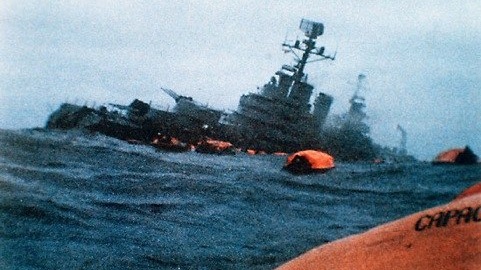
May 2, 1982: ARA General Belgrano lists heavily to port in the Atlantic Ocean, while its crew abandon ship. Sailor’s picture via Press Association
❚ TODAY WAS THE DAY 30 YEARS AGO that Britain accepted the Argentine surrender on the Falkland Islands in the South Atlantic Ocean, 74 days after going to war. This returned the islands to British control. The conflict led to the deaths of 649 Argentine and 255 British servicemen and 3 Falkland Island civilians. The words yomp, Exocet and Gotcha assumed poignant everyday connotations.
✱ 9:00 BST David Bowie and The Story of Ziggy Stardust — exhilaratingly observant new TV doc narrated by Jarvis Cocker, 2012, directed by James Hale and exec-produced by Paul Bullock who brought us the brilliant Prince, A Purple Reign last year. Tight, total and definitive (in everything but an Angie contribution), it has contemporary rivals queueing to heap on the respect while nailing the genius with several gasp-out-loud revelations (you will sit up when Mike Garson hits the piano!). Quote of the era: “I can’t stand the premise of going on in jeans and being real.” A landmark. Repeated June 23, 25 and on iPlayer
✱ 10:00 The Genius of David Bowie — energised compilation of best archive performances, 2012, with breathtaking mature renderings of Heroes, Ashes and Fashion, plus magnificent Lou Reed and Iggy Pop as guests among others you’d rather ignore. Also June 23, 25
✱ 11:00 Ziggy Stardust & the Spiders from Mars — D A Pennebaker’s plodding, murky and utterly amateur film might as well have been bootlegged going by its appalling camerawork, shoddy editing, fudge sound (relieved only by its backstage footage revealing Bowie as the angst-ridden artiste). It was shot live at Hammersmith Odeon in 1973, the night Ziggy made his last stand even with Mick Ronson at peak power. “The first we knew we were unemployed was onstage,” the drummer Woody admitted at the Ziggy plaque unveiling in March. Historical curio worth a first watch just so you can feel the heat of real fan worship. If only the evident genius of Bowie himself could have been more watchably captured! But luckily I saw the whole wowie spectacle from Row C so the Standard was the first paper to break the news next morning. (This was the world pre-Twitter, remember – indeed, pre-rolling news of any kind.)
✱ 12:30 David Bowie at the BBC — live concert at the Radio Theatre, 2000, brilliant mix of classic songs (Fame, Man Who Sold The World, Always Crashing, Wild is the Wind) plus Gail Ann Dorsey on bass guitar. Also June 23, 25.
✱ TONIGHT — Another brilliant radio doc on The Birth of Glam presented by Gary Kemp goes out June 13 at 10pm BST on Radio 2 … Two years ago under its original title The Glory of Glam it prompted a major assessment of the difference between glitter and glam here at Shapersofthe80s. At that time we said “If this documentary doesn’t win a Sony radio award, there’s no justice.”
❚ OLD HABITS, EH? A day in the spotlight and Simon Barker, aka Six, starts rewriting history! There we were last night in a Spitalfields gallery, chatting for the first time in 20 years at Punk’s Dead, his new show of early photographs of the now fabled Bromley Contingent, the posse of a dozen fashionistas who helped put the Sex Pistols on the map back in 1976. Having staked his claim to fame as the only person clapping at the end of the Pistols’ sixth gig (Dec 9, 1975, at Ravensbourne College) and being one of four fans with the band during the infamous “Filth & Fury” TV interview (Dec 1, 1976), Simon today works as a photographer in Prague.
Why Prague, I ask, as a big fan of the Bohemian medieval city? He groans: “Oh no! Why Prague? Why does everyone ask me the same question?” You’d never guess Simon and I used to natter away as if we liked each other back in the 80s when I’d pop into Viv’s Worlds End shop after going for a haircut next door at Smile. OK then, Six, why *Bromley*? As in Bromley Contingent. What was in the water in Bromley that produced his posse of poser punks?
“Ah, excellent question!” he replies. “We hated the name. It was created by the media — that woman Caroline Coon.” This is a double-edged dig at both the middle-class, ex-hippy Melody Maker writer who coined the phrase after seeing the “very striking” posse at three Pistols gigs in a row and asking where they came from (Bromley is a town in the south London commuter belt)… and also at me for being another member of the despised legion of journalists.
His Always-a-Punk gene is really kicking in now. “In actual fact, only two of us — me and Steve [Bailey, aka Severin] — came from Bromley. Siouxsie [Susan Ballion, later singer with the Banshees] was from Chislehurst. Billy [Broad, later Idol] lived in Bickley. And Jordan [born Pamela Rooke] came up from Seaford.
“For me and Steve, living in that bit of suburbia, Bromley had the best connection into London — 20 minutes by train. Any further away and it wouldn’t have been so easy to visit for gigs, sex, Louise’s…”
Aha, the location-location transport solution! A recurring theme, because in a surprisingly cooperative interview in 2002 Six did admit that his reason for moving to the Czech Republic “was its location. It is the heart of Europe and a great base to travel from.”
Six was either being pure-punk cussed by splitting hairs about his posse, or possibly was having a bit of a hashtag_Senior_Moment. Bickley is after all the next stop down the line from Bromley, only 2,000 metres away, and Chislehurst another 1,000 metres further on. But fair enough, he’s got a point. Even if you include Sioux and Idol and Bertie “Berlin” Marshall, who lived three doors away from Bowie’s mum in Bromley, five out of a posse of 12 does not a “Bromley” Contingent make. So last night, we witnessed history being rewritten.
WHO waS WHO in the “Bromley” Contingent
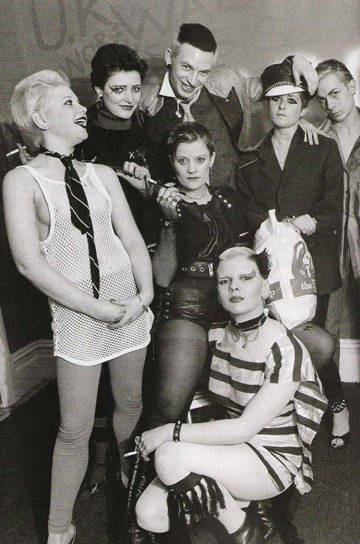
Ray Stevenson’s classic 1976 pic of some of the Bromley Contingent, plus Soo Catwoman who came from Ealing
According to Wikipedia: Siouxsie Sioux, Jordan, Soo Catwoman, Simon “Boy” Barker, Debbie Juvenile (née Wilson), Linda Ashby, Philip Sallon, Alan Salisbury, Simone Thomas, Bertie “Berlin” Marshall, Tracie O’Keefe, Steve Severin, Billy Idol and Sharon Hayman.
Caroline Coon’s 1977 book The New Wave Punk Rock Explosion remains a fresh and pro-fan account of the movement’s origins, less prone to mythologising than later histories
❏ Mind you, the true superstar present in the Spitalfields gallery was Jordan herself, Queen of Punks, artfully positioned in front of Six’s truly iconic portrait of her on the wall, priced at £300 a pop. There wasn’t a moment all evening when she wasn’t surrounded by a buzz of fans and old stars of punk and she was such easy company, chatting away without airs or graces. She said: “I’m a veterinary nurse now and I breed Burmese cats. Look at the number of photos here of me and Siouxsie with cats.”
She has returned to live in Seaford but loves telling the 70s stories about travelling up to London from the south coast resort, being harangued by commuters for her spiky hair and outrageous bondage clothes from McLaren and Westwood’s Chelsea shops Sex and Seditionaries. To keep her out of trouble, one British Rail guard told her to go sit in first class. “The day I came up to apply for a job at Sex, it was shut, so I wandered over to Harrods and applied there in my blonde spikes and green face foundation. They gave me a part-time job in Way In” (their trendy top-floor fashion department).
As the single most inventive pioneer of definitive punk looks, Jordan soon joined Sex, however, becoming their totemic house model and honorary fifth member of the Sex Pistols, all too willing to flash her tits for the press at their ninth gig in Andrew Logan’s loft. In 1977 she briefly managed Adam & The Ants in their hardcore phase, but most notoriously starred in Derek Jarman’s dystopian fantasy movie, Jubilee, singing a raunchy version of Rule Britannia.
Morning after the Sex Pistols’ TV swearathon with Bill Grundy, 1976
At Punk’s Dead: Steve Walsh, Six, Derek Dunbar
At Punk’s Dead: Bertie “Berlin” Marshall (left and centre) with Andy Polaris
At Punk’s Dead: Marco Pirroni and Jordan
At Punk’s Dead: Andy Polaris and Six
At Punk’s Dead: Andy Polaris and Jordan
Tits out! Jordan with Sex Pistols at Andrew Logan’s Valentine party, 1976
The Year Of Punk 19/12/77
“You don’t have to be a fantastic musician”: Six explains the magic at 7:15 in Janet Street-Porter’s LWT documentary, The Year of Punk, 1977 … Click pic to view video at YouTube
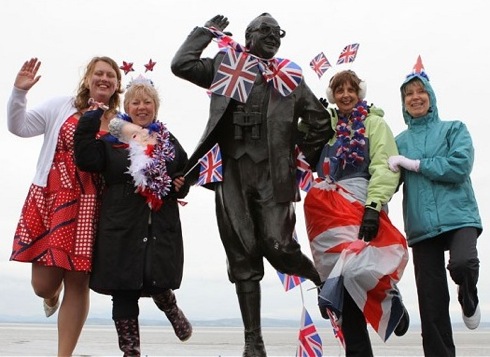
Morecambe, the Lancashire seaside resort: By the Eric Morecambe statue, rain doesn’t stop people celebrating the Diamond Jubilee. (Photo: Rachel Adams)
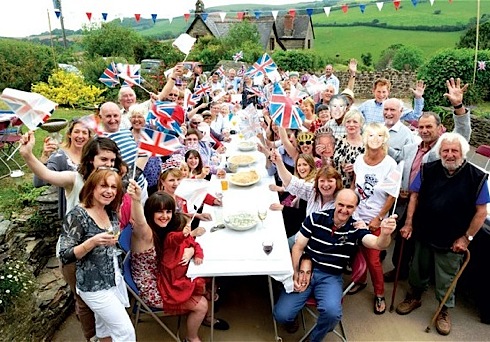
“ Yesterday, more than 10,000 street parties were held across the UK. Special credit must go to the two villages that celebrated the Jubilee together, thus creating the country’s longest street party, stretching from Goring in Oxfordshire across the bridge to Streatley in Berkshire. Yes, the weather turned rotten, but there’s nothing we British like better than an opportunity to display our “mustn’t grumble” hardiness. As John Bishop, the comedian, put it on Twitter: Anyone can enjoy a carnival in the sun. Only the British can enjoy a carnival in the rain ” … / Continued online
On the Thames: the Spirit of Chartwell as royal barge for a day (Photo: Getty)
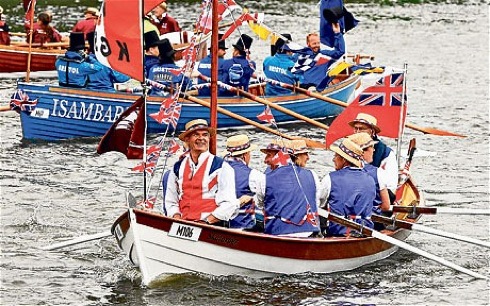
❏ The major event celebratingQueen Elizabeth II’s 60 years on the throne was the seven-mile long flotilla of boats making up the Thames River Pageant through London, where 1.2 million people had gathered to watch. Apart from the heavens opening late in the day to drown a distinguished chorus of floating opera singers, the big wince of the day came early in the BBC’s dumbed-down coverage, when a commentator called the Queen “Her Royal Highness” — a crime for which her predecessor Her Majesty Queen Elizabeth I would have dispatched him to the Tower with the command “Off with his head.”
Much is made of how well the British mount large-scale ceremonials, which always rest heavily on our love of dressing up. This tradition starts and ends with the monarch and centuries of practice, which means that in the modern era the relevance of a monarchy is always subject to review. At such times the nation turns to our oldest daily paper, The Times (est’d 1785) and of all the national newspapers this morning The Thunderer rose best to the occasion. Dedicating a whole page to its editorial, the paper invoked Shakespeare’s “this scepter’d isle” speech to offer an appreciation of our 1,200-year history during which rebel barons forced King John to grant us basic liberties through Magna Carta in the year 1215. Sadly, since the paper began charging for online access, most Brits will not have read this stirring and unsentimental analysis. Here’s an extract…
“ Elizabeth II owes her unarguably special hold on British life not simply to heredity but also to the fact that she, like the little ships, is a living connection to modern Britain’s founding wartime myth. That connection cannot endure indefinitely. The past may be another country. But so is the future.
And then there is London and its river. What message do they send today, especially to the rest of Britain? Much was made, in the build-up and the coverage, to the sense of continuity which Sunday’s pageant was intended to evoke. It was the biggest flotilla since the time of Charles II. But the complacent continuity of unified Britishness is more myth than fact. A monarch in a barge like a burnished throne, sailing down London’s river from Chelsea, home of oligarchs and plutocrats, to the City, home of the unpunished financial sector for whose misdeeds the rest of us are paying, cannot be a value-free act. Contemporary London offends as well as dazzles. So can the monarchy.
London is a pragmatic city in a nation short of certainties. The Thames tells many stories, not always glorious ones. And this also, says the narrator of Heart of Darkness from aboard a Thames yawl, has been one of the dark places of the earth. It’s a pity about the rain, because the event — and the Queen — deserved better. It was a colourful occasion on a grey day. It was full of spirit. But whether the nation which it affected to embody actually exists is another matter ” … / Full text online
In the Thames flotilla: A Shetland yoal manned by Kingston Grammar School veterans upstages a boat full of Brunels (Photo: Anthony Devlin)
“ The Thames Pageant, the centrepiece of the Diamond Jubilee festivities, was the most spectacular such event since the Aqua Triumphalis, the arrival along the Thames in 1662 of Charles II’s bride, Catherine of Braganza, accompanied by a flotilla of 10,000 vessels. Samuel Pepys wrote in his diary about “the most magnificent triumph that ever floated on the Thames, considering the innumerable boates and vessells dress’d and adorn’d with all imaginable pomp”, with “musiq and peals of ordnance from both ye vessels and the shore”.
The pageant was an imaginative masterstroke. It celebrated our maritime past on our most famous waterway, what the historian David Starkey has called the “liquid history” that runs through our national story. But it embraced much, much more. For this was also about the warp and weft of life as it is lived in this country by ordinary people. It was about the clubs, the societies, the associations, the guilds who cherish these wonderful vessels and keep them afloat – and yesterday had the chance to show them off. And didn’t they look magnificent? It is this spirit, writ large, that is such an important part of what we are. At our best we pull together to get things done.
Yesterday also showed how we like a party. For there was nothing po-faced about this marvellous spectacle: it was a truly joyous occasion. If anything, the gloomy weather seems to have made people even more determined to go out and enjoy the show ” … / Continued online
Deepest Somerset: Jubilee party goers get into full swing (Photo: Guy Harrop)
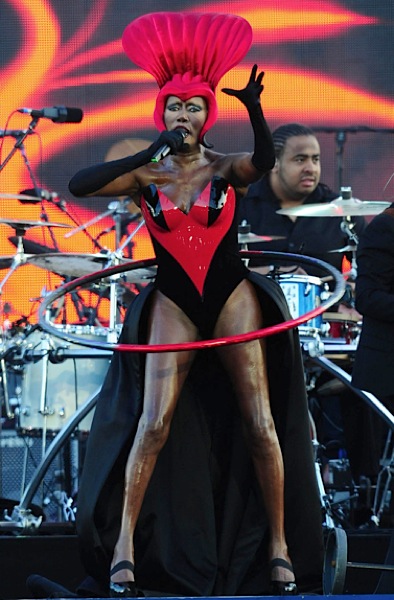
PS: GRACE IN HULA HOOP — DON’T ASK WHY!
Slave to the Rhythm: Grace Jones at the Diamond Jubilee Concert. (Photo: Ian West)
➢ Update: Monday night’s Diamond Jubilee Concert with Buckingham Palace as the backdrop featured schmaltzy music from all six decades of the Queen’s reign and much limp humour which backfired on almost every comedian linking the acts except Peter Kay whose fooling proved him to be the compleat court jester. Musical standouts included opener Robbie Williams, JLS, Sir Tom Jones, Kylie, Madness performing Our House from the palace roof and Sir Paul McCartney’s closing set. Wackiest performance was Grace Jones, glazed from top to toe as if ready for basting and singing Slave to Rhythm while hula hooping. Priceless. She’s 64, you know. The most lavish son et lumière firework display for years capped the lot.
❏ Former BBC Radio 4 controller Mark Damazer told Radio 4’s Today programme: “All that went wrong was the very conscious attempt to make the whole event informal and to use the modern idiom.”
❏ Gillian Reynolds, the Daily Telegraph’s radio critic, responded by saying viewers would have preferred more informative commentary rather than “fun” coverage: “I could not reconcile the marvellous framing of the shots — beautiful photographs — with the words that were coming out. Nobody explained what Dunkirk was. I know what Dunkirk was — I remember it — but nobody explained it. Nobody explained what the Little Boats did was perfectly extraordinary. I felt a bit let down.”
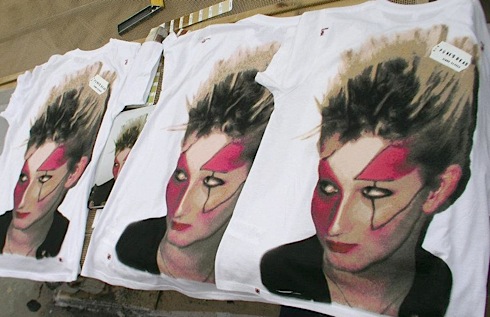
Jordan the queen of punk: pantone matched first samples fresh from the printers on Derek Dunbar’s Facebook page today
❚ HOW MUCH MORE IS THERE TO KNOW ABOUT PUNK? Not much, you might think. Yet today Derek Dunbar — the King’s Road fixer, model, singer, Jarmanite and McLaren acolyte, now styling himself as project manager — announced on Facebook that he is producing some T-shirts emblazoned with Jordan’s image (Jordan the queen of punk, immortalised in Derek Jarman’s movie Jubilee). “These are the first samples we will produce once Six has finished at his exhibition in London so I hope to start in 3 weeks or 4 weeks.”
Exhibition? Six? Who? Those in the know know that Six is aka Simon and Simon was the quiet one in among Susan Dallion (later Siouxsie Sioux), Steve Severin, Debbie Juvenile and Soo Catwoman in those seminal 1976 snaps of the Bromley Contingent — first followers of the Sex Pistols and the Chelsea retail outlets of Malcolm McLaren and Vivienne Westwood. Some of the Contingent became headliners in the punk explosion, Simon playing his part by appearing with the Pistols on the infamous teatime TV show that lost television journalist Bill Grundy his job. More discreetly, as a resident of the St James’s Hotel in Westminster, Simon provided a refuge for punk’s suburban protagonists.
1976: Jordan and Simon Barker aka Six (from Derek Dunbar’s Facebook album)
Under his pseudonym Six, he now reveals: “In 1976, I bought myself one of the cheapest pocket cameras available. Fully automatic, with no controls or settings… Subconsciously I concentrated on the women and artists at the heart of what would later be known as punk in London. The photos you see were spur-of-the-moment shots taken by myself for myself and, up until now, I used to think they weren’t good enough to show people.”
Far from it. A quick google reveals these early snapshots to be “a rare and intimate account of punk’s ability to mint newness” and they evince “the cool stillness of seeming to live beyond the end of history.” Ohhhhh!!! Orgasmic! And you’re asking, Who said THAT?
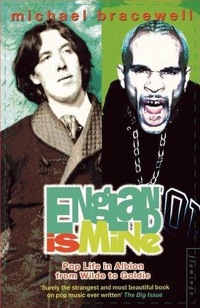
Google, please tell. The verdict comes from Michael Bracewell (author of England is Mine: Pop Life in Albion from Wilde to Goldie, 2009), one of those writers whose cultural observations you know are worth the effort to read, wrapped though they are in ripely purple prose. And in a recent article about Six, he announces what these days is the official line, that “Punk lasted in the UK for little more than 14 months, between 1976 and the Jubilee summer of 1977.” Anything later was accounted an offshoot of punk, or dubbed simply New Wave!!!
You raise an eyebrow, salivating for more. And more is delivered in his Independent piece from last March…
1 To some, punk was primarily political in its energy, carrying class war or a reclamation of the Situationist desire to ‘wreck culture’ to the brutalist Britain of the pre-Thatcher 1970s.
2 To others, it was an avant-garde fashion parade: a damply British reclamation of the Zurich Dada or the Ballets Russes.
3 And to yet others it was the gleeful desecration of rock music’s Church of Authenticity, in which had been worshipped the sanctity of the Blues.
4 Speaking with Malcolm McLaren – arguably punk’s architect – shortly before his death in 2010, the case was put more simply: if punk could lay any claim on historic status, he said, it would best be remembered as ‘like doing the Twist in a ruin’.
Sensational, whichever way you take your pick! But he’s warming to his own conclusion:
5 Punk … appeared to confront the stagnation of cultural consumerism – by describing, in a language of self-parody, the notion of modernity itself reaching critical mass and unsurprisingly imploding. Hence, perhaps, the slogan above the door of the SEX boutique at 430 King’s Road in Chelsea: ‘Modernity Killed Every Night’.
Divine! We can go to our graves sure about the meaning of punk, once and for all. Or rather, five times and for all.
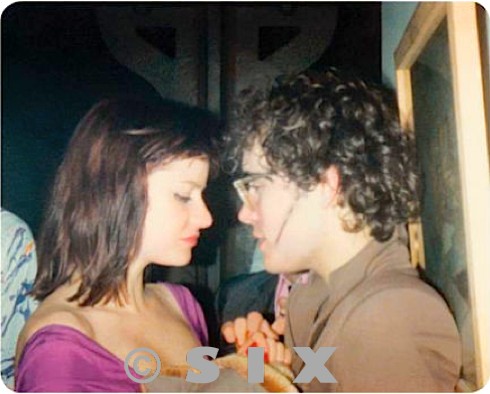
1977: Little Nell with Adam Ant at a Butler’s Wharf party. Photographed by Six
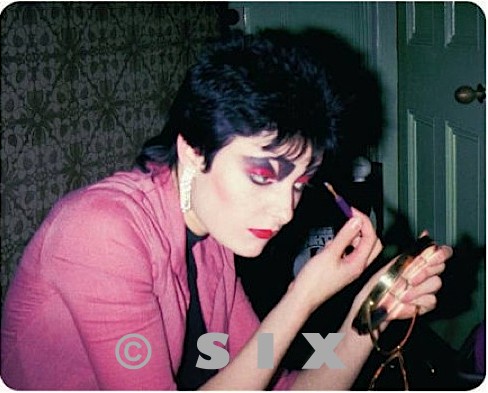
1977: Siouxsie Sioux at the St James hotel. Photographed by Six
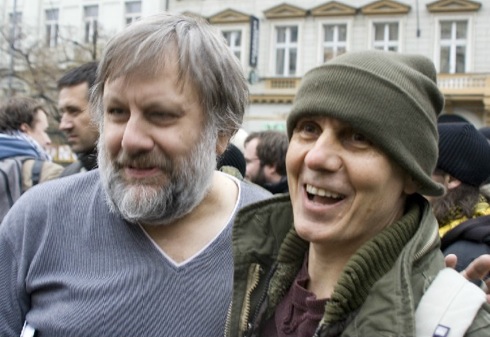
Six in Prague: Barker demonstrating with Slovenian philosopher Slavoj Žižek who has become the zeitgeist interpreter of social phenomena in the 20-tweens
The Year Of Punk 19/12/77
“You don’t have to be a fantastic musician”: Six explains the magic at 7:15 in Janet Street-Porter’s LWT documentary, The Year of Punk, 1977 … Click pic to view video at YouTube
➢ Choose “View full site” – then in the blue bar atop your mobile page, click the three horizontal lines linking to many blue themed pages with background article
MORE INTERESTING THAN MOST PEOPLE’S FANTASIES — THE SWINGING EIGHTIES 1978-1984
They didn’t call themselves New Romantics, or the Blitz Kids – but other people did.
“I’d find people at the Blitz who were possible only in my imagination. But they were real” — Stephen Jones, hatmaker, 1983. (Illustration courtesy Iain R Webb, 1983)
“The truth about those Blitz club people was more interesting than most people’s fantasies” — Steve Dagger, pop group manager, 1983
PRAISE INDEED!
“See David Johnson’s fabulously detailed website Shapers of the 80s to which I am hugely indebted” – Political historian Dominic Sandbrook, in his book Who Dares Wins, 2019
“The (velvet) goldmine that is Shapers of the 80s” – Verdict of Chris O’Leary, respected author and blogger who analyses Bowie song by song at Pushing Ahead of the Dame
“The rather brilliant Shapers of the 80s website” – Dylan Jones in his Sweet Dreams paperback, 2021
A UNIQUE HISTORY
➢ WELCOME to the Swinging 80s ➢ THE BLOG POSTS on this front page report topical updates ➢ ROLL OVER THE MENU at page top to go deeper into the past ➢ FOR NEWS & MONTH BY MONTH SEARCH scroll down this sidebar
❏ Header artwork by Kat Starchild shows Blitz Kids Darla Jane Gilroy, Elise Brazier, Judi Frankland and Steve Strange, with David Bowie at centre in his 1980 video for Ashes to Ashes
VINCENT ON AIR 2026
✱ Deejay legend Robbie Vincent has returned to JazzFM on Sundays 1-3pm… Catch up on Robbie’s JazzFM August Bank Holiday 2020 session thanks to AhhhhhSoul with four hours of “nothing but essential rhythms of soul, jazz and funk”.
TOLD FOR THE FIRST TIME
◆ Who was who in Spandau’s break-out year of 1980? The Invisible Hand of Shapersofthe80s draws a selective timeline for The unprecedented rise and rise of Spandau Ballet –– Turn to our inside page
SEARCH our 925 posts or ZOOM DOWN TO THE ARCHIVE INDEX
UNTOLD BLITZ STORIES
✱ If you thought there was no more to know about the birth of Blitz culture in 1980 then get your hands on a sensational book by an obsessive music fan called David Barrat. It is gripping, original and epic – a spooky tale of coincidence and parallel lives as mind-tingling as a Sherlock Holmes yarn. Titled both New Romantics Who Never Were and The Untold Story of Spandau Ballet! Sample this initial taster here at Shapers of the 80s
CHEWING THE FAT
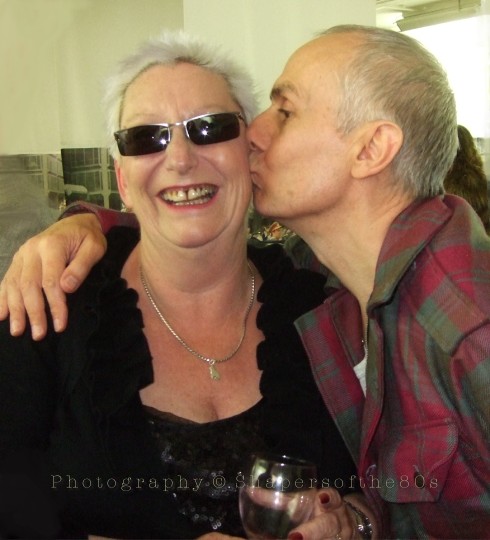
✱ Jawing at Soho Radio on the 80s clubland revolution (from 32 mins) and on art (@55 mins) is probably the most influential shaper of the 80s, former Wag-club director Chris Sullivan (pictured) with editor of this website David Johnson
LANDMARK FAREWELLS. . . HIT THE INDEX TAB UP TOP FOR EVERYTHING ELSE













 ➢➢ Shapers of the 80s ➣➣