Category Archives: North America

➤ Anna declares McQueen a pioneer of dreams and drama

St Paul’s Cathedral, McQueen, ceremony, Anna Wintour,Hilary Alexander

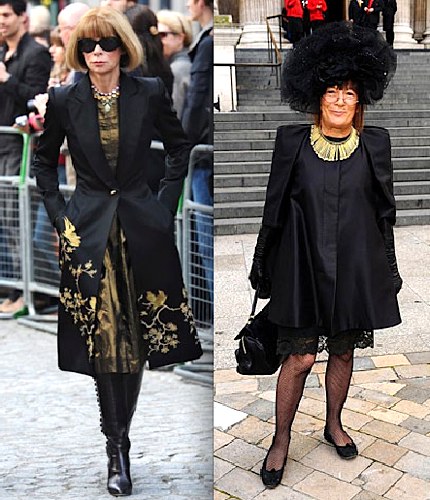
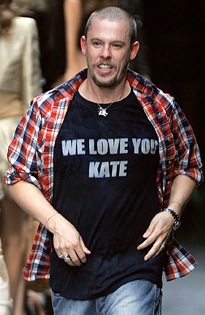
A hint of gold from the doyennes attending St Paul’s Cathedral for the McQueen ceremony: Anna Wintour, Vogue editor, and Hilary Alexander, Daily Telegraph fashion director. Photographs © Glenn Copus/PA/Getty

WITH LONDON FASHION WEEK IN FULL SWING, hundreds of leading fashionistas gathered in St Paul’s Cathedral today for a ceremony in memory of Alexander McQueen. A taxi driver’s son who grew up in London’s East End, he became Britain’s most confrontational, unfettered and theatrical designer. He died in February aged 40, having been appointed a CBE and named British Designer of the Year four times by the British Fashion Council.
St Paul’s Cathedral, Alexander McQueen, London Fashion Week, ceremony,  tributes,

Alexander McQueen: enfant terrible of the runway

The world’s most powerful arbiter of fashion, Vogue editor Anna Wintour, led today’s tributes. Models Kate Moss and Naomi Campbell, actress Sarah Jessica Parker, muse Daphne Guinness and designer Stella McCartney were among the congregation, which also included relatives and former colleagues of McQueen.

Anna Wintour is the English-born daughter of Charles — editor of the Evening Standard during the Swinging 60s when his London paper achieved international acclaim. After removing her sunglasses, something she rarely does in public, Anna paid a moving tribute to McQueen: “He was a complex and gifted young man who, as a child, liked nothing more than watching the birds from the roof of his east London tower block.
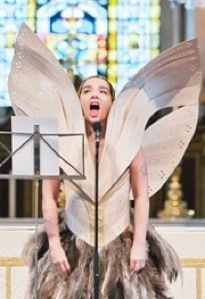
Bjork, Alexander McQueen, memorial,

Bjork performing Gloomy Sunday

“He had an 18-year-long career of pioneering his dreams and dramas. He cared what people thought of his clothes but not of him. He never appeared at ease with himself and hated to travel away from his beloved London.”

Björk sang the haunting hymn Gloomy Sunday, which reflects on the horrors of modern culture, and there were also addresses from jeweller Shaun Leane, model Annabelle Neilson, McQueen’s nephew Gary Hulyer and milliner Philip Treacy. Composer and pianist Michael Nyman and the London Community Gospel Choir gave musical performances.

➢ Fuller Evening Standard report of the McQueen service, plus gallery

➢ Backstage with Hilary — Cheek and effervescence spice the Telegraph doyenne’s videos and reports of the autumn shows in New York, London and Milan

➢ “My father really decided for me that I should work in fashion” — Anna Wintour in The September Issue. Out this week on DVD, the most gripping movie ever about editorial decisionmaking, OK, on the world’s most powerful fashion magazine, but for that very reason, junking $50k’s worth of photography is a measure of that power. [“Knocks All the President’s Men into a cocked hat” — Shapersofthe80s]

FRONT PAGE

2010 ➤ Egghead versus bimbo: Paglia demolishes Gaga

Lady Gaga,sexual revolution,demolition job

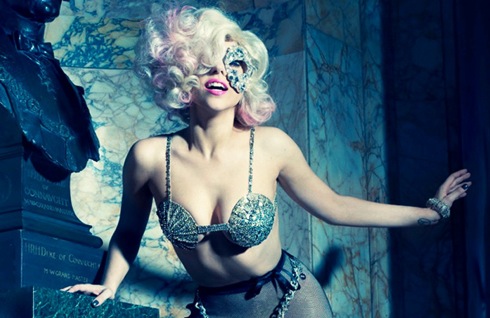
Lady Gaga in performance: does she mark the end of the sexual revolution?

Camille Paglia,Hurricane Camille,Lady Gaga,death of sex

Paglia the hurricane

❚ CAMILLE PAGLIA describes herself as a “dissident feminist”. Others have dubbed her “Hurricane Camille”. With a PhD from Yale, she is one of America’s brightest women, variously expressing iconoclastic opinions as a social philosopher, cultural critic, author and educator who believes that most women are bisexual. Her powers of reasoning mean that she is not easily dismissed. So when in today’s Sunday Times Magazine she detonates a dynamite demolition job on the popstar Lady Gaga, we should perhaps take notice. She argues that Gaga is “sexually dysfunctional”, and marks the end of the sexual revolution. Then she savages Gaga’s “little monster” fans. Here are Paglia’s juiciest soundbites:

❏ “Despite showing acres of pallid flesh in the fetish-bondage garb of urban prostitution, Gaga isn’t sexy at all — she’s like a gangly marionette or plasticised android.”

❏ “How could a figure so calculated and artificial, so clinical and strangely antiseptic, so stripped of genuine eroticism have become the icon of her generation? Can it be that Gaga represents the exhausted end of the sexual revolution?”

❏ “For Gaga, sex is mainly decor and surface; she’s like a laminated piece of ersatz rococo furniture. Alarmingly, Generation Gaga can’t tell the difference. Is it the death of sex?”

❏ “Drag queens, whom Gaga professes to admire, are usually far sexier in many of her over-the-top outfits than she is.”

Stefani Germanotta,Lady Gaga,MTV

Stefani Joanne Angelina Germanotta: as brunette herself on MTV's Boiling Points in 2005, and as Lady Gaga last year, blonde but without make-up

❏ “Marlene and Madonna gave the impression, true or false, of being pansexual. Gaga, for all her writhing and posturing, is asexual.”

❏ “Most of her worshippers seem to have had little or no contact with such powerful performers as Tina Turner or Janis Joplin, with their huge personalities and deep wells of passion.”

❏ “Generation Gaga doesn’t identify with powerful vocal styles because their own voices have atrophied: they communicate mutely via a constant stream of atomised, telegraphic text messages. Gaga’s fans are marooned in a global technocracy of fancy gadgets but emotional poverty.”

➢ To read the rest of Paglia’s appraisal of Gaga visit The Sunday Times Magazine

‘Now, come on, people, do you really believe that Lady Gaga is 23 years old?’

➢ In her Salon column last November 10, Camille Paglia threw out this invective:

❏ “Do you really believe that Lady Gaga is 23 years old? I’ve been in advanced doubt about it for a while, particularly after seeing this ‘Rare pictures!’ video of early photos of her hanging with some mighty tough critters. (A friend of mine said of Gaga in this vid: ‘Too many miles of bad road there.’) I think Gaga was a hell of a lot sexier as a fun Italian-American brunette. This artificial, masklike, over-the-top Club Kids thing that she’s now into seems compulsive and wearily passé. Give it a rest, and focus on the music!”

➢ Tuesday top-up from the throne-room at Popjustice:

Camille Paglia wrote a big thing about Lady Gaga for the Sunday Times. Some of her points were good but a lot of it felt like she was writing the article for the benefit of one reader — Madonna — and most of the good bits were buried by an avalanche of General Missingthepointness. We particularly love an outraged Paglia railing against Lady Gaga for “rudely” wearing sunglasses in interviews, and the idea that Lady Gaga has gone on tour to escape scrutiny (?!). Give it a rest Paggo.

FRONT PAGE

1966 ➤ When John Lennon became US public enemy number one

Beatles, burnings, Alabama,more popular than Jesus

Birmingham, Alabama in 1966: a warm welcome awaits The Beatles

Beatles, tour, USA 1966, burnings, Shea Stadium,more popular than Jesus

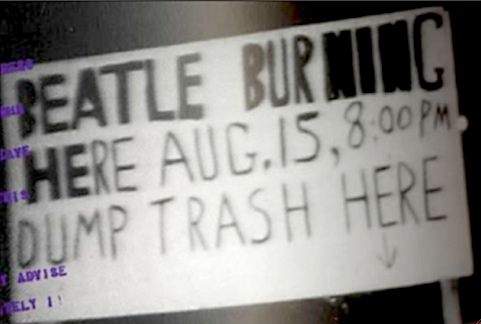
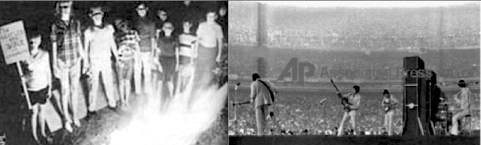
From the extreme right to another: God-fearing fans burn Beatles records in the Bible Belt in 1966 . . . while 45,000 more pack Shea Stadium in New York City. (Picture by AP)

❚ FAME FASCINATES NOW NO LESS THAN IT DID THEN. Interest in John Lennon intensifies this year because it brings the 70th anniversary of his birth and the 30th of his murder in New York. There, a prestigious 70th birthday celebration is being held at Radio City Music Hall on September 25 starring The Fab Faux, a premier-league tribute band. Soon after, Liverpool goes into overdrive for two whole months of Lennon worship.

Lennon Naked, BBC, drama, Naoko Mori

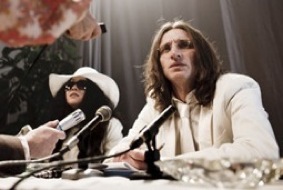
Lennon Naked, an unflattering new drama-doc: Christopher Eccleston stars as John Lennon with Naoko Mori as Yoko Ono. © BBC

Tonight and tomorrow BBC4 steals a march with Lennon Naked, a robust drama-documentary charting the musician’s activities from 1967 to 1971, a turbulent period which included the dissolution of The Beatles as the most popular group in pop history, huge enough to have pioneered the stadium concert. The sudden death in 1967 of gifted Beatles manager Brian Epstein was devastating for each of the Fab Four – Lennon most of all. He leaned ever more heavily on the bewitching catalyst for change in his own fortunes, the artist Yoko Ono, whom he had met the previous November in London.

With Beatlemania at its height, and the Fabs the coolest ambassadors for Swinging London, 1966 had precipitated its own trauma. Not only was Lennon taking his first steps exploring the not-yet fashionable halucinatory drug LSD, but in July a bombshell exploded in his lap, as The Beatles’ world tour was about to descend on 14 cities in North America.

An interview was published in an American teen magazine in which he boldly asserted of The Beatles’ fame: “We’re more popular than Jesus now.” Across the American Bible-belt and beyond, God-fearing Christians were outraged. Anti-Beatle demonstrations and public burnings of their records ensued, the Ku Klux Klan – a right-wing hate group – vowed vengeance and death threats were reported. Such was the pressure on the whole entourage that when a fan threw a lit firecracker onstage in Memphis and it went off, the Beatles’ press agent Tony Barrow recalls: “All of us at the side of the stage, including three Beatles on stage, all looked immediately at John Lennon. We would not at that moment have been surprised to see that guy go down.”

Though repeated apologies were issued at press conferences across the States, after the San Francisco concert on August 29, 1966, the whole furore persuaded the band to stop touring ever again.

The now notorious “Jesus” quote had arisen in conversation with the British journalist Maureen Cleave, a clear-sighted interviewer on the London Evening Standard where it had been first published without raising an eyebrow in the increasingly secular UK. Today, Shapersofthe80s republishes her riveting account of her tour of Lennon’s Weybridge home, which set out to explore the then novel phenomenon of four popstars who were so famous they couldn’t set foot in public without being mobbed. Thanks to the trust the Fab Four placed in her, Cleave sought to put Beatlemania under the microscope by interviewing John, George, Paul and Ringo separately and successively, under the series title How Does a Beatle Live? Lennon, for one, would ask when you rang, “What day is it?” – with genuine interest.

➢➢ Click to read the original article on Lennon,
How Does a Beatle Live?

Maureen Cleave, The Beatles, Evening Standard,more popular than Jesus

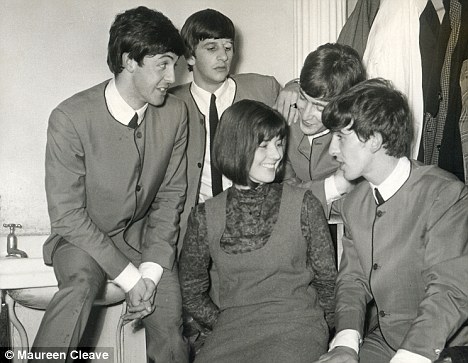
Maureen Cleave recalls: “Ringo used to say the only place he felt safe was in the lavatory; so the Standard once took a photograph of them all there, with Paul sitting on the washbasin.” She never mentions that she was sitting in the middle.

➢➢ Beatles pics from 1966 – Daily Mirror slideshows

FRONT PAGE

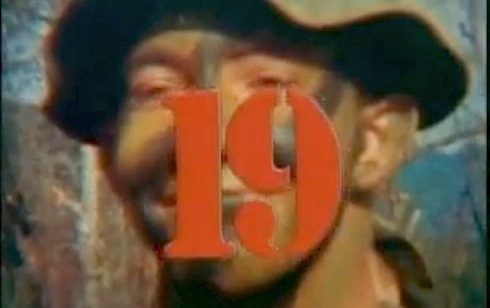
1985 ➤ Nnnnn-na-na-na, nnnnn-na-na, Nineteen

Paul Hardcastle, Nineteen,pop video

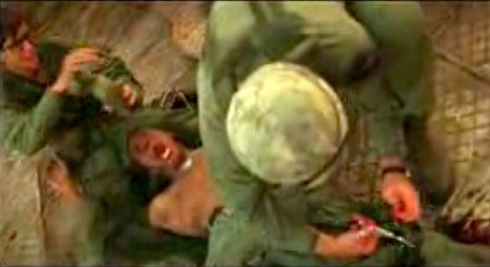
Vietnam conscripts: their average age was 19

◼ IN 1985 THE LONDON MUSICIAN Paul Hardcastle stunned Europe with his hynotic anti-war hit, 19, which spent weeks at No 1 in the charts. It was effectively a rap sampled from the voiceover to the Emmy-nominated documentary Vietnam Requiem, which made the shock claim that “In World War Two the average age of the combat soldier was 26. In Vietnam he was 19.” This year, Hardcastle was watching a documentary about British soldiers serving in Afghanistan when he heard an officer say: “I looked at my men. The average age was 19 — my God, I’m taking boys to war.” For the 25th anniversary of his hit Hardcastle updated and wrote a new version of 19 called Boys To War which was released yesterday in the UK.

Sadly, the infinitely more visceral original from 1985 knocks spots off the languid new version, while this stark Tribute To Vietnam Vets achieves its own stomach-churning effect.

Paul Hardcastle, Nineteen, Vietnam war, video

The grim truth: field surgery for a teenage Vietnam combatant

FRONT PAGE

2010 ➤ Comeback Shard comfy as ‘Auntie Sade’

Sade  1983

Wow! Then and now: Sade backstage in August 1983 while still seeking a recording contract and, right, as shot to launch her 2010 album. Vintage picture © by Shapersofthe80s

SADE IS TALKING FRANKLY AND REFLECTIVELY. It’s a rare treat from a singer who rarely ever breaks cover. Ten years on from her last album, Lovers Rock, she is said to be the most successful solo female artist Britain has ever produced – more than 50m albums sold over 26 years, valued at £30m in The Sunday Times Rich List. She is the first to acknowledge that Sade is a band, and together they have won a Brit Award for Best British Album of 1984 (view award speech) plus nine other Brit nominations, three Grammies (for 1985, 1993, 2001, plus two other nominations) and Sade herself was appointed an OBE, an order of chivalry, by the Queen (2002).

Sade Adu,New York, Axiom, fashion, Blitz Kids, Ian Watts,Princess Diana

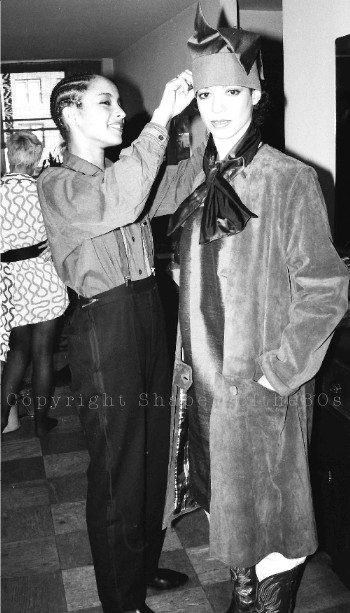
New York 1981, preparing for the Axiom show that accompanied Spandau Ballet on the first Blitz Kids invasion: In braided short hair and hallmark narrow pants, Sade fits a model with her outfit on the Demob label. Sade once told Shapers that Princess Diana’s question to her after a Prince’s Trust concert was: “Do you always dress like a man?” Photographed © by Shapersofthe80s

In yesterday’s Sunday Times Magazine, according to the writer Robert Sandall whom Sade knows of old, the Blitz clubbing veteran was giving the only face-to-face interview to coincide with this month’s release of her new album, titled Soldier of Love.

Sandall delivers full value as Sade really does let her guard down, surprisingly further than most of us who used to know her might have expected, especially about her “complicated” inter-racial family background. (She was born Helen Folasade Adu in Nigeria, raised in the UK at Clacton-on-Sea, and took a fashion BA at St Martin’s School of Art). She also talks about motherhood with a 13-year-old daughter and her several romances – “I’ve paid some rugged dues,” she observes. Highlights among many soundbites…

❏ On being a black singer in a white soul outfit: “I didn’t have any confidence as a singer, but I found that I liked writing songs.”

❏ The same band of clubbing wags from 1983 is reunited for the album – Paul Denman, Andrew Hale and Stuart Matthewman. They remain one tight unit on the new album, we’re told, under the control of a matriarch who likes the nickname “Auntie Sade”. [Note for newbies: say it Shah-day /ʃɑːˈdeɪ/. Only friends are allowed to use the nickname Shard.]

❏ On her new man, Ian Watts, who has been in turn Royal Marine, fireman and scientist: “I always said that if I could just find a guy who could chop wood and had a nice smile it didn’t bother me if he was an aristocrat or a thug as long as he was a good guy. I’ve ended up with an educated thug!”

❏ The old charge that Sade was the backdrop of the yuppie era still rankles: “With my family history, that really irks me. And it so annoyed me at the time, when we were secretly giving money we didn’t even have yet to Arthur Scargill and the striking miners.”

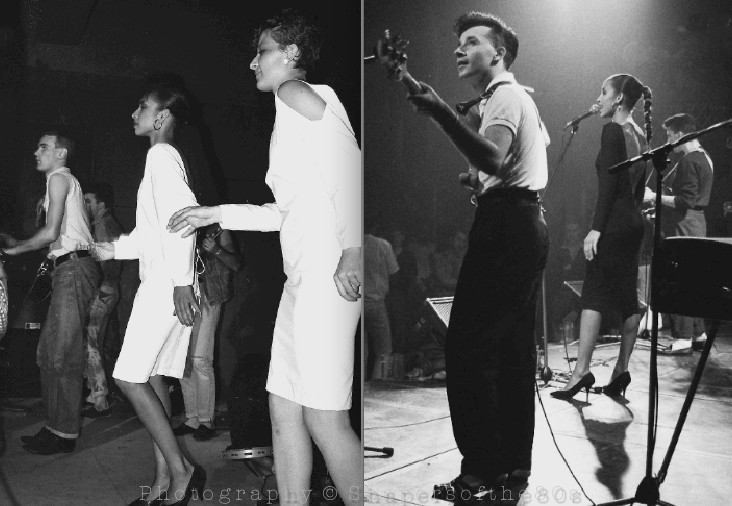
One year’s progress: left, Sade with Latin soul band Pride at the Fridge, Sep 1982; and with the smaller band Sade in Aug 1983 at the Yow club, London, Paul Denman to the fore. Ten months after splitting they had a record deal. Photographed © by Shapersofthe80s

Sade

Sade 2010: Talks us through her new album in a video documentary

➢➢ For links to new video documentary and tracks see Sade box in sidebar, right

➢➢ A Reluctant Return: In this month’s New York Times interview, Sade worries about being “too candid” with the press, yet reveals she is considering marriage

➢➢ Kanye collaboration rumours in this National Post interview, Feb 16, 2010

➢➢ Compare and contrast quotes with this version at ThisIsGloucestershire!

➢➢ Click for pix of Sade’s Demob designs during 1981’s first Blitz invasion of the US

➢➢ More pix of Sade helping backstage during Steve Strange’s 1982 fashion show in Paris

FRONT PAGE