Category Archives: London

➤ Shapersofthe80s is declared an “invaluable website” by British historian

“winter of discontent” ,  Leicester Square, strikes,

Britain’s infamous “winter of discontent” that brought down the Labour government in 1979: as public service workers went on strike, rubbish piled-up even in London’s Leicester Square

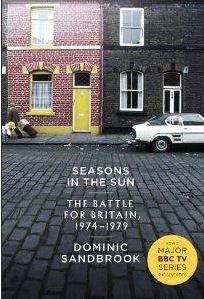
Seasons in the Sun,Battle for Britain, Dominic Sandbrook, books, history, Allen Lane,❚ AN “INVALUABLE WEBSITE” — this is the verdict on Shapersofthe80s by historian Dominic Sandbrook, author of the rich new cultural analysis, Seasons in the Sun: The Battle for Britain, 1974–1979. It’s a doorstep of a book, yet highly readable, which reveals numerous upbeat aspects to the chaotic decade many write off as worthless.

Chapter 31 is especially inspirational! Sandbrook gives generous credit to key characters who Shapersofthe80s has long maintained deserve recognition as movers and shapers pivotal to the energy of the 80s. And, having quoted chunks from our own texts, the historian gives due acknowledgement in his extensive bibliography. Indeed, the scope of his research is more impressive than for much other contemporary history, as Sandbrook not only cites political and economic mandarins, but also sifts fine detail from popular culture and eye-witness reportage across the whole social spectrum.

Sandbrook writes: “Behind the lurid news stories, the late 1970s were the decisive point in our recent history. Across the country, a profound argument about the future of the nation was being played out, not just in families and schools but in everything from episodes of Doctor Who to singles by the Clash. These years marked the peak of trade union power and the apogee of an old working-class Britain – but they also saw the birth of home computers, the rise of the ready meal and the triumph of a Grantham grocer’s daughter who would change our history for ever”

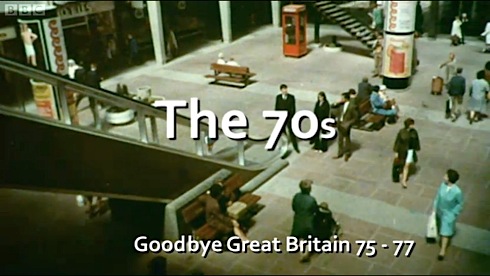
Seasons in the Sun is the fourth title in Sandbrook’s survey of postwar Britain. His unstuffy combination of high and low life is behind the BBC2 series The Seventies currently viewable live and on iPlayer.

BBC2 series The Seventies,Seasons in the Sun ,Dominic Sandbrook

Sandbrook’s Seasons in the Sun forms the basis of the current BBC2 TV series The Seventies

REVIEWS OF SEASONS IN THE SUN

❏ “The first three volumes of Dominic Sandbrook’s epic history of Britain between 1956 and 1979 were exceptionally good. The fourth, Seasons in the Sun, is magnificent … marked by its pace, style, wit, narrative and characterisation as by its exhaustive research.” — Roger Hutchinson, Scotsman

❏ “Sandbrook has created a specific style of narrative history, blending high politics, social change and popular culture … his books are always readable and assured, and Seasons in the Sun is no exception … Anyone who genuinely believes we have never been so badly governed should read this splendid book.” — Stephen Robinson, Sunday Times

1977, Jayaben Desai, Grunwick, strike, picket

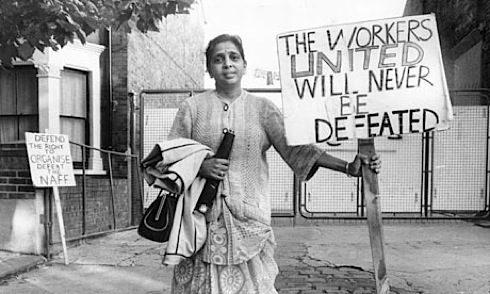
August 1977: Jayaben Desai, treasurer of the strike committee at the Grunwick photo-processing plant, had been picketing for a year, supported by white, male trade unionists while postmen blocked the company’s mail. (Photograph by Graham Wood/Getty)

EVEN WIDER PERSPECTIVE FROM LEADING PLAYWRIGHT

➢ Playwright David Edgar draws together the Sandbrook quartet in The Guardian, May 9, 2012: The 1970s was the moment when our century arrived… As Sandbrook insists, the women’s liberation movement was as much about Hull’s fishermen’s wives and female machinists at Ford Dagenham as feminist activists disrupting Miss World. In 1971, workers campaigning against the closure of Upper Clyde Shipbuilders borrowed the student tactic of the sit-in. As 1970s chronicler Andy Beckett argues, the gay groups who stood shoulder to shoulder with trade unionists outside Grunwick prefigured an alliance which “would become commonplace in the decade to come”. The identity politics that were to become such a satirised feature of the left of the 1970s arose not just out of campus and culture but class war… / continued at Guardian online

FRONT PAGE

2012 ➤ How guitar wizard Bert taught two million young Brits to “play in a day”

Bert Weedon, “Mr Guitar” ,Play in a Day ,tutor,Eric Clapton,

ERIC CLAPTON, the only three-time inductee to the Rock and Roll Hall of Fame, once said: “I wouldn’t have felt the urge to press on without the tips and encouragement that Bert’s book gives you. I’ve never met a player of any consequence that doesn’t say the same thing”

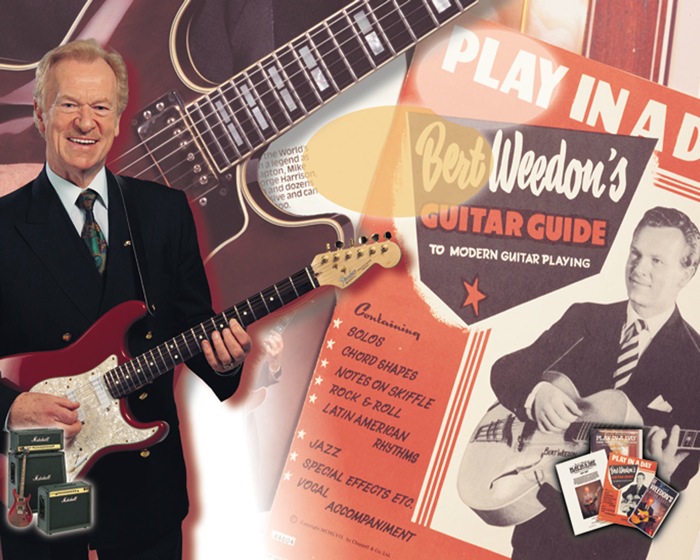
➢ On his death, The Guardian pays tribute to Bert “Mr Guitar” Weedon, author of the novice guitar players’ bible which has sold over two million copies since it was published in 1957 …

The manual Play in a Day was the bible for generations of budding guitarists in the 1950s and 1960s. Its author was Bert Weedon, an unassuming dance-band musician whose unpatronising approach made him Britain’s earliest expert on the instrumental niceties of rock’n’roll. Weedon, who has died aged 91, was among the first British musicians to incorporate into his style the innovations of American country and western, boogie and rock’n’roll guitarists.

Hank Marvin, Paul McCartney, George Harrison, Brian May and Eric Clapton were among those whose introduction to the guitar was strumming through the exercises in Weedon’s tutor books. McCartney’s testimony was typical: “George and I went through the Bert Weedon books and learned D and A together … / continued online

❏ Herbert Maurice William Weedon, guitarist, born 10 May 1920; died 20 April 2012

➢ Play in a Day is still in print — details at Bert Weedon’s own website where he offers plenty of tips and hints

FRONT PAGE

2012 ➤ East London hipsters: leave your mark on Dazed’s instant history map

Jamie Hawkesworth,Dazed & Confused ,Secret History, East London

Photographed by Jamie Hawkesworth, clockwise from top left: Elijah Butterz, Nasir Mazhar, Tracey Moberly, Kathryn Ferguson, Yang Du, Martine Rose, Missy the dog, James Edson, Charlotte Jansen

➢ Kicking off its Secret History of East London project, the May issue of Dazed & Confused “asks a host of creatives, pioneers and dreamers whether rising rents, silicon roundabouts and a surfeit of artisinal [sic] coffee means that it’s all over for the creative inhabitants of east London”.

The young photographer Jamie Hawkesworth was asked to capture parts of the creative community — portraits of the artists, designers, musicians, publishers etc working from the area — and for his own memories of east London: “I’m always inspired by people that have a really strong character, a real sense of being and an expressive personality that comes across in the slightest of touches.” See above for the result.

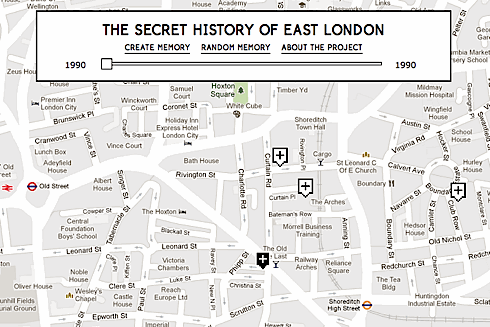
Dazed Digital invites you to map your memories on its interactive timeline

Secret History ,East London ,dazeddigital,Cantaloupe

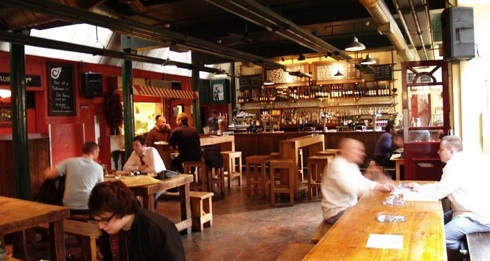
At Dazed Digital: a few hundred yards adrift, a black cross marks the fabled Cantaloupe where boys and girls learned the cruel facts of life about Shoreditch in the 90s


➢ Being taught the rules of London in the Canteloupe [sic] — See black cross added today by Duncan to Dazed Digital’s map. He says: “When I first moved to London in 1998 from Manchester, in fact my second day I think it was, I was in the back of the Canteloupe on Charlotte Road in Shoreditch and got talking to a guy from Manchester who told me the ‘rule of London’ being that you have to be brutal and move through social groups until you find YOUR people … taking the ones from a group you like the most and then surfing through people because London runs deep. It was a ‘big city’ chat. I didn’t really follow the advice, but I remember the advice like it was yesterday… Today (17th April) I walked past the Canteloupe and it has just closed, being refitted…”

Secret History ,East London ,dazeddigital,Cantaloupe,restaurants

Since November 1995 scruffy old Cantaloupe has been the benchmark of cool among the artisan streets of the Wild East: “as essential to Shoreditch as misunderstood haircuts, bubbling new musical hybrids and devil-may-care debauchery”

FRONT PAGE

1912–2012 ➤ My pal Tucker’s Titanic moment and the truth about the “Unsinkable” Molly Brown

A Night To Remember ,Tucker McGuire ,movies,Unsinkable Molly Brown,centenary, Titanic,Mrs James Joseph Brown,

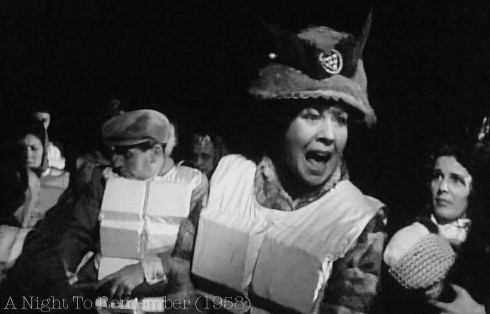
“Come on girls!” — Tucker McGuire as the Unsinkable Molly Brown in A Night To Remember, 1958. (ITV Studios Home Entertainment DVD)

❚ TUCKER McGUIRE WAS SOMEBODY I’D KNOWN for years before we actually met in London in 1982. She was an American-born actress who’d made her home in England in the 1930s and she played 34 screen roles, according to IMDb, and hundreds more on radio. But the one I knew her from — along with thousands of other British cinema-goers — was her feisty performance in what endures today as the most thrilling version of the Titanic disaster, A Night To Remember, directed as an authentic docu-drama by Roy Ward Baker at Pinewood Studios not far from London in 1958.

As well as the stars Kenneth More and Honor Blackman, this J Arthur Rank mini-epic featured a galaxy of British character actors playing cameo roles from boiler-room to bridge. Tucker was cast as the American millionairess Mrs Margaret “Molly” Brown. And she delivers the scene-stealing line everybody remembers, moments after the mightiest ocean liner of its day slipped beneath the calm mirror-like North Atlantic 100 years ago today.

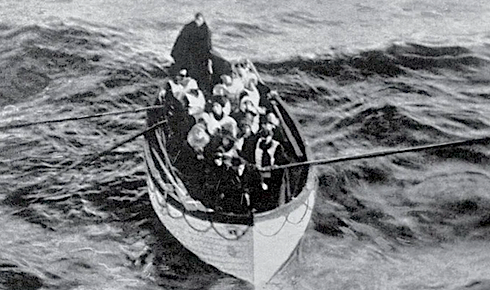
Though Lifeboat No 6 had capacity for 65 people, it held only 19 women and four men who now stared in horror and awe as the broken Titanic ultimately stood up on end, paused and then vanished in one vertical plunge. Unexpectedly, say eye-witness survivors, the clear night air was suddenly torn with an appalling crescendo of wailing from the hundreds of fellow-passengers struggling for their lives and drowning in the bitter freezing water.

A Night To Remember, DVD, Blu-Ray, Titanic,Roy Ward Baker,Pinewood Studios

A Night To Remember, 1958: the most accurate telling of the Titanic tragedy in its day thrilled audiences long before CGI effects were invented. This mighty mock-up of the doomed liner was built in a field at Pinewood and water scenes shot at Ruislip Lido. (2012 DVD cover from ITV Studios Home Entertainment)

In Rank’s movie, 44-year-old Mrs Brown grabs her oar and insists they turn their lifeboat round and return to save the desperate swimmers: “Come on girls! Row!” She is straight-away rebuked by quartermaster Robert Hichens, the 29-year-old crewman at the helm (who had been at the wheel of the Titanic itself at the liner’s moment of impact with the iceberg). He yells that turning back risked swamping the boat with too many people, whereupon the millionaire women’s rights activist becomes immortalised for ever as the heroic and “Unsinkable” Molly Brown. She tells him: “You get fresh with me son, and I’ll throw you overboard.”

It took 40 minutes after the Titanic sank for the wails of 1,514 doomed souls to be silenced. Hichens gloomily allowed the women to row around for a while, then his boat joined up with Lifeboat No 16 to await rescue in the silent night. With the dawn, a total of 710 survivors were taken aboard by the RMS Carpathia.

Titanic, Lifeboat No 6, Frederick Fleet , Carpathia, Robert Hichens, Unsinkable Molly Brown

Titanic’s Lifeboat No 6 approaches RMS Carpathia to be rescued in 1912: Quartermaster Hichens can be seen at the rear manning the tiller and Frederick Fleet, the look-out who first saw the iceberg, is seen at the bow preparing to catch a tow-line. Is it too fanciful to imagine the large hat at centre belonging to the “Unsinkable” Molly Brown? (Photograph by Louis Mansfield Ogden © Royal Museums Greenwich)

❏ Tucker McGuire is among 13 actresses, including Debbie Reynolds, to have portrayed the “Unsinkable” Molly Brown, and like so many thespians, proved to be a hugely entertaining character when we met 30 years ago. She had been widowed three years earlier so wanted to widen her social circle by joining an evening class I used to give in creative writing in central London. She didn’t let on about her most famous role for a long while, but when she did I knew exactly who she was, along with the rest of the nation’s vintage movie fans who had seen A Night To Remember on TV seemingly every other Sunday afternoon since 1958.

Though at 69 she was old enough to be granny to most of us, Tucker was vivacious company and after the class often invited the regulars for drinks at her basement flat where she’d show us snapshots from her career and her yearbook for the class of 1930 at Handley High School in Winchester, Virginia. As part of the written coursework she submitted an affecting review of Katherine Mansfield’s Taking the Veil, “an unhappy daydream with a happy ending — a perfect love story. It has drama and comedy and leaves one glad to have read it”. In March 1982 our group went to the Lyric Theatre in Hammersmith to see Patricia Routledge and Paul Eddington starring in the newest comedy by Michael Frayn. It proved achingly hilarious and Tucker’s verdict was, in true billboard tradition, that “this one will run and run”. How prescient: a brilliant revival of Noises Off is playing to packed houses at the Old Vic right now.

Tucker died in 1988. Despite her extrovert demeanour, she’d never talked about her family or why she had left America so young. Last month’s DVD rereleases of A Night to Remember gave new life to Tucker’s line “Come on girls!” and prompted a sentimental search session with Google which revealed a daughter Janie Booth, who is also an actress here in Britain. Anne Tucker McGuire was born in Winchester, Virginia, where her father was President of the American Medical Association. Tucker’s first mentions in England include playing in Three Men on a Horse at the Wyndham’s Theatre, London, and making the Albert de Courville film Strangers on Honeymoon, both in 1936.

Tom Macaulay,Dark Stranger, Tucker McGuire,

Tucker’s husband, Tom Macaulay, in Dark Stranger, 1946

Her old Harrovian husband called himself Tom Macaulay as an actor but his fuller name Thomas Macaulay Booth resonates with British history. The Macaulays included Zachary, the 18th-century slavery abolitionist, and Thomas Babington, the celebrated historian and Whig politician.

The Booth family was no less distinguished: Charles Booth was a 19th-century shipowner and social researcher whose study of working-class life in London led to the founding of old-age pensions. His greatest innovation, documented in Life and Labour of the People in London, included the socially coded Maps Descriptive of London Poverty 1898-99, and revealed that 35% were living in abject poverty. He was elected president of the Royal Statistical Society (1892–4).

A Night To Remember ,Tucker McGuire ,movies,Unsinkable Molly Brown,centenary, Titanic,Mrs James Joseph Brown

Two faces of Mrs James Joseph Brown: the real Denver socialite and women’s activist around 1912, and (right) feisty Tucker McGuire in the 1958 Titanic movie A Night To Remember

❏ Back in the real world of Mrs James Joseph Brown, “Molly” had been born Margaret Tobin in 1867 to Irish immigrants in Hannibal, Mo. From becoming a teen bride in Denver, she struck it rich with her husband, joint-owner of a Colorado gold mine, and enjoyed devoting her life to philanthropy and campaigning for labour rights and women’s suffrage. Mrs Brown eventually separated amicably from her husband and in 1912 went to explore Egypt along with Colonel John Jacob Astor and his wife Madeleine, stars of New York society.

On returning, all three boarded the Titanic at Cherbourg, along with their servants, for the voyage to the States. In the ship’s final hour, the chivalrous Colonel Astor kissed his wife goodbye, saw her into a lifeboat and went to his death smoking a cigarette by the bridge. He was the richest passenger aboard the Titanic, and left a $150 million fortune ($11.92 billion, today).

Mrs Brown died in 1932 pursuing another lifelong passion — acting. Incidentally, she didn’t use either of the famous nicknames Molly or “Unsinkable”. These were given her by a gossip columnist in her hometown of Denver, Colorado.
A Night To Remember,centenary, Titanic,John Jacob Astor,lifeboats

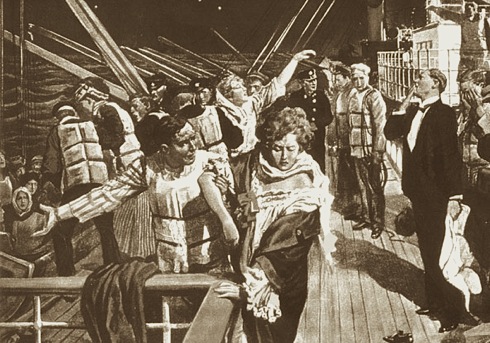
“Women and children first”: The Edwardian code of chivalry prevented men from boarding the Titanic’s 20 lifeboats before all the women had done so. The grim truth was that there was lifeboat capacity for only half the passengers and crew. The agony for American millionaire John Jacob Astor (depicted here) was deepened by knowing his wife Madeleine was pregnant with their first child. (Illustration by Fortunino Matania)

➢ Museum located in her Denver home tells story of Titanic survivor Molly Brown – by Colleen Slevin, Associated Press

➢ A Night to Remember (1958,digitally remastered DVD)

➢ Criterion Collection: Night to Remember (1958, Blu-ray US import)

FRONT PAGE

➤ Trimphone aside, can you spot the designs that changed the look of Britain over 60 years?

British Design,exhibition ,Innovation, Modern Age, Victoria & Albert Museum,

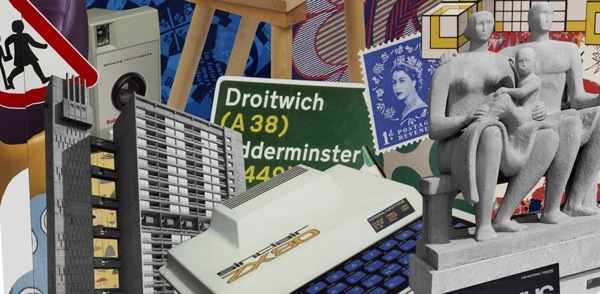
British Design catalogue collage: road signs, high-rises, Kodak cameras, postage stamps, computers and Henry Moore — all are exhibited here

“Britain has since 1948 sustained an extraordinarily vigorous creative culture, even against a background of manufacturers leaving the stage like the instrumentalists in Haydn’s Farewell Symphony. It’s an inclusive culture, hence tapestries and Jaguars. It’s a culture that swoops artfully between high and low. It’s a culture that could import, with characteristic fairhandedness, both John Betjeman and Nikolaus Pevsner. The one in thrall to the village, the other in thrall to steel and glass. Wonderfully, each was a founder of The Victorian Society. Their contrasting spirits dominate British design in the years before The Beatles’ first LP. Thereafter, the Britain of crumpets-with-vicar became the undisputed global capital of youth culture whose furious organic vitality still invigorates business life.”

➢ Stephen Bayley, former chief executive of the Design Museum, writing in The Independent

Denys Lasdun, University of East Anglia,architecture

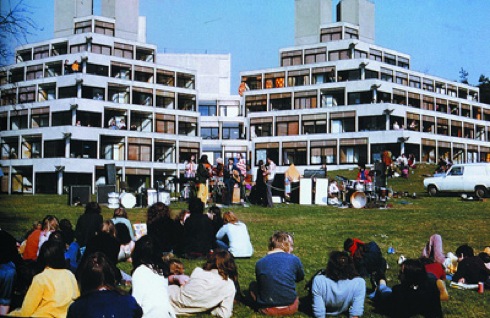
Architect Denys Lasdun’s University of East Anglia, 1962-68: raised walkways, striking ‘ziggurats’ and no building on campus more than five minutes’ walk away

❚ AN EXHIBITION TITLED British Design 1948–2012: Innovation in the Modern Age, is bound to infuriate as much as it excites. The grimly claustrophobic galleries that host temporary shows at the Victoria & Albert Museum abound with iconic and nostalgic everyday objects, rather as a good car-boot sale does. Yet the omission of much imaginative British media is unforgivable — the template for newspaper colour supplements laid out by The Sunday Times plus a serious investment in photo-reportage, for example… the more-British-than-British essence with which the American Joseph Losey propelled a whole chapter of stylish cinema… the sci-fi television fantasies of The Prisoner or Doctor Who…

Twiggy , Mary Quant ,miniskirt,Swinging London, youth culture

Twiggy models the Mary Quant miniskirt, 1965: named after the designer’s favourite car, the mini encapsulated the youth culture of Swinging London — energetic and unconventional

What the V&A show’s three themes propose — under the headings Tradition & Modernity, through the Subversion of pop, to Innovation & Creativity — amounts to a vital module for every art or design student in the education system, whose forebears, thank goodness, benefited from the shake-up imposed in 1960 by the Coldstream Report.

Ignore most dithering reviews of this hot-and-cold exhibition. Instead, do savour the argumentative Stephen Bayley, writing in that onetime model of new newspaper design, The Independent. He nails the paradox of this show in a daydream: “I became drunk on memories of whimsy, charm, gentility, wit and Macmillan-era futurism. My imagination never turned to the ruins of industry, the loss of technological competence, the barrenness of every British city except London and the fact that the economy of our once-busy island workshop is now based on the theory and practice of a dodgy casino.”

Bayley then comes to the nub of the matter: “The tricky thing is ‘design’ itself. It’s often muddled not only with ‘innovation’, but with invention, fashion and taste-making, sometimes even with art. After more than 150 years of promoting design at the V&A, no one seems to have any very clear idea of what it is. If it is a real subject, it must have a discipline. But what discipline connects Spence’s Coventry Cathedral with Damien Hirst’s 1997 Pharmacy restaurant in Notting Hill, west London, each of which features here?

“If, as the design lobby often insists, ‘everything has been designed’, then everyone is a designer. So what special qualities do professional designers bring to any task?”

British Design,exhibition ,Innovation, Modern Age, Festival of Britain, Skylon, Concorde

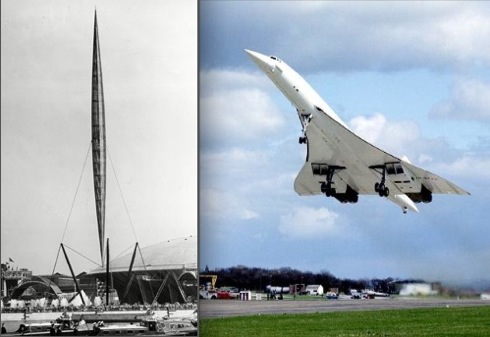
Notions of modernity: at the Festival of Britain, 1951, the Skylon designed by Powell & Moya was rendered by the practice’s junior architect James Gowan as a monumentalised missile, and symbolised the dawning age of science. In 1979, BA’s sixth Concorde took off on its maiden flight

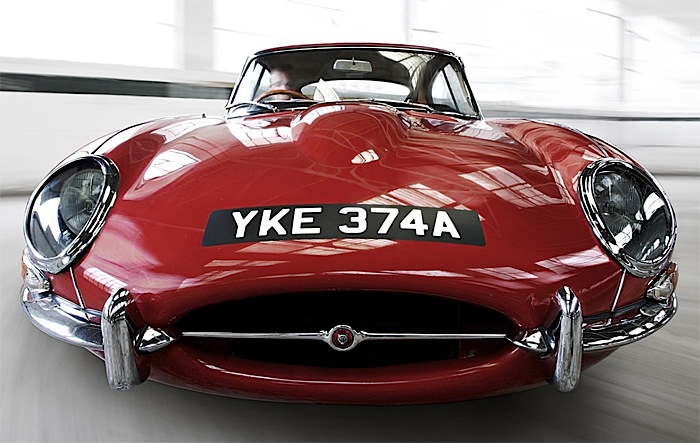
Aim Bayley’s question at three triumphs of design in the V&A show: the kinetic balancing act of the Festival of Britain’s Skylon structure; the bird-wing aerodynamics of Concorde miniaturised at the V&A in a 20-ft model; and the most thrilling artefact in the entire show: the skilfully lit Jaguar E-Type from 1961 which rival manufacturer Enzo Ferrari declared “the most beautiful car ever made”. Drop down to one knee and view the Jag diagonally from any corner and wonder at its lack of straight lines. One curve after another creates changing perspectives that conspire to emulate speed even as it stands motionless before you. Seldom will you hear both men and women purring over such a seductive silhouette! Seldom will you ever see such a thrilling manmade object.

There are a good number of breathtaking moments in this show that beg you to ask why and how an exhibit stopped you in your tracks, though not as many as you would wish.

Malcolm Sayer, Jaguar E-Type,sports car ,

Relish the curves: designed by Malcolm Sayer, the Jaguar E-Type 3.8-litre sports car was launched at the Geneva Motor Show in 1961 as a two-seat coupe or convertible, with a top speed of 150 mph. The car’s shape is the epitome of speed

➢ British Design 1948–2012: Innovation in the Modern Age, runs at the Victoria & Albert Museum, Mar 31 until Aug 12

FRONT PAGE