Category Archives: London

➤ Sotheby’s first David Bowie art auction raises twice the expected total sales figure

Frank Auerbach, Sotheby’s, Bowie/Collector, auction

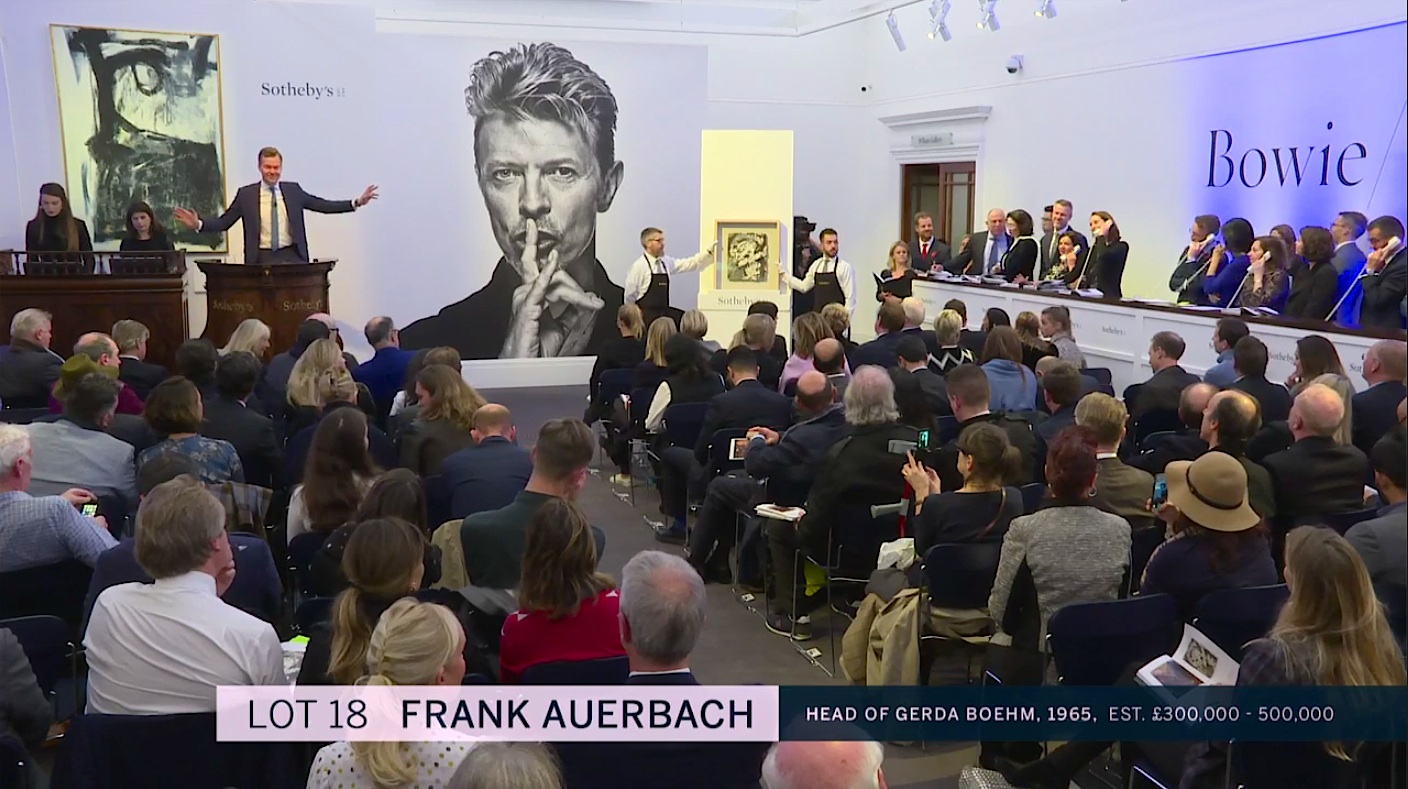
At Sotheby’s Bowie/Collector auction tonight: the pop star’s favourite painting, Frank Auerbach’s portrait Head of Gerda Boehm, eventually went for went for £3.35m. (Screengrab from Sotheby’s live webcast)

PART 1 OF THE BOWIE/COLLECTOR SALE saw its 47 modern and contemporary artworks raise £24m tonight – just over twice the total of top prices estimated by Sotheby’s the auctioneer in advance. So the “Bowie premium” added to market prices for the privilege of owning a memento of the pop icon’s personal collection averaged 105% (with wild extremes either side).

Bowie/Collector, Sothebys, Frank Auerbach

Bowie’s inspiration: Auerbach’s Head of Gerda Boehm (Sotheby)

Most suspenseful bidding came for Bowie’s favourite painting, the Frank Auerbach portrait that the pop star said set his mood every day when he rose: Head of Gerda Boehm was estimated at best to sell for £500k but eventually went for £3.35m when a new bidder popped up at the £2m mark and staged a fight to the end.

As might have been expected, two Jean-Michel Basquiat works went for roughly two-thirds more than best estimates – £2m for an Untitled collage and £6.2m for his large acrylic Air Power. The final lot, a Damien Hirst spin painting on which Bowie collaborated, sold for £625k (top estimate £350k). Hirst’s other work, Untitled Fish For David, 1995, sold for £150k (top estimate £60,000).

Sadly the handful of works that didn’t even reach their low estimates included an exquisite Wyndham Lewis collage, a Paolozzi bronze, a rich Picabia portrait in oil, and a Bomberg townscape in oil. Among many moments of high-speed amusement that enlivened the event was the auctioneer’s unique pronunciation of Lytton Strachey’s name, which suggested this was the first time he’d come across it.

➢ Two more sales of 300 artworks owned by Bowie continue at Sotheby’s London through Friday, live online

➢ Previously at Shapersofthe80s: Bowie’s passionate eye for art proves to be not bad at all

➢ Previously at Shapersofthe80s: Bowie’s taste in art: respectable, with bargains to be had at Sotheby’s auction

FRONT PAGE

➤ Bowie’s taste in art: respectable, with bargains to be had at Sotheby’s auction

Damien Hirst, David Bowie, Sotheby's, auction, contemporary art,

Damien Hirst, Untitled Fish For David, 1995, est £40,000–60,000 – From the Young British Artist who preserved an adult tiger shark in a giant tank, this gift from Damien Hirst to David Bowie contains a tiny 2-inch fish in formaldehyde, as “a profound inquiry into human existence”. Here displayed at Sotheby’s London, reflecting and refracting other art in the saleroom. (Photography © Shapersofthe80s)

BEFORE THE AUCTION OF DAVID BOWIE’S ART at Sotheby’s, treat yourself to the free exhibition of 350 works owned by the pop star who died this year. His eclectic taste embraces pop art, Damien Hirst, German expressionism, Tintoretto, Surrealism, Contemporary African, a chess set by Man Ray, a couple of Duchamps, and much primary coloured contemporary furniture from Italy’s Memphis Group (which occupies much of Part 3 of the sale, dedicated to Design). The auction represents about half of Bowie’s entire art collection which he admitted to buying obsessively over 30 years. The evidence is that he had a sharp eye.

What’s surprising is the number of eminently collectable smaller items being offered at affordable prices which are bound to attract first-timers to next week’s three sales – all offering online bidding. Painted tabletop sculptures in aluminium by Ivor Abrahams are priced at a few hundred pounds, his bronze sculptures at perhaps £1,500. Ceramic plates decorated by Picasso and Cocteau are priced at just over a thousand and there’s even Sir Stanley Spencer’s artist’s palette for £2,000. Having toured the Bowie exhibition highlights to New York, Los Angeles and Hong Kong, Sotheby’s is geared up for long-distance bidding.

Click any pic below to enlarge and launch slideshow


The full set now on display makes an engaging and mischievous show, crammed with paintings and sculpture that may not be masterpieces, as the BBC’s arts editor Will Gompertz has noted [video below], but by and large represent good examples from highly regarded artists. In light of which, many of Sotheby’s estimated starting prices seem temptingly low.

Frances Christie, head of its Modern & Post-War British Art Department, explained why they have to apply prevailing market prices: “It’s hard to quantify what the ‘Bowie effect’ might be. We have to take into account market precedents, so for example, the world record for Peter Lanyon’s work is £370k. The Lanyon painting Trevalgan in the sale is not as well known so we have priced it at about £250k, which I think is fair. The range of our estimates can only be a guide.”

“David was like a child, childish and childlike
when he came to see me in the studio and we made
a giant spin painting together” – Damien Hirst

Frances is pleased that as a collector Bowie favoured 20th-century British modernists and, with some prices starting in the low thousands, this sale might help spread the word abroad for names such as Gill, Wadsworth, Bomberg, Minton, Nevinson, Wyndham Lewis, Hitchens, Tunnard, Armitage, Chadwick, Kossoff, not forgetting Moore, Sutherland, Auerbach and Scott.

Gompertz remarked: “Bowie’s taste appears to have been fairly conservative but very specific. He liked the art that came from the same place as him: mid-20th-century UK. It is art that you could argue shared his philosophy, a philosophy that went on to shape his aesthetic. It is art that questioned, that was preoccupied with the surface, that had many sides; that never quite settled. Art that performed.”

Just totting up the top estimates for the 47 Modern and Contemporary works in Part 1 of Sotheby’s sale – which stars Francis Picabia, Damien Hirst, Patrick Caulfield and Jean-Michel Basquiat – could yield £11.6million. How the “Bowie premium” might inflate these auctioneer’s estimated prices is what promises to keep us on our toes throughout Thursday and Friday.

painting, David Bowie, Sotheby's, auction, contemporary art, Memphis Group, Paul Feiler

Bowie/Collector in a nutshell: Paul Feiler, Horizontal Blue + Sienna, 1960, oil on board, est £30,000–50,000. Right, painting by Ian McKever (est £3k), plus bronzes by Denis Mitchell (est from £5k), Memphis table by Sottsass (est £3k)

➢ The Bowie/Collector exhibition is free, unticketed and open to all at Sotheby’s, Bond Street, until noon on Thursday 10 Nov, 2016

➢ Potential buyers must register in advance for the three auctions. All offer ticketed admission to the saleroom, online bidding (BIDnow), absentee bidding or telephone bidding. Incidentally, the web catalogue contains much extra information about selected works, as well as condition reports for all.

➢ BBC arts editor Will Gompertz appraises David Bowie’s taste in art

➢ On video – Working with Bowie: an insight into an incredible mind, by his curators

FRONT PAGE

2016 ➤ Britain’s first robot Eric comes back to life

science, robotics, Eric-the-robot, Science Museum, exhibitions,demonstrations, London,

Eric the robot, then and now: Emerging from the workshop in 1928, left, and today on gleaming display in London’s Science Museum. His former tight-lipped expression has been enlivened with spiky teeth by his builder Giles Walker

MEET ERIC, BRITAIN’S FIRST ROBOT, built in 1928 and reincarnated as this full-size working replica by London’s Science Museum in a preview of next year’s blockbuster exhibition on 500 years of robotics. Within a decade of the word robot being coined in Karel Čapek’s 1920 play R.U.R. (Rossum’s Universal Robots), the 6ft-tall Eric toured the world as superstar but four years later he suddenly vanished. More than 800 backers of the museum’s Kickstarter campaign funded an Eric lookalike to be recreated by artist and robot builder Giles Walker. The new Eric has now joined the permanent collection and you can see him on static display until 30 November, though he’s giving three animated demos daily as a sparky mechanical person. Free.

The world’s first robots: inrobots, Karel Čapek, RUR , theatre

The world’s first robots: in Čapek’s play R.U.R. of 1921

Originally built by Captain W.H. Richards & A.H. Reffell to stand in for the Duke of York and open a model engineers exhibition, Eric was everything we now imagine a robot to be: humanoid, metallic and able to talk, though he moved only in limited ways, standing and sitting and moving his limbs. Giles Walker’s reincarnation maintains Eric’s primitive charm but has added some sleek touches, such as flexible elbows. The original had 35,000 volts sparking through his lips as he spoke. Today Giles has given Eric LEDs flashing across some spiky teeth instead, which is “a lot safer”.

Of the insides, he adds: “I’ve converted what was originally a load of pulleys and electromagnets into a digital system.” This makes Eric a very modern old robot, despite the verdict of TV star John Barrowman when Eric appeared on BBC TV’s One Show last week. He thought Eric looked like “an older-type cyberman”. Actually, John, the truth is probably the exact opposite: that Doctor Who’s cybermen were inspired by the Eric of the 1920s.

➢ Visit Eric on display in London

➢ At the Science Museum curator Ben Russell reveals more about the building of Eric

FRONT PAGE

➤ A chapter of Bowie’s musical legacy best forgotten

David Bowie, Lazarus, msjuicals, Michael C Hall, Enda Walsh,

Click to enlarge: cinemascopic stage for Lazarus in New York with Michael C. Hall (left), Cristin Milioti and Michael Esper. (Photo Jan Versweyveld)

WHOEVER GULLED DAVID BOWIE into endorsing the inconsequential and tedious off-Broadway production of Lazarus which opened in London this week can never be forgiven. It is a disgrace on two levels: there’s not an ounce of theatre to this live “play” in which Bowie’s songs are the sole source of inspiration. And the theatre’s sightlines are atrocious.

The only merit in the entire performance comes from the live musicians. The actors have forgotten any training they had, merely meandering around the stage, sitting or lying on it, semaphoring superficially; the script, “a new story” written by Enda Walsh with Bowie, hasn’t the first idea about how to deliver their characters; and the plot moves no further than it was left in the book by Walter Tevis and the cult film on which Lazarus bases its existence, The Man Who Fell to Earth (1976), directed brilliantly by Nicolas Roeg and starring Bowie. In this musical claiming to be a “sequel”, after two mind-numbing hours nothing has been advanced for the immortal Earth-bound alien Thomas Newton who lives on gin and television.

Lazarus, Michael C Hall

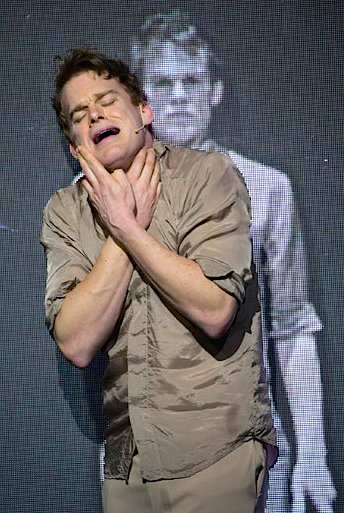
Michael C Hall as Newton on the London stage

It creaks like a period piece of sci-fi by ignoring the major technologies that have transformed fiction no less than real-life during the past 40 years: the personal computer, the genome, the internet, artificial intelligence. This year’s TV drama The Night Manager, as an updating of John Le Carre’s 1993 novel, was infinitely more electrifying about the nowness of progress.

Nostalgia does find its place in the best new number Bowie wrote for Lazarus, Where Are We Now?, a deeply affecting tour of the melancholy old postwar Berlin which anybody who visited before the fall of the wall will never forget. Alas, here a culture gap yawns between the imaginative compass of music and the human efforts live onstage which all musical theatre must reconcile. Lazarus is a rock-world concept, bereft of dramatic chemistry, that relies on projected light to evoke the visual kaleidoscope of music videos, from which The Message is whatever key image the PR machine decides to promote. Theatre, it ain’t.

Worse, the biggest insult of all are the ticket prices in the 900-seat temporary installation calling itself the King’s Cross Theatre and being charged by Robert Fox and Jones/Tintoretto Entertainment. Quite apart from the external soundtrack from traffic and aircraft and railway activity, whoever designed this space and its sightlines has never sat in a theatre before.

From our so-called “TOP PRICE” * £65 tickets, situated about two-thirds of the way back, we never had a view of more than the top half of the wide cinemascopic stage. The angle of the raked auditorium was entirely to blame for placing at least six heads directly in front of each paying customer, and everybody else within range spent the duration bobbing their heads and weaving sideways to catch a glimpse of the stage and its often inanimate actors. The bigger disgrace is that other customers had been charged at “Premium” price levels from £160 downwards.

Frankly, I am convinced Bowie is turning in his grave at this presentation of his music.

* Surely a trades mis-description when there are THREE “Premium” price tiers above the so-called “Top Price”!

➢ Tickets still available for Lazarus which runs
until 22 Jan in London

13 NOV UPDATE: THE LONDON REVIEWS

➢ Michael Billington, the Guardian: “an exploration of the existential angst that pervades Bowie’s music: this is the story of a man never wholly at ease in himself or his surroundings. I found myself more impressed by the visual sophistication than emotionally engaged by the story.”

➢ Susannah Clapp, The Observer: “an extended pop video. Woozy and rapt. Long on style but short on wit.”

➢ David Jays, Sunday Times Culture: “an otherwordly muddle… Bowie devised a portentous scenario; Walsh keeps it dead on the page.”

➢ Roundup of reviews in The Stage: “Pretty much the entire world’s press turned out to review its London opening. And everyone disagrees.”

➢ Singer Andy Polaris experiences his own unsettling realisation during Lazarus the musical

David Bowie, The Man Who Fell to Earth, Nicolas Roeg, films,

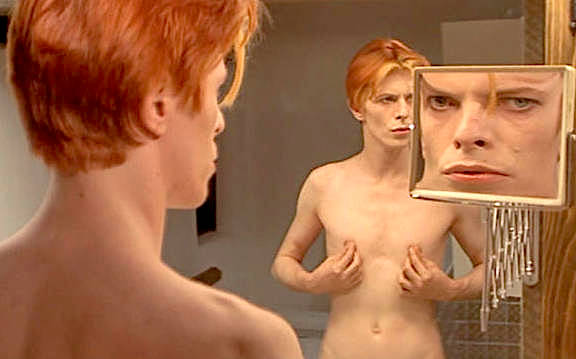
Bowie as Newton in the film TMWFTE, 1976: androgynous rock star as an alien visiting Earth from the planet Anthea

➢ David Bowie’s last three songs: decoding the final transmission – Dorian Lynskey at The Guardian

➢ Previously at Shapersofthe80s: A sensational portrait of Bowie as the man who shaped our responses

➢ Previously at Shapersofthe80s:
“I’m not a rock star” Bowie often said

LAZARUS FROM BOWIE’S ALBUM BLACKSTAR

FRONT PAGE

2016 ➤ On film: two electrifying hours of The Beatles as they’ve never been seen and heard

The Beatles, Eight Days a Week, Ron Howard, documentary, film, Paul McCartney, Ringo Starr, John Lennon, George Harrison, Swinging Sixties, live concert, vintage, pop music, Shea Stadium, touring,

Pristine footage: The Beatles play Shea Stadium in August 1965. (Image: SubaFilms)

LAST NIGHT AT A LONDON CINEMA I saw the most exciting live pop concert since the same band played live in the Swinging Sixties. Ron Howard’s new Beatles documentary, Eight Days A Week about the touring years 1963-66, is a sensational feast of long-lost performance footage that confronts us with the Fab Four’s raw onstage energy and pounding tempo – the audio as gorgeously restored as the images. This two-hour celebration of Beatle genius goes behind the clichés of hysteria to give us Access All Areas. It delivers one revelation after another, from Paul’s “Oh-my-God” moment when Ringo joined the band, to the jaw-dropping recording of a top-ten single in 90 minutes of studio time, to their 1964 triumph for civil rights when the band refused to tour in the US until audience segregation was abandoned at their venues.

New interviews from Ringo Starr and Paul McCartney keep dropping gems of insight about this the most commercially successful group in pop history, while vintage footage does as much justice to lippy John Lennon and “quiet” George Harrison who are no longer with us.

Throughout this joyous moptops-into-men odyssey we’re wide-eyed at the sheer cheek of these multimedia superstars, aged between 19 and 22, who created their own interview style by pinging back witty ad-libs to questions from the world’s media. The downside was mass hysteria from teenaged babyboom fans laying siege to hotels and airports where they repeatedly overwhelmed police and security on an often scarifying scale.

Beatle albums sat at No 1 in the charts for 20 to 30 weeks at a time – more No 1 albums than any other musical act. Their 20 No 1 hit singles on the Billboard Hot 100 chart remain unchallenged.

The Beatles, Eight Days a Week, Ron Howard, documentary, film, Paul McCartney, Ringo Starr, John Lennon, George Harrison, Swinging Sixties, live concert, vintage, pop music, Shea Stadium, touring,

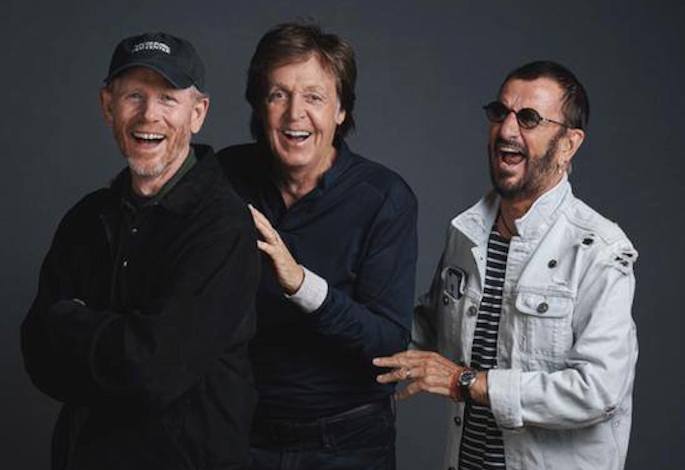
Ron Howard with Paul and Ringo this week: “I love this photo that was taken yesterday at Abbey Road Studios in historic Studio 2 while we were promoting The Beatles: Eight Days a Week”

Everything The Beatles did was without precedent. Among their innovations they launched arena rock and at Shea Stadium Howard’s doc ensures that we hear George’s guitar chords above the screaming audience of 55,000 fans. As a shock reminder of Sixties technology, Vox had built three new amps for the Beatles, each souped up to 100 watts (!!!) specially for touring America, their output being relayed via microphones to feed the stadium’s tinny loudspeaker system!!!

It is a breath-taking source of inspiration to know that during The Beatles’ far from meteoric early years, this Liverpudlian band of brothers had played at least 456 live gigs before signing their recording contract with EMI. Yes, 456 !!! With that amount of practice, it should be no surprise to find that their legacy amounts to 237 original compositions – songs which most people on the planet can hum, while the most radical among them personify the Sixties counterculture. As the best-selling band in history, the Fabs revolutionised all of music for ever.

Howard’s previous reality epics include the wonderful Apollo 13 and the gripping joust, Frost/Nixon. This week he told The Guardian: “I began to think of the Beatles story as like Das Boot: they’re in it together, they have each other, they know what their objective is, but, y’know, it’s a dangerous world out there.”

WHAT THE PRESS ARE SAYING

➢ Ron Howard trashes the idea that there’s nothing new to say about the Beatles – The Guardian:
This is about the Beatles as live phenomenon, and the fact that their music was all the more remarkable because it had to be heard above the scream – that ambient sound of sex, excitement and modernity, mixed in with a thin chirrup of press envy. The scream was an important part of it. . . an almost unbroken four-year, semi-improvised multimedia performance for which there was no pre-existing template – not simply the music but the giant public spectacle and public scrutiny.

➢ 10 Things we learned from Eight Days a Week
– Rolling Stone:

In February 1964, the band and their entourage occupied nearly the entire 12th floor of the Plaza NYC, including the 10-room presidential suite. But despite the space, the four friends retired to smaller quarters. “The four of us ended up in the bathroom just to get a break from the incredible pressure,” Starr says.

➢ “We were force-grown, like rhubarb,” says John Lennon
– Daily Telegraph:

The film shrewdly draws a line between the Beatles’ mischievous sense of humour and their long-time producer George Martin’s earlier life recording alternative comedy. Martin had worked with the Goons, an enormous influence on the band’s growing lyrical eccentricity in that period, as well as their off-the-cuff ribbing of strait-laced reporters.

REMASTERED UK FOOTAGE, MANCHESTER 1963

Previously at Shapers of the 80s:

➢ No wonder The Beatles changed the shape of music after 456 sessions practising in public

➢ 1963, With The Beatles the day Kennedy was shot: “The second house was distinctly more subdued”

➢ 1966, More popular than Jesus: the fascinating Lennon interview in full

FRONT PAGE