
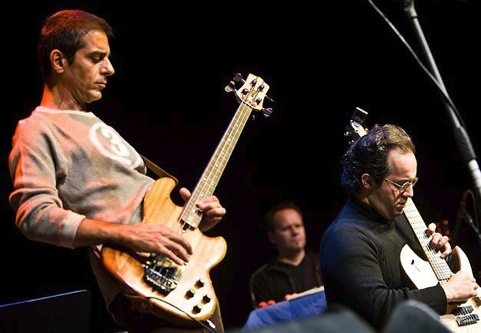
Mick Karn: former 80s popstar today struggling to make ends meet
❚ BITTER-SWEET NEWS TO HEAR THAT MIDGE URE has leapt straight into the breach to organise a benefit concert [See update at foot of this post] for Mick Karn, the former bass-player with 80s hit group Japan. Karn’s website has announced that he has been diagnosed with “advanced stages of cancer” and is struggling to pay his medical bills in Cyprus where he lives with wife and child.
One aspect of this sad news is to be reminded that not all chart-topping “popstars” become millionaires, especially the drummers and sax-players and guitarists who don’t get a chance to write lyrics, which is what generate the big money in royalties. The typical pop group makes two albums in as many years. As hugely influential pathfinders for the glam-into-synth-pop era, Japan had a very good run: over eight years, six studio albums and one live, plus umpteen compilations. Yet the pop industry is not noted for its pension schemes.
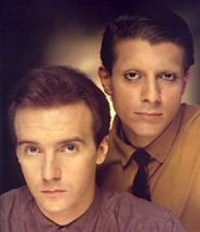
Ure and Kahn: Fashion single in 1983
Another aspect of this week’s news is to be starkly reminded of our own mortality. Mick Karn will be “only” 52 on his birthday next month. When Michael Jackson died last June, he was “only” 50 and more than a few among our pop pals from the Swinging 80s generation said they suddenly felt the hairs prickle on the backs of their necks. Jacko was exactly their age. So was Steve (Stella) New when he died last month, at “only” 50.
What seems to chill us is the threat of the Big C. For most of the past three decades various forms of heart disease have been the most common cause of death in the UK. But whether as a result of dietary change or gym culture, circulatory diseases have shown the greatest decline, while life expectancy at birth has increased by six years on average to 79. It’s often said that if the heart doesn’t get you in the end, cancer will, but what’s little appreciated is that cancer is the prime cause of death among men when they’re younger – in their thirties. From there on, cardiovascular causes and, curiously, geography become more decisive. So, given a man’s susceptibility, perhaps we ought not to be surprised when cancer claims him earlier in life than a woman.
“We understand death for the first time when he puts his hand upon one whom we love,” it is said. “Only” 50, if we’ve come this far, brings ever more frequent intimations of our own mortality, that tilt us from the Wordsworthian vision towards a more pragmatic view of our role as a toiler in the scheme of things. The hot-blooded proclamations of Jimmy Dean, Pete Townshend and Roger McGough starts sounding like romantic indulgence: “Live fast, die young”? You have to be kidding! “Hope I die before I get old”? Oh no, you don’t really! “Let me die a young man’s death”? Absolutely not! As the grand old man of British sculpture, Henry Moore, told The Face shortly before he died at 88: “The work is what’s important, and I haven’t got much time left.”
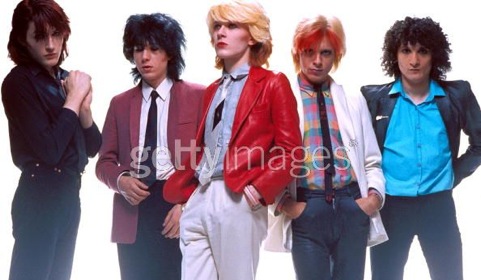
Japan in May 1979: Steve Jansen, Richard Barbieri, David Sylvian, Mick Karn, Rob Dean. Photographed © by Fin Costello
So all power to Midge Ure for grasping the nettle and planning to celebrate a life not yet fully run. He has urged fans to give Karn both “financial help and emotional help”. In addition, Ure, as the joint-founder of Band Aid, 1984’s fund-raising supergroup, is well versed in how to organise a benefit for Karn. BBC 6Music reports: “While no acts are confirmed yet for the concert, which is to take place some time this year, Ure has his sights on reuniting Japan for the show.” (Karn’s website later said these had not been Midge’s words.)
Ure said of Karn’s diagnosis: “The situation is not very good. The cancer has spread, he is going through chemo right now — but surrounded by family and friends, he has a positive attitude.”
❚ IN 1982 WHEN PETE TOWNSHEND WAS PUTTING TOGETHER a supergroup to launch the first Prince’s Trust Gala, he chose Karn for the line-up and described him as by far the best bassist in the UK. This event was the showcase that led to his collaborations with Kate Bush, Joan Armatrading, Pete Murphy (Dalis Car, 1984), Midge (the chart single After a Fashion, 1983) and many more. The intervening years have yielded 13 solo albums, among which The Tooth Mother (1995) is a standout for its juzz-funky innovation.
Of Karn’s musicianship, Ure said: “Until I heard Japan, I had never heard a bass guitar played like that. It was almost like playing a lead instrument, incredibly percussive and melodic, something that inspired me.”
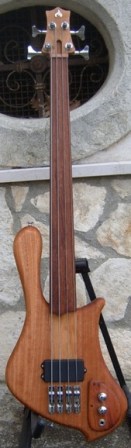
Mick Karn Appeal – This Fretless
Bass could be yours
Armando Pugliese from Prometeus Guitars in Italy has kindly agreed to donate the proceeds from the auction of a fretless bass guitar to Karn’s appeal – either the bass pictured here, which he lovingly made for himself, or one built to your spec. This a serious instrument worth a high three-figure sum. Auction ends Friday June 25.
[Update: Auction now ended. Winning bid, 1502 Euros.]
Karn’s unusual fretless bass technique is at once surreal, exotic and sinuous, practised in the early days on an aluminum-necked Travis Bean instrument. His best friend guitarist David Torn once said: “It’s like if Bootsy was Moroccan.”
Motown’s James Jamerson insisted that the bass can actually drive a melody, and Karn agrees. It was one of the hallmarks of Japan’s music. The group was founded in 1974 (when Karn was 15) with schoolmates in south London: David Sylvian, David’s younger brother Steve Jansen, and Richard Barbieri. They decided to play Roxy-ish art-rock, both pre-punk and despite punk. By 1979 and the release of their pivotal third album, the synth-driven Quiet Life, Japan’s long hair, glam make-up and progressive melodies saw them branded as New Romantics in all but club membership. In reality they presaged the UK’s edgy new pure pop by going off on their own musical tangent with Sylvian’s sardonic crooning, quirky Eastern influences and saxophone arrangements.
Talk of a reunion might just be a bridge too far, given the deep personal tensions that drove Karn and Sylvian apart in 1982. In 2006, Karn told Beatmag: “For all four of us to agree would be nigh-on impossible. But there’s something I’d really, really enjoy about being on stage with them again, and I’d enjoy playing the old Japan songs again, with my fellow bandmates. That was an enjoyable period of my life, and I’d like to experience it again.”
➢ Extract from Mick Karn’s response on his website, June 14:
“Your comments and well wishes have left me speechless, in the same way that our news had affected you. The support and love you give me is felt by all of us here, every day . . .
“At the time of first posting my news I was striving to obtain a medical card that would pay for treatment here in Cyprus and I am pleased to say that in recent days, since becoming officially diagnosed through a series of specific tests, the state will now take care of my basic medical costs . . . Donations that have been received will remain in a fund which will be used to augment the state care . . .
“Words cannot truly express the full scope of my gratitude and feeling of good fortune to have so many friends, both near and far.”
➢ Another response on his website, Sept 3:
“Thanks to the appeal fund, Mick and his family were able to move to London where he is currently being treated. This really wouldn’t have possible without the support of Mick’s friends and all of you who have raised money for the fund. When it’s appropriate, there will be further updates. Mick also hopes to work with Peter Murphy on a follow up to their Dali’s Car album, The Waking Hour, towards the end of September.”
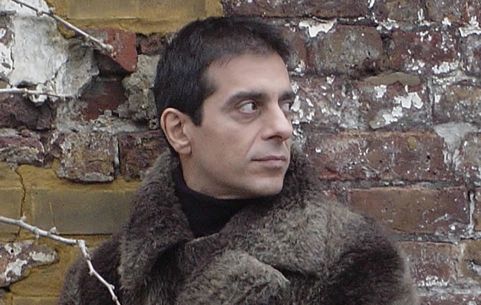
Karn at home: searching music, candid memories
➤ Latest reflections by the restless Karn on a road well travelled
❚ MICK KARN GIVES AN INTERVIEW to Rob Kirby in the next issue of re:VOX, a pocket magazine dedicated to 80s electronica. The guitarist says of the restless and searching quality in much of his latest album, The Concrete Twin, which was released in January: “My recordings are always a way of dealing with unresolved issues, most of them mentioned in the book [his autobiography] . . . It’s impossible not to hear music wherever you go. Everything I hear will eventually turn into an influence on some level, subconsciously.”
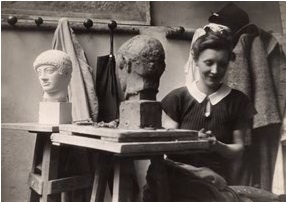
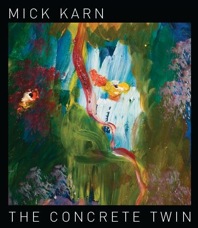 Who, or what, is The Concrete Twin of the album’s title (£7.99 as a download, £17.49 as CD from Karn’s site)? It brings to mind the self-sculpture of Antony Gormley. Karn, who has been admired as a sculptor for 30 years alongside riding the music industry rollercoaster, says: “I guess it’s the closest I’ll come to mixing music with sculpture. The concrete twin is another self we all have. The ‘hard’ side of us that can withstand all the trials and tribulations that life has to offer.”
What prompted you to commit your thoughts on your past life so candidly to the book, Japan and Self Existence (£16.96 from Lulu), which has roused strong reactions? Was it the relocation to Cyprus? “Just tired of meeting so many people that have the wrong idea, and that well-known people can have the same human flaws as anyone else. I feel glad that people know the truth due to the book, but contented, no. I’m never contented. It’s my motivation for carrying on. Self-publishing was the last option. Debi spent three years on my behalf, approaching every publisher that we could think of. The reaction was always positive, but the explanation the same: too many biographies by musicians on the market.”
❏ Extracts from Musique Concrete, an interview with Mick Karn in re:VOX #9, on sale in late June at £1.50 from Rob Kirby, 2 Bramshott Close, London Road, Hitchin, Herts SG4 9EP.
➢ Mick Karn’s own website – Download his latest album The Concrete Twin, order his autobiography, view his sculpture online (“amazingly accomplished” – John Russell-Taylor)
➢ Honorable tension: Karn gives a substantial interview to music journalist Anil Prasad in 1996 for Innerviews, the web’s longest-running music magazine. Extract here . . .
On the line-up for Japan’s 1989 reunion as Rain Tree Crow: “We really wanted a soloist and a guitarist. David Torn was my first choice. I recommended him to everyone. It looked as if it was going to happen for a while. But the David Sylvian we’d always known was one of complete control. That made it very difficult for us to work with him. And that was another reason why the band just couldn’t work. We found that as more time went by, the more and more control David [Sylvian] wanted to take — to the point of not wanting David Torn to come into the picture, because he decided to take care of the guitar himself . . .”
➢ VIEW ♫ ♫ Japan on Top Ten New Romantics – Paul Morley: “There was a wonderful moment when it happened for Japan with the album Ghosts, when us serious NME people embraced them, because they seem to have left behind the weird clothing and the makeup” !!! Oh yes.



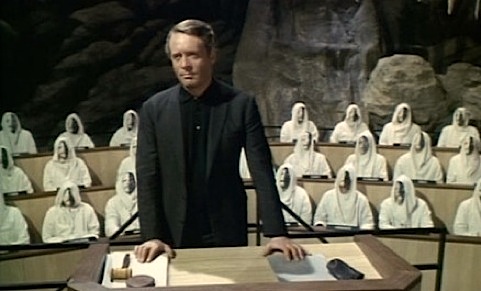
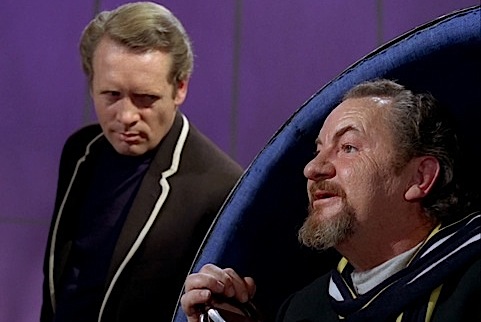
 The Prisoner made a star of angry, intelligent Patrick McGoohan, who frowned a lot and so became the coolest dude of all time (after Jimmy Dean). He was also the show’s creator and executive producer and played Lotus-driving good-guy No 6, a secret agent they (who?) won’t allow to retire. In the wake of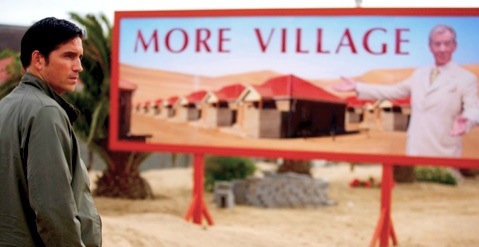
 The new Prisoner has been, hmm, let’s say, zip-coded: 93-6-2-oh! It does contain some neat homages to the earlier epic. McGoohan its creator and its No 6 now reappears as No 93 (right), an old man whose first words pose the new enigma. It brings a tear to the eye to know that at the grand old age of 80, the cool dude Pat died only last year, soon after filming. The other treat is a moody and vengeful balloon called Rover (below). We never knew quite what Rover was the first time round, but he does indeed return.
 The Prisoner always was said to be “ahead of its time”. In 1968, Isaac Asimov gloomily declared it was about failure, and was popular because it “cracks the old undemocratic folly of success for the few”. Indeed, years later McGoohan conceded that the bicycle logo was an ironic symbol of progress. Ah, ironic – that’s the word. Perhaps






 ➢➢ Shapers of the 80s ➣➣