Category Archives: Culture

➤ Another eyeopener from always-there Ridgers

photography,exhibition, Derek Ridgers

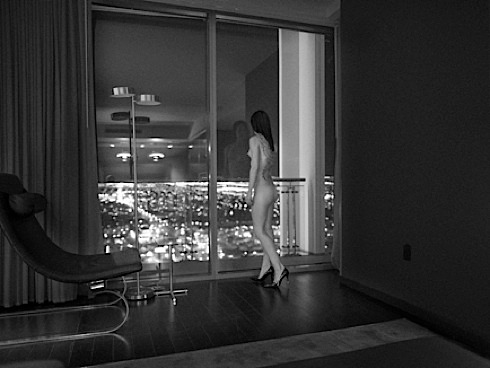
Natassia Doubleoseven, Las Vegas 2012 – photography © Derek Ridgers


❚ PUNK AND CLUB PHOTOGRAPHER Derek Ridgers has a new show titled Afternoon At The Seven Palms And Other Stories which opened this week at The Society Club in Soho.

At his blog Ridgers writes: This is my first foray into the world of a very mild form of erotica. It’s really more like naked portraits. I’m not at all sure how it’ll go down but Babette and Carrie have been very encouraging. The above photograph is of the mysterious and exotic secret agent Natassia Doubleoseven. There are two photographs of her in the show (I’d better not tell you her real name in case she has me eliminated)… The Society Club is a small but trendy cafe/ bookstore/ gallery and it’s run by Babette and Carrie, who have both been very supportive. Some afternoons I go there and have a chat and a coffee and stare out of the window … / Continued online

➢ The Society Club is at 12 Ingestre Place, London W1F OJF

FRONT PAGE

➤ The Rite that caused a riot: shocking in 1913, thrilling still

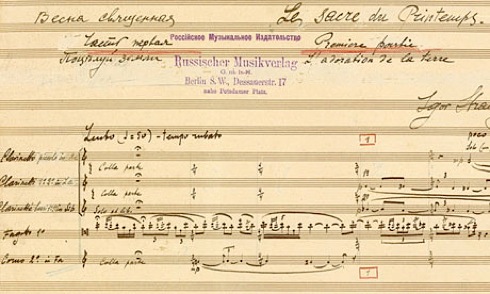
A section of a facsimile of Stravinsky’s manuscript for Rite of Spring, which was published this year to mark the centenary

Section of a facsimile of Stravinsky’s manuscript for The Rite of Spring, which was published this year to mark the centenary

❚ IF IT’S GOOD ENOUGH FOR The Guardian’s front page 100 years after the event, readers of Shapersofthe80s will want to know about it. Here’s a fulsome appreciation by the leading British composer George Benjamin on the pivotal piece of music which was premiered 100 years ago today in Paris by Diaghilev’s Ballets Russes, why it caused a riot by the audience and became a model for masters who followed…

➢ How Stravinsky’s Rite of Spring has shaped 100 years of music – from today’s Guardian: Piece first performed in Paris exactly 100 years ago, emblematic of era of great scientific, artistic and intellectual ferment

The Rite of Spring was a revolutionary work for a revolutionary time. Its first performance in Paris, exactly 100 years ago, was a key moment in cultural history – a tumultuous scandal. Written on the eve of the first world war and the Russian revolution, the piece is the emblem of an era of great scientific, artistic and intellectual ferment. No composer since can avoid the shadow of this great icon of the 20th century, and score after score by modern masters would be unthinkable without its model… / Continued at Guardian Online

➢ The Rite live tomorrow night on BBC Radio 3

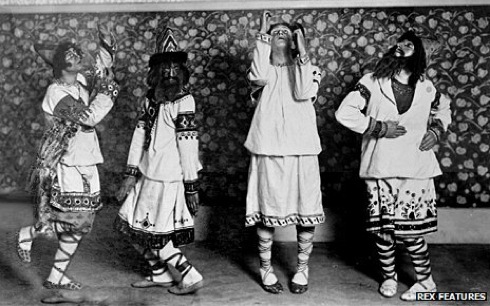
Choreographer and dancer Vaslav Nijinsky, left, in the original Rite of Spring performed by the Ballets Russes

Choreographer and dancer Vaslav Nijinsky, left, in the original Rite of Spring performed by the Ballets Russes

➢ Did The Rite of Spring really spark a riot? – BBC News Magazine:

Lydia Sokolova, one of the dancers said the audience came prepared: “They had got themselves all ready. They didn’t even let the music be played for the overture. As soon as it was known that the conductor was there, the uproar began,” she said in an interview recorded in 1965… / Continued at BBC Online

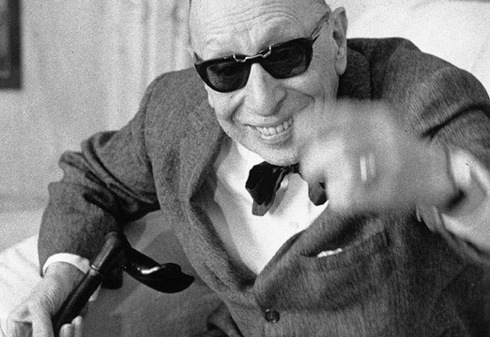
Igor Stravinsky on The Rite: “The 8-notes chord is new, but the accents are even more new ... Give it 100 years”

Igor Stravinsky on The Rite: “The 8-notes chord is new, but the accents are even more new … Give it 100 years”

❏ Robert Craft, now aged 89, the composer’s American confidant, wrote this immaculate summary of Stravinsky for 1000 Makers of Music (Sunday Times partwork published in 1997):
In 1913, The Rite of Spring changed the rhythmic language of music: it is an epicentre of 20th-century modernism. Stravinsky’s music ranges widely, from the exaltation of Symphony of Psalms to the farcical fun of Renard, from the tenderness of Pulcinella, the deeply felt love-music of The Rake’s Progress to the grace of Apollo. The music is lyrical both in dramatic forms (Oedipus Rex) and purely instrumental (the violin-piano Dithyramb), and all of it dances as it sings. The ludic element (Circus Polka) is considerable, but much less so than the religious (Mass) and the humanist (Petrushka). Stravinsky’s influence is alive and immeasurable. He once said: “Music is the best means we have for digesting time.”

FRONT PAGE

➤ Glenda Jackson silences Tories in Commons tirade against Thatcher

Glenda Jackson ,video, Commons ,debate, Thatcher

Glenda Jackson lets rip: click on image to run video in a new window

By far the most heinous demonstration of Thatcherism was across the whole country in metropolitan areas where every shop doorway became the bedroom, the living room, the bathroom for the homeless. They grew in their thousands, and many of those homeless people had been thrown out onto the streets from the closure of the longterm mental hospitals. It was called care in the community. What it effectively was was no care at all in the community.

During her era London became a city Hogarth would have recognised. Everything I had been taught to regard as a vice was under Thatcherism in fact a virtue: greed, selfishness, no care for the weaker. Sharp elbows, sharp knees, they were the way forward.” – Glenda Jackson MP, in today’s Parliamentary debate which “considered the matter of tributes to the Baroness Thatcher”

London, Gin Lane, Hogarth, prints

Gin Lane (1751) by English artist William Hogarth: shocking scenes of infanticide, starvation, madness, decay and suicide in London

➢ “If the measure of a great political leader is the extent to which they leave a footprint on those that follow, Margaret Thatcher, for better or worse, was a great leader,” writes Patrick Wintour in The Guardian – “David Cameron has never been able quite to embrace or reject her politics. He, like many of his contemporaries, has almost internalised the trauma of her premiership and ejection from Downing Street in 1990… / Continued online

➢ The politicised argument over how to remember the former prime minister is not about the past,” writes Jonathan Freedland in The Guardian – “The wider Tory tribe seems determined to use the nine-day limbo between her passing and her funeral to define Thatcher in death in a way that would have seemed impossible, if not outright absurd, in life…” / Continued online

FRONT PAGE

2013 ➤ Duran’s Rhodes exhumes a 90s art-rock project that anticipated the downside of the internet

Duran Duran, Nick Rhodes, TV Mania, albums, photography, Bored with Prozac,

Never ask an artist “Why?” An inner Rhodes and another Cuccurullo, step up to brand their new project, TV Mania

➢ Nick Rhodes will exhibit a collection of original photographic works for sale at The Vinyl Factory Soho, London W1F 7BE, March 8-April 5. The collection, entitled Bei Incubi – translated as Beautiful Nightmares – will feature 20 Polaroids, and more than 30 original photographs and prints that have all been taken and signed by Nick.

❚ THE PHOTO SHOW celebrates the release on Monday of Nick Rhodes’s new experimental electronic album Bored with Prozac and the Internet? in a collaboration with former Duran Duran guitarist Warren Cuccurullo. Originally created in the mid-90s for the Broadway stage as the music to a “bizarre TV soap opera”, the tracks tell the tale of Cathy and Ray (named from the cathode ray tube) and their two children Sassy and Snoop, a fame-hungry family who give away their freedom to scientists in exchange for reality-show fame.

Bored was culled from a collection of tunes recorded when the band were between day jobs. Using samples from such sources as The Outer Limits and the British TV show Planet Fashion, TV Mania’s pastiche of cool beats and melodic hooks proved surprisingly prescient.

“It was innocently masquerading as an art-rock project, but there was a deep concept behind it all,” Cuccurullo says. “We were envisioning a world where a family would give up their day-to-day privacy and allow their existence to be televised to the masses, and this was two years before Truman showed and four years before Survivor. Now everyone is giving away their most intimate details online and on reality TV.”

“In 1996 the internet was still in its infancy,” Rhodes adds. “I was fascinated by communication and how things were becoming more instant and this was decades before all the sites we have now to communicate in different ways.”

A few months after Rhodes and Cuccurullo finished recording Bored with Prozac, a series called Big Brother hit the airwaves. “We looked at each other in absolute disbelief,” Rhodes says. “It was an idea that was in the ether at the time. We decided to lock it in the bottom drawer whilst we changed the story.”

➢ More details at TV Mania’s website

TAYLOR’s TALE FROM LOST SOUL TO HUMAN BEING
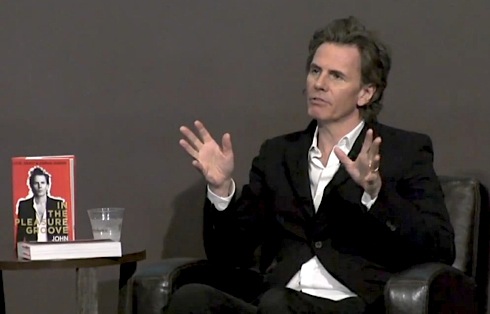
 John Taylor, Duran Duran, interview, books, video, In the Pleasure Groove,

John Taylor grilled for Google… Click on pic to run video in another window

❏ Also published today: John Taylor bassist and cofounder of Duran Duran can now be seen on video visiting Google Los Angeles last November to discuss his frank autobiography In the Pleasure Groove: Love, Death and Duran Duran. [Click on the pic to run video in another window]

Taylor tells his audience: “I have to fight to hold onto my memory these days, because there’s so much info coming at me… I started formulating an idea for the book, which is in three parts. There’s growing up in the 60s in the Midlands of England and becoming ‘John’… It’s a coming-of-age book, watching this little kid, an only child, and how he got into music. I had to find it for myself, at that time, 12-13-14, where the desire to remake my identity was so strong, and music in the UK had a lot of very strong personalities: David Bowie, Freddie Mercury, Rod Stewart, Bryan Ferry. And for a kid who was not really connecting with school, I started connecting with these guys.

“The second section is hysteria and that’s really about the first five years of the 80s, this wild ride Duran Duran took. Then the third part is about becoming an adult human being … some of the more profound highlights of the last 15 years: losing parents, gaining children, marriages, divorces, all of that sort of real-life stuff. But through the lens of an ex-popstar.”

FRONT PAGE

➤ Bowie as the human equivalent of a Google search

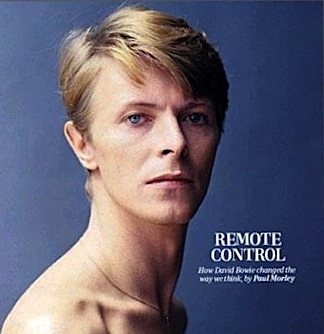
➢ David Bowie’s role was an unlikely form of education for a teenager in thrall to the Zen-master popstar – Paul Morley recalls his influence in The Telegraph Review, March 2, 2013

Telegraph online,David Bowie ,Paul Morley,

Today’s Telegraph Review cover

When I was a 15-year-old David Bowie fan in 1972, Bowie was for me a kind of teacher, so much more inspiring and motivating than my real teachers. In the middle of a mundane, mainstream world that limited possibility, his explosive mind and the way he represented it through sheer otherness suggested everything was possible.

He was the human equivalent of a Google search, a portal through which you could step into an amazing, very different wider world – if he mentioned in an interview, or referenced in his work, someone like Andy Warhol, Jean Cocteau, Antonin Artaud or Marcel Duchamp, I would immediately want to find out what he was talking about. He flooded plain everyday reality with extraordinary, unexpected information, processing the details through a buoyant, mobile mind, and made intellectual discovery seem incredibly glamorous. He helped create in my own mind a need to discover ways of making sense of both the universe and the self by seeking out the different, the difficult and the daring… / Continued at Telegraph online

➢ Riddle of the train Bowie could not have taken in
Where Are We Now?

➢ 2013, The Bowiesconti proxy has spoken – Shapersofthe80s translates revelations from the Visconti interview

➢ David Bowie is the enigmatic title of a retrospective exhibition drawn from Bowie’s personal archive. Opening March 23 it has been extended to August 11, 2013, at the Victoria & Albert museum, London SW7 2RL. Book online, in person at the museum, or by phone +44 (0)20 7907 7073 where you will spend a lifetime on hold.

FRONT PAGE