Category Archives: Chronology

1980 ➤ Birth of The Face: magazine that launched a generation of stylists and style sections

❚ WHEN NICK LOGAN, A FORMER EDITOR OF THE NME, launched The Face in May 1980 little did he realise it would become the decade’s “style bible” and one of the six great postwar magazines to change the course of British journalism. The Face married music, popular culture, politics and street style with radical art direction and new fonts by Neville Brody. It paid peanuts to a select bunch of savvy and passionate writers, photographers and “stylists” who gave the word a fresh meaning (almost entirely lost today) and inspired an avalanche of imitators in mainstream media, retail, advertising and beyond.

The Face, magazine, 1984, men in skirtsItself dubbed “the world’s best-dressed magazine”, The Face broke with mainstream complacency by actively inventing or giving focus to entire movements that combined clothes, music and attitude. Many came to define the 80s – from The Cult With No Name which was eventually rechristened New Romantics, the Hard Times ripped Levi ensemble, the Burberry-loving Casuals, and the “bad boy” Buffalo silhouette created by Ray Petri and Jamie Morgan. This, if any, became the urban male uniform of the mid-80s, and was celebrated only last winter by an issue of Arena Homme + magazine, art directed by Brody who designed for the occasion two custom typefaces called Buffalo and Popaganda.

At its peak The Face sold 100,000 copies monthly. Brody moved on in 1986 and Logan in 1999, though the title endured until 2004. Logan launched Arena in 1986 as a men’s monthly, soon edited by Dylan Jones, who today edits GQ UK. The British edition of Arena endured until 2009.

➢➢ The birth of The Face — Read the first article introducing Nick Logan’s new magazine, in the Evening Standard on May 1, 1980

HOW THE TWO KEY SHAPERS BEHIND THE FACE SAW IT
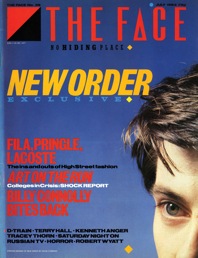
The Face, magazines, July 1983, New Order, Art on the Run❚ NICK LOGAN, publisher of The Face, was a working-class journalist from East London “People said you couldn’t then call a magazine anything as obscure as just The Face… I didn’t see why Tatler should have good paper and good photography and it should be denied to people like me.”

❚ NEVILLE BRODY on art-directing the early Face “It was a big laboratory. The New Order cover was a picture of the lead singer, and it wasn’t that great, a bright blue background. I said to Nick this picture was so shit and he said, Why don’t you crop it off the corner of the page? All you saw was the top left-hand corner of his face – immediately so commercial, and no other commercial magazine would have done anything like it. Great courage is what set his magazine apart.”

➢➢ Launching the style decade Lively social analysis in BBC Radio 4’s anniversary documentary starring all the usual suspects: on iPlayer until May 13

FRONT PAGE

2010 ➤ Index of posts for March-April

McLaren, O'Dowd,Shapersofthe80s,Index March April 2010

McLaren departs this world ... O’Dowd demands a place in the spotlight

➢ Kemp sets a new standard for rock memoirs

➢ Grace Jones turns her back on London ;-)

➢ Rich List puts George Michael top of the popstars from the un-lucrative 80s

➢ In Australia, Spandau make Jason feel like a kid again: one true pop fan reviews their show

➢ What a tear-jerker! McLaren mashes up his own musical ‘Requiem to Myself’

➢ Punk glitterati see McLaren noisily to his grave

➢ Nnnnn-na-na-na, nnnnn-na-na, Nineteen

➢ Midge stakes his claim as the weathervane of synth-pop who helped shape the British New Wave

➢ Sci-fi’s coolest Number 6 finds Gandalf in charge and relocated to 93-6-2-oh!

➢ McLaren — Svengali of Pistols and punk remembered by those who knew him

++++++

➢ Uh-oh, A2A is back and we’re about to be Quattroed in HD!

➢ Ex-jailbird George takes his first trancey steps on the path to sainthood

➢ A giant dies: Charlie Gillett, the man who defined rock’n’roll and world music

➢ Barcelona: Spandau wow lifelong fans in their other spiritual home

➢ Albums that defined the new 80s funk

FRONT PAGE

2010 ➤ What a tear-jerker! McLaren mashes up his own musical ‘Requiem to Myself’

LISTEN TO MCLAREN’S REQUIEM
EXCLUSIVELY AT SHAPERS OF THE 80S

Hitchcock , Vertigo, The Mekons,

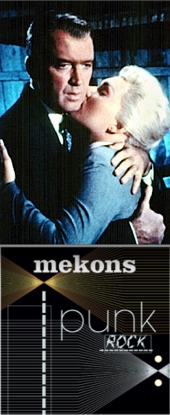
Romance and anguish: James Stewart and Kim Novak in the psycho-drama Vertigo (top), and the post-punk Mekons

◼︎ TWO UNEXPECTED RECENT VIDEOS have acquired poignant new life in the wake of Malcolm McLaren’s death, Svengali of punk that he was. Few people could have guessed that the soundtrack to one of last month’s Paris ready-to-wear fashion shows [in the video above] would be McLaren’s final creative achievement.

It was completed after his diagnosis of cancer and possibly in acceptance of his own mortality.

What seduces the listener is the overwhelming melancholy McLaren evokes, in what suddenly amounts to a Requiem to Myself. It was commissioned by Dries Van Noten – to set a deliberately discomfiting mood for his runway show amid the gilded opulence of the Hôtel de Ville in Paris on March 3.

After McLaren’s funeral, his partner Young Kim described the piece to Shapers of the 80s as “quintessential Malcolm McLaren – an entirely original and powerful, elegant but punk collage”. She gave us permission to run the full 13-minute mash-up in clean mp3 format, featuring the Vertigo theme, Mekons, Roxy, Raincoats and Burundi Beat.

➢ CLICK HERE for the full McLaren/Dries Van Noten soundtrack and background report on its creation on our inside page

➢ The Raincoats perform The Raincoats for Don’t Look Back in London, May 20, 2010, at The Scala in London

➢ More at Shapersofthe80s: Svengali of Pistols and punk remembered by those who knew him

++++++++++++

McLaren on how to fail brilliantly
in this ‘karaoke world’

◼︎ “THIS WORLD WE LIVE IN TODAY is no more than a karaoke world, an ersatz society, which provides us with only the opportunity to revel in our stupidity… A karaoke world is one in which life is lived by proxy.” So said Malcolm McLaren last October, only days before he discovered he was unwell. He was presenting a keynote speech to 1,000 delegates in London at the Handheld Learning Conference 2009 about the future of learning and education.

➢ Details from the Learning Conference also on our inside page

FRONT PAGE

2010 ➤ A giant dies: Charlie Gillett, the man who defined rock’n’roll and world music

Charlie Gillett, BBC, Radio London

Charlie Gillett at BBC Radio London: he presented the influential Honky Tonk from 1972 until 1978

❚ ONE OF THE MOST ENDURING INFLUENCES on the British and other music scenes died yesterday. Charlie Gillett was a passionate music publisher, journalist, author in 1970 of the first serious book to appraise the birth of rock’n’roll, and a much-loved deejay who presented “possibly the most engaging show on British radio”.

In 1997 he celebrated some of his discoveries in a massive Sunday Times reference work, 1,000 Makers of Music. He was part of a panel who first coined the term “world music” and from 1999 became internationally renowned through the BBC World Service. From January this year, for health reasons, Charlie decided to take a rest from his work. This morning, his own Sound of the World website was inundated with tributes, while Charlie’s choice of music was still streaming at his djjackdaw page at MySpace, along with a beautiful and resonant video of the French chanteuse Soha singing C’est bien mieux comme ça…

➢➢ Full tributes and links to Charlie
Gillett’s world of music

FRONT PAGE

2010 ➤ ‘Missing Link’ Kids roar back to life

Rich Kids, rich memories: Gary Kemp joins Glen Matlock, left, with Midge Ure and Steve New to the right. Rusty Egan on drums is masked by the bright lights. Ropy mobile picture © by Shapersofthe80s

Rich Kids, rich memories: Gary Kemp joins Glen Matlock, left, with Midge Ure and Steve New to the right. Rusty Egan on drums is masked by the bright lights. Ropy mobile pic © by Shapersofthe80s

❚ RICH KIDS ARE USUALLY WRITTEN OFF as “a short-lived, much-hyped rock band from London”, founded in 1977 by songwriter and bassist Glen Matlock, after he quit The Sex Pistols more enamoured with 60s sounds than 70s. Indeed the Kids were a one-hit wonder with only one eponymous single ever making the lower reaches of the charts, for five weeks in 1978. Yet with hindsight, they are today dubbed by the cognoscenti such as Spandau Ballet songwriter Gary Kemp and his band’s manager Steve Dagger as the “Missing Link” between punk and the New Romantics movement – an admission that was absolutely verboten in Spandau’s early days.

All of which made a one-off reunion gig at the Islington Academy last night, Jan 7, 2010, a curious footnote to history. For in the audience were some of the coolest clubbers from the 1970s scene, as enthusiastic as schoolboys, snapping away on their phonecams. Everybody, of course, was now hitting paunchy middle age, both onstage and off, and it took several numbers before the band got into its power-pop stride.

The occasion was poignant. Matlock and his mates were staging a charity benefit for fellow Kids guitarist Steve New who is fighting ill health. As in the old days, Midge Ure turned out on lead vocals with Rusty Egan on drums. Then for Ghosts of Princes in Towers, Spandau’s Kemp received a warm welcome by joining his iconic heroes wearing Romantic plaid trews and jamming on guitar. The other occasional Kids member, ex-Clash guitarist Mick Jones, supported last night’s bill in his noisy incarnation as Carbon/Silicon with fellow punk Tony James.

Rich Kids 1978

Tell-tale signs: Rich Kids began pushing pop in new directions in 1978, first with their name and their lyrics, reinforced with colourful 60s-style clothes and moptop haircuts – just look at Rusty’s barnet

So what was the missing link during the post-punk vacuum? The tell-tale signs are all over the early photos of Rich Kids and especially in their very Mod-flavoured 1978 debut on Top of the Pops that epitomised power pop, viewable in this video. The ex-Pistol Matlock favoured melody, the glam popster Ure favoured electronics while both revered the Small Faces as gods from the 1960s. In Mojo magazine last month, Ure said: “What Glen did back then by asking me to come and join the band was incredibly brave. He could have chosen any cool, punky young guitarist-singer in London – I mean, there were thousands of them. Instead he chose this teenybop, bubble-gum type guy, therefore making things incredibly difficult for himself… I suppose the Rich Kids were the Humble Pie of our day: not The Herd and Small Faces, but the Pistols and Slik – you couldn’t get anything more opposite.”

Marching Men: Rich Kids’ single, 1978

At last night’s gig, fashionista Graham K Smith, formerly of New Sounds New Styles, drew a stark contrast between the look flouted by the Kids and the black-or-black prescribed by the punk fashion police. “The Rich Kids were fops. They were absolutely going against the dour sartorial styles of the time. Their hair was long, shaggy, grown-out pudding bowls. Matlock was in velvet jackets and baggy, piratical shirts (at least two years before Vivienne’s seminal pirate collection). Midge was in pink and red towelling nursery garb, and the immaculate Steve New was pushing the boundaries in pink leopardskin-print drainpipes, with his updated take on 1974’s mohair jumper vibe. In retrospect, the Kids are the link between early 70s glam, and the full-on fop explosion of the early 80s.”

It’s the fortunes of the Kids’ shifting yet highly talented personnel and their projects which make them significant. As writer Simon Mills “from Smash Hits” (launched 1978) said last night: “Can you name all the bands Midge Ure has been in?” From Slik in 1974 onwards, this Scottish weathervane has graced more than half a dozen, see here. As a DJ Egan of course pioneered the electrosynth dance sounds that were to transform UK clubbing, splitting with the guitar-led Rich Kids to form the synth-led group Visage in 1978 with Ure and Steve Strange, who quickly established himself as the popinjay of New Romance. It was Ure’s vocals that eventually established one of the seminal sounds of the 80s with the band Ultravox, who also set a benchmark for pop videos by shooting on celluloid to achieve a cinematic effect, notably with Vienna in 1981.

Last night, after breaking a few sticks on his drumkit, Egan had the last word: “I’ll be glad to get back to deejaying.”

➢➢ Click here to watch Ghosts of Princes in Towers
➢➢ Click here to watch the concert finale
➢➢ Click here for Phil Singleton’s full review and masses of pix

Rich Kids 2010

Last bow: Rich Kids and friends at the Academy. Mobile pic © by Graham K Smith

FRONT PAGE