“It did all right, Culture Club, but, you know, move on” – Boy George the ex-singer
“Dance music is probably the most exciting it’s been in years” – Boy George the deejay
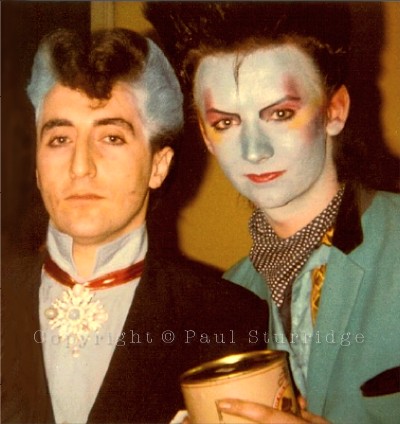
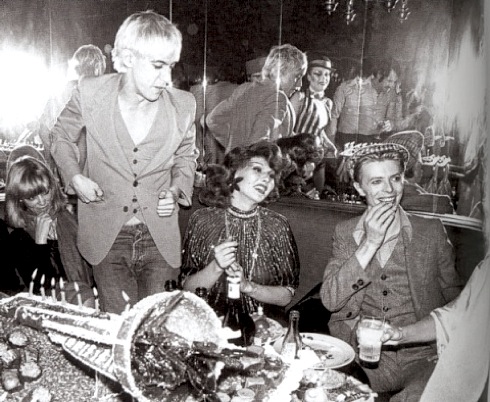
Philip Sallon partying with blue-faced George in 1980 when he was an obsessive record collector. (Photographed by Paul Sturridge)
❏ Feb 20 update: The new slimline beardie, tachioed George interviewed at the Brits:
“Twitter were very nice and got my name back [from somebody else] but Facebook won’t do it – so I actually don’t own my Facebook page. I’m Angela Gina Dust”
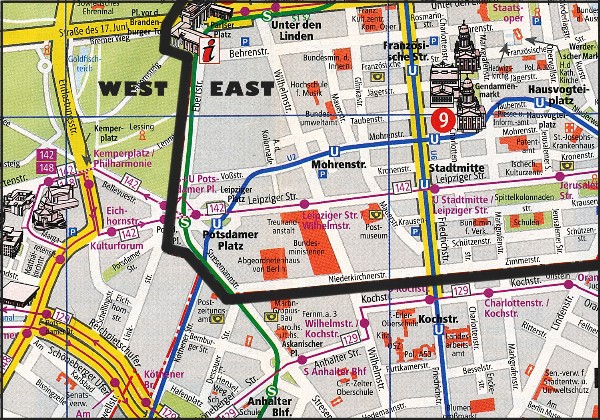
Divided Berlin: the wall shown in black places the U-Bahn station (blue) at Potsdamer Platz inside the Soviet sector, along with the S-Bahn station (green)
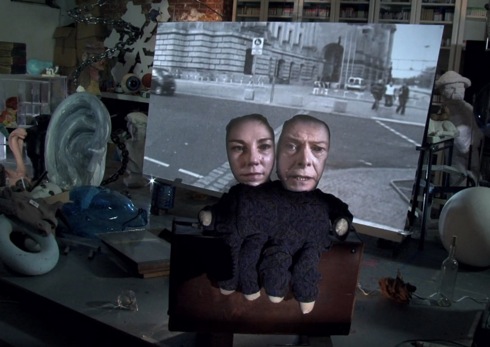
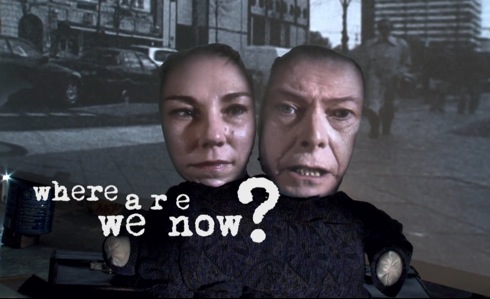
❚ THE NEW MUSIC VIDEO for Where Are We Now? raises challenges during David Bowie’s nostalgic Berlin city tour that his fans expect to decipher. Lesser mysteries were quickly cracked this week:
1 – The woman’s face on the cuddly toy is the video director’s wife Jacqueline Humphries.
2 – The T-shirt slogan “m/s Song of Norway” refers to both a retired and renamed cruise ship (Royal Caribbean has used Iggy Pop’s Lust for Life in its commercials), and an operetta that was made into a film starring Bowie’s onetime girlfriend Hermione Farthingale who inspired a song.
3 – The closing shots of the Siegessäule (Victory Column) resonate also as the title of Berlin’s gay community magazine.
4 – The lyric’s curious non-idiomatic phrase “walking the dead” coincidentally references the title of an American drama about a transgendered person.
But the real Poirot Puzzler raised by the opening line of the song is this: *How* did Bowie “get the train from Potsdamer Platz” (incidentally, or deliberately, misspelt on screen) to reach his Berlin haunts in the 70s? Today any of us can easily take the U2 towards Nürnberger Strasse, the lyric’s next destination, where once, he sings, he would sit in the cool Dschungel nightclub frequented by assorted popstars (his favourite seat was on a balcony overlooking the bar). We can also take the S1 line south from PP to the trendy Schöneberg district where Bowie used to share rooms with Iggy Pop.
But not when Bowie lived in Berlin, during the years now identified with his Berlin Trilogy of albums, 1976-79. Why not? Because of the 12-ft high Wall, fortified with minefields, anti-tank defences and ruthlessly guarded, the symbol of communism which had divided the city since 1961. As we see from the map (above) both the stations for the S-Bahn surface train line and the U-Bahn underground line lay on the East side of the wall within the Soviet sector.
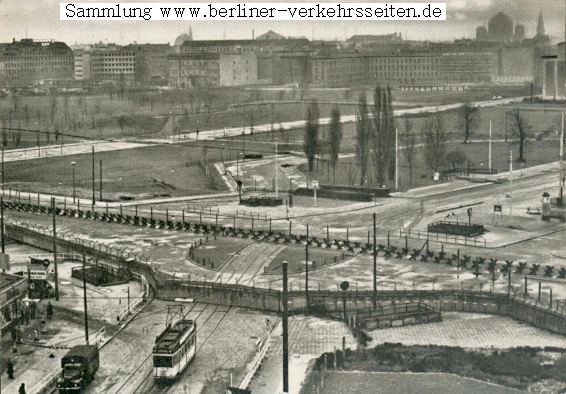
In the late 70s the site of Potsdamer Platz was a wide-open wasteland on the East of the Wall, a No Man’s Land chillingly known as the Kill Zone, where guards could gun down the continuing stream of desperate East Berliners courageous enough to make a dash for the West.
Potsdamer Platz in 1961: the postwar wasteland is divided by the first low-rise Wall and was to become known as the Kill Zone
Bowie’s workplace, the Hansa Studios where he recorded Low and Heroes, actually overlooked the Wall from the American sector, in Köthener Strasse a few yards south of Potsdamer Platz. Catching sight of two lovers near the Wall inspired the theme for the number, Heroes, in 1977, one of his most creative song-writing periods.
But Bowie could not have taken his train from either of those stations because they had been closed and barricaded when the Wall was built. Western trains continued to cross East Berlin along lines which emerged in the West but they passed through without stopping at many such stations which became known as Geisterbahnhöfe (ghost stations). Concrete collars at tunnel entrances scraped the sides of the trains to deter escapees from clinging to them. Half a lifetime later, on March 3, 1992, the S1 stop in Potsdamer Platz was the last ghost station to reopen after the reunification of Germany.
Perhaps Bowie departed from some other station? What about the 19th-century regional railway terminus called Potsdamer Bahnhof, you say? It fed ritziness into the heart of the metropolis and Potsdamer Platz became one of Berlin’s busiest traffic intersections where famously Europe’s first traffic lights were installed in 1924. The whole area was, however, laid waste during World War Two and the last trains you could have taken from this station ran in 1945.
Ah, yes but what about the innovative M-Bahn, the Magnetic Levitation line which powered south from the Philharmonie, skirting the Wall by Potsdamer Platz as it headed down to the river? Sorry, this didn’t open until 1989.
So how on earth did David Bowie take his train from Potsdamer Platz?
Is our hero indulging some romantic fantasy on behalf of an East Berliner during the 70s, making a wistful trip to the freewheeling delights of Schöneberg and the KaDeWe department store that became an attainable dream only after the fall of the Wall – as he sings, by crossing the Bösebrücke on November 9, 1989?
And why the first word of the song? Why *had* he to get this train at all? He was well-known for cycling everywhere in Berlin, such was the personal freedom he enjoyed there. And why from Potsdamer Platz?
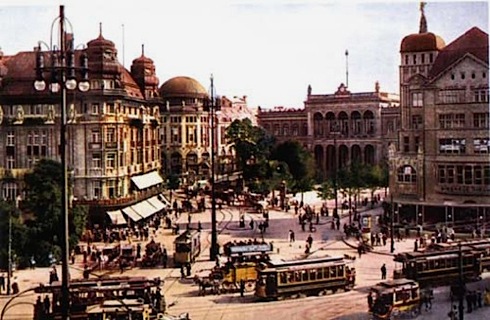
Potsdamer Platz in 1910: looking south towards the Potsdamer Bahnhof
JAN 16 INSIGHT FROM THE NME
❏ Bowie producer Tony Viscontisays of Where Are We Now?: “To me, it’s not about the three-years he spent in Berlin in the 70s. It feels like just one day he had an epiphany walking in the street.” So there we have it. A walk in the street. Puts our post above out with the trash. Still, it painted a picture of an era that is probably unimaginable for anybody who hadn’t visited the divided city between 1961 and 1989.
When Bonn became the capital of West Germany in 1949, the war-ravaged city of Berlin grew ever more desolate, despite the handful of nightclubs where hedonism was very much defined as the antidote to the privations of daily life. The Western sectors felt like a minor provincial city with a population of 2 million, mostly consisting of the elderly, because everybody else had left to make new lives elsewhere. Just turning 30, Bowie and Iggy were among the city’s youngest inhabitants and their work as musicians was one of the few productive industries in an enfeebled economy.
Nightclubbing 1977: Bowie and Iggy enjoy the Berlin nightlife
The Soviet sector, which we Westerners were privileged to visit, unlike its citizens wishing to make the opposite journey, felt tragic: rundown beyond the point of dilapidation, with high-rise Tower blocks in the brutalist Soviet style built to ease the pressure on a crowded population and signal the “modernity” of the East. As with visits to the Soviet Union, tourists were usually conscious of being followed or at least monitored by East German security personnel, and woe betide any local who behaved in an inappropriately friendly manner toward visitors! With the Stasi (state security service) relying on family members to inform on each other, the East became a society of subterfuge, with a black economy built less on cash than barter and influence at all levels of daily life.
+++ ❚ SURPRISE WAS THE SECRET WEAPON. Even the star’s longtime London publicists were told only on Friday. For months there must have been “sudden death” clauses in his 35 collaborators’ contracts to deter them from breathing a word about the 14 songs on his first album in a decade, or about yesterday’s haunting new single, realised in a resourcefully resonant music video that navigates those fertile but often fraught landmarks from Berlin in the 70s as if in Google Street View… every one a turning point… ghosts from the tragic city’s Cold-War hinterland as well as the singer’s own.
Driven by piano and synth, the song is a bittersweet elegy. Its poignant title asks Where Are We Now? and is rendered with suitable despair, while the accompanying images reinforce the singer’s seemingly mournful contemplations on “walking the dead”. Yet all comes clearer with repeated viewing when the self-deprecating humour brightens your moist eyes. The old fella’s tremulous voice, eroded half an octave lower than we remember, is courageously confessing with dignity and relief what all buddhists seek in the journey through life – enlightenment. There may be melancholy in his acceptance of mortality but it is unsentimental. “As long as there’s sun / As long as there’s rain” and crucially “As long as there’s fire”, then “You know, you know”.
The news broke at 5am in the UK (midnight in New York) on his 66th birthday, and the world’s media suddenly received the good news like a shot in the arm. No, Bowie had not retired, laid low after heart surgery in 2004, but was back with a bang. By breakfast-time BBC Radio’s flagship current affairs show Today rushed a critic into the studio to enthuse about the new ballad as legacy from Bowie’s so-called Berlin Trilogy of albums, 1976-79, produced by Tony Visconti, as is the new album. The veteran anchor John Humphrys empathised with a “weariness” he detected in the voice.
By 3pm the single was topping the British iTunes chart and by midnight the next day’s national press were trumpeting their finest prose stylists in spreads devoted to the last of the godlike popstars who define their era. This is the sizzle The Thin White Duke still generates. If Mr Humphrys thinks Bowie was sounding his age, in The Times Caitlin Moran thinks the song shows every year of Bowie’s age beautifully…
THE FOXED VOICE
➢ Caitlin Moran in The Times says Bowie arrived out of retirement overnight, like unexpected snow “It is a worn voice, a gentle voice, a voice with small burn-holes, slight foxing. Of all the things, it most reminded me of David Attenborough narrating some extraordinary murmuration of starlings, or a thaw. A voice that has a superior grasp of how large the universe is; a voice that has come to appreciate the value in simply being alive.”
THE LIVING POET
➢ Poet Alan Jenkins blogs at The Times Literary Supp and shares his elation at the arrival of a masterpiece “Almost from the first and unfailingly ever since, Bowie has been a byword for musical boldness and invention. His instinctive power as a lyricist has perhaps been somewhat overlooked – his characteristic note a combination of the shy and portentous, of confessional detail and unembarrassed declamation, of raw truthfulness and authentically barmy allegorizing. Where…? takes us haltingly into personal history and personal mortality, distilling from its simple, beautiful progressions an atmosphere of bewildered sorrow that is not entirely dispelled by the tender-stoical declarations of the final moments.”
➢ Neil McCormick in the Telegraph declares the perfect comeback “Lush, stately, beautifully strange, weaving resonant piano chords, decaying synths and echoing drums around a simple chord progression and a weary, tenderly understated, quietly defiant vocal, the ageing Starman reminisces about days in Berlin… It is to the slightly wonky, retro-futuristic ambience of late Seventies rock electronica that Where Are We Now? returns … It was a musical style influenced by one-time collaborator Brian Eno and once heralded for its icy futurism, but now it sounds familiar enough to be instantly accessible yet oddly contemporary. Retro synths are all the rage once again, early electronica deemed to have a quality of human warmth often absent in hi-tech digital pop.”
THE SELF PROMOTER
➢ Alexis Petridis in The Guardian on an object lesson in record promotion “The main reason it’s created such a fuss is simply because no one knew. It’s incredible that, in an era of gossip websites and messageboard rumours, one of the biggest stars in the world, presumed retired, can spend two years making a new album without the merest whisper of it reaching the public. But somehow he did it… Whatever The Next Day sounds like [the album due on March 11], he’s turned it into the biggest release of 2013 by the simple expedient of doing absolutely nothing other than make an album. Furthermore, he’s managed to maintain the myth and mystique that was always central to his stardom and his art in a world where rock and pop music has almost no myth or mystique left.”
THE WHISPERING SAGE
➢ At the Quietus Chris Roberts asks: After a decade of artlessness Bowie is back. So why are so many clowns complaining? “The delicately-sung single, Where Are We Now?, is not “instant”, or flash. It is not a sad by-numbers attempt to recapture old glories. It is very much Bowie, but it is a quivering ghost of a Bowie song, the imprint of his fabulous past gently laid over a forlorn, elegiac yet life-affirming drape of meditations and reveries about missing the old Europe and, possibly, youth. It is becoming of the man, and of the star. And it is becoming obvious that, after all this time, he wouldn’t have let it out of the house if he didn’t believe it would add to his body of work and polish his mythology. It is spectral, frail, yearning without chest-beating, candid in its few, clipped phrases and sighs concerning the heart’s filthy lessons. The crooning peacock is now a whispering sage.”
BOWIE’S BERLIN SIGHTS DECODED
➢ Helen Pidd, The Guardian’s former Berlin correspondent, helps identify key Berlin landmarks in Bowie’s video “In the 20s Potsdamer Platz was the place to be, full of sexy lesbians in smoking jackets and the sort of boys Christopher Isherwood fancied. Then we bombed it. After the war, the East Germans built the Berlin Wall around it, placing it in a no man’s land. If you’ve seen Wim Wenders’ film Wings of Desire, you’ll remember the old man sitting on a sofa in what purported to be the deserted Potsdamer Platz…
“The archetypal Berlin art studio-cum-squat: This is a modern cliche of the German capital. Bowie, in his enigmatic slogan T-shirt, looks like any other foreign immigrant who has come to Berlin to “do my art” (read: go to Berghain and get an asymmetric haircut). Like many of the city’s young pretenders, he is carrying a notebook and no doubt tells people at squat parties he is a writer.”
ECHOES OF EXTRAS?
+++ ❏ And in lighter vein…More than one fan has noticed that parts of the new melody bear a resemblance to Pathetic Little Fat Man, Bowie’s improvised tribute to Ricky Gervais in his BBC sitcom Extras in 2006 (above)
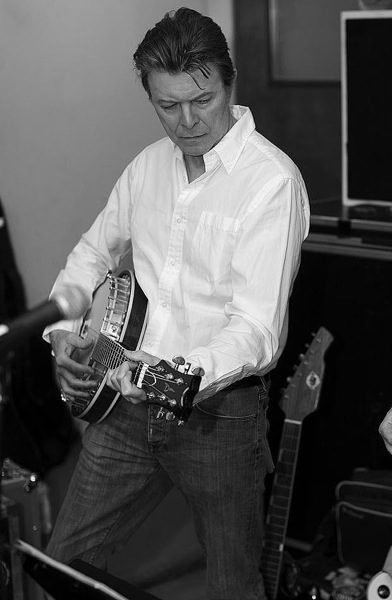
Banjo-man! Exclusive birthday photograph (Jimmy King )
❚ BRITISH POP’S NEXT JUSTIN TIMBALIKE, according to PopJustice, is Tyler James, the slick-suited Mr Fit who amazingly did NOT win The Voice TV talent show last year, despite a brilliant soulful voice and emotive falsetto. This week he swaggers through the video [below] for his new single Worry About You, featuring British rapper Kano to underline hard-man East London cred. It’s the second heartfelt tune to be released from his recent album A Place I Go, some songs on which reflect his turbulent past as a best buddy of the tragic Amy Winehouse who died last summer.
In the softly porny video for his last release Single Tear we see Tyler as a ho-master. In the new video for Worry About You he moves up to scarfaced power player in gangland. What is it with casting white boys as gangstas? It doesn’t wash. Nor does it square with the songwriter’s yearning in lyrics such as “I haven’t cried a single tear whole year” and “Worry about you baby, I worry about you”. This dude cares about people.
OK, his album is a ballad-led tearjerker but among 14 tracks it contains only two upbeat numbers: we hear none of the mischief we can see in those bright blue eyes. The reviews have been mixed and a consensus feels his handlers have yet to grasp how to project Tyler’s simmering matinee-idol charisma. What is it with today’s pop-biz shapers that they no longer know how to assess a talent and play to his strengths?
Before-and-after designs: left, coloured Plasticine model … right, real food on the plate by El Bulli chefs
❚ EATING CAN BE THEATRE, just as food can be art. The Catalan chef Ferran Adriá is Houdini and Picasso in one, commonly lauded as the best in the world. His three-Michelin starred restaurant El Bulli, two hours north of Barcelona, was an academy repeatedly garlanded by scholars who take dining seriously. Since 1987 it grew to serve 1,500 plates daily, prepared by 50 cooks and served by 30 staff typically to only 50 companions at table. Its culinary revolution is known as “molecular gastronomy” famed for scented gels and foams and for using every part of every animal and plant.
Adrià’s manifesto: No 10 of his 23 principles that summarise El Bulli’s cuisine
Now after 25 years of experiments, Adriá is replacing the restaurant with an inspirational foundation, while his career is being celebrated in Spain’s first major exhibition about cooking. In a series of galleries at Barcelona’s Palau Robert, we are blown away by a fearsomely complete collection of photos, letters, utensils, mementoes, and a vast poster of the 1,846 dishes catalogued by the restaurant. Best of all are the videos in which we see his edible creations being conjured. Another simple but charming glimpse behind the magician’s hand is a table-top displaying before-and-after designs of individual dishes: ingredients modelled from coloured Plasticine are composed as templates for his chefs to translate – abracadabra! – into the resulting plates of food shown alongside.
“ Tonight’s dinner involves all the senses, it engages the mind, and is also, at times, a strangely emotional experience. The dishes can be confrontational as well as exquisite… The constant stream of surprises continues for more than four hours – the green leaf that tasted exactly of oysters; the grilled strawberry with ginger on the outside and an injection of gin on the inside; the polenta gnocchi with coffee and saffron yuba; the perfect razor clam with its gelatin twin in the other half of the opened shell. Playful, arresting, occasionally alarming, the meal is almost like a story… ” / Continued at Guardian Online
❚ THE “WORLD’S MOST USELESS MACHINE” is not new news but it did raise a smile during a trip to the year-old Museum of Ideas and Inventions – essentially a hands-on diversion for restless children – while Christmassing in Barcelona. The co-founder of Massachusetts Institute of Technology’s laboratory of artificial intelligence, Marvin Minsky, came up with the idea in 1952. Electronics engineer and the “father of information theory” Claude Shannon, who worked with Minsky at IBM, liked the idea so he built the machine. It is a battery powered box, the sole purpose of which is to turn itself off after some human hand has turned it on.
You too can assemble your own useless machine in beginner-level electronics kit form (from US$35 + shipping), or in a ready-soldered version (from US$55 + shipping). Both include printed circuit board.
➢ Choose “View full site” – then in the blue bar atop your mobile page, click the three horizontal lines linking to many blue themed pages with background article
MORE INTERESTING THAN MOST PEOPLE’S FANTASIES — THE SWINGING EIGHTIES 1978-1984
They didn’t call themselves New Romantics, or the Blitz Kids – but other people did.
“I’d find people at the Blitz who were possible only in my imagination. But they were real” — Stephen Jones, hatmaker, 1983. (Illustration courtesy Iain R Webb, 1983)
“The truth about those Blitz club people was more interesting than most people’s fantasies” — Steve Dagger, pop group manager, 1983
PRAISE INDEED!
“See David Johnson’s fabulously detailed website Shapers of the 80s to which I am hugely indebted” – Political historian Dominic Sandbrook, in his book Who Dares Wins, 2019
“The (velvet) goldmine that is Shapers of the 80s” – Verdict of Chris O’Leary, respected author and blogger who analyses Bowie song by song at Pushing Ahead of the Dame
“The rather brilliant Shapers of the 80s website” – Dylan Jones in his Sweet Dreams paperback, 2021
A UNIQUE HISTORY
➢ WELCOME to the Swinging 80s ➢ THE BLOG POSTS on this front page report topical updates ➢ ROLL OVER THE MENU at page top to go deeper into the past ➢ FOR NEWS & MONTH BY MONTH SEARCH scroll down this sidebar
❏ Header artwork by Kat Starchild shows Blitz Kids Darla Jane Gilroy, Elise Brazier, Judi Frankland and Steve Strange, with David Bowie at centre in his 1980 video for Ashes to Ashes
VINCENT ON AIR 2026
✱ Deejay legend Robbie Vincent has returned to JazzFM on Sundays 1-3pm… Catch up on Robbie’s JazzFM August Bank Holiday 2020 session thanks to AhhhhhSoul with four hours of “nothing but essential rhythms of soul, jazz and funk”.
TOLD FOR THE FIRST TIME
◆ Who was who in Spandau’s break-out year of 1980? The Invisible Hand of Shapersofthe80s draws a selective timeline for The unprecedented rise and rise of Spandau Ballet –– Turn to our inside page
SEARCH our 925 posts or ZOOM DOWN TO THE ARCHIVE INDEX
UNTOLD BLITZ STORIES
✱ If you thought there was no more to know about the birth of Blitz culture in 1980 then get your hands on a sensational book by an obsessive music fan called David Barrat. It is gripping, original and epic – a spooky tale of coincidence and parallel lives as mind-tingling as a Sherlock Holmes yarn. Titled both New Romantics Who Never Were and The Untold Story of Spandau Ballet! Sample this initial taster here at Shapers of the 80s
CHEWING THE FAT
✱ Jawing at Soho Radio on the 80s clubland revolution (from 32 mins) and on art (@55 mins) is probably the most influential shaper of the 80s, former Wag-club director Chris Sullivan (pictured) with editor of this website David Johnson
LANDMARK FAREWELLS. . . HIT THE INDEX TAB UP TOP FOR EVERYTHING ELSE











 ➢➢ Shapers of the 80s ➣➣