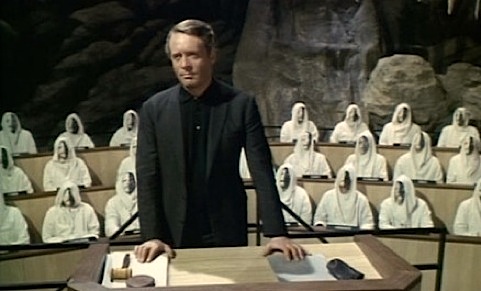
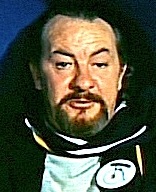
 ❚ THE MAN ABOVE IS CALLED No 6: “I am not a number, I am a free man.” The man on the right is the sinister No 2: “I am the boss.” – “No. One is the boss.”
Such staccato dialogue sustained 17 almost hour-long episodes of The Prisoner in 1967, widely regarded as British TV’s most original series. And was it intense! And mould-breaking. It has been declared the 13th most cultish sci-fi series ever by refusing to solve its own enigma: What on earth was it about? The Prisoner was set in a stylised prison village that was a real-world architectural gem, with quirky costumes and motifs such as its pennyfarthing logo which nobody explained. The show calculated to provoke.
 The Prisoner made a star of angry, intelligent Patrick McGoohan, who frowned a lot and so became the coolest dude of all time (after Jimmy Dean). He was also the show’s creator and executive producer and played Lotus-driving good-guy No 6, a secret agent they (who?) won’t allow to retire. In the wake of Michael Caine’s sudden fame as Harry Palmer, it proved a trippy, tongue-in-cheek, cold-war precursor to knowing dramas such as The X-Files, 24, Lost, Twin Peaks, even The Matrix and The Truman Show, by being witty and profound by turns. Over its 17 episodes every Brit actor with swagger signed up for a cameo role, with Leo McKern, Peter Wyngarde, Mary Morris and Patrick Cargill replacing each other in the role of No 2. Dare to start watching the stunning Blu-ray DVD (Network, 2009) of the original 1967 Prisoner and you’ll be agog at how it stands the test of time. (Given that the BBC had launched Europe’s first colour TV service only three months before, The Prisoner’s crisp 35mm cinematography is exceptional for its day.) Don’t expect shoot-em-up action, just heated arguments about who’s on whose side.
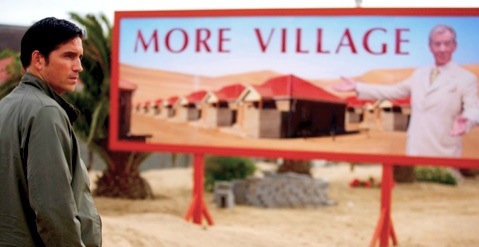
The six-part remake launches on ITV this week, April 17. The man on the left is now No 6 – he’s an American called Jim Caviezel, who once played Jesus in a Mel Gibson movie. The man in the white suit is the new No 2, one of Britain’s greatest actor-knights known internationally to cinema audiences as Gandalf. (The geeks out there might like to know that the Official Prisoner Appreciation Society will be getting all dressed up for their convention at Portmeirion, the original show’s Welsh location, this very weekend.)
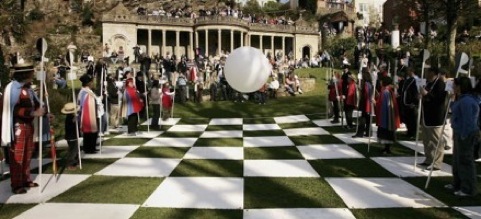
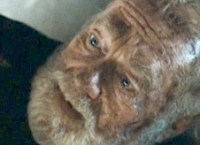 The new Prisoner has been, hmm, let’s say, zip-coded: 93-6-2-oh! It does contain some neat homages to the earlier epic. McGoohan its creator and its No 6 now reappears as No 93 (right), an old man whose first words pose the new enigma. It brings a tear to the eye to know that at the grand old age of 80, the cool dude Pat died only last year, soon after filming. The other treat is a moody and vengeful balloon called Rover (below). We never knew quite what Rover was the first time round, but he does indeed return.
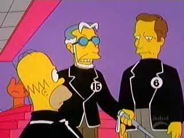 The Prisoner always was said to be “ahead of its time”. In 1968, Isaac Asimov gloomily declared it was about failure, and was popular because it “cracks the old undemocratic folly of success for the few”. Indeed, years later McGoohan conceded that the bicycle logo was an ironic symbol of progress. Ah, ironic – that’s the word. Perhaps Homer Simpson was the best judge.
THE DAY NUMBER 2 REALLY CRACKED
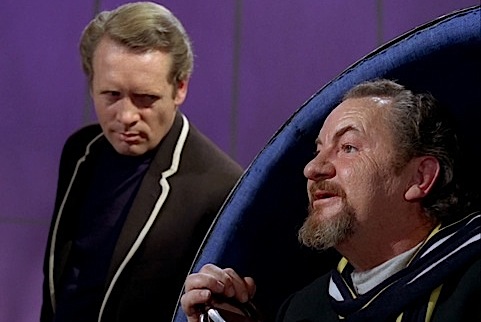
No 6 v No 2: McGoohan and McKern locked in a power struggle
❚ AS PRODUCER, THE USUALLY TACIT McGOOHAN made an extraordinary confession about the pressures of making The Prisoner in his interview with Warner Troyer for TVOntario, which was broadcast in 1977. He’s talking about the episode titled Once Upon a Time:
“That was written in the 36-hour period. And Leo McKern, who was a very good friend of mine and a very fine actor [familiar to most of us, in his later years, as Rumpole of the Bailey], came in on short notice to do it, and it was mainly a two-hander. The brainwashing thing, he was trying to brainwash me and in the end No 6 turns the tables. And the dialogue was very peculiar because all it consisted of was mainly “Six, Six, Six,” and five pages of that at one time. And Leo, one lunchtime, went up to his dressing room and I went to see the rushes and I knew he was tired. I went up to the dressing room to tell him how good I thought he’d been in the rushes. And he’s curled up in the fetus position on his couch there, and he says, “Go away! Go away you bastard! I don’t want to see you again.” I said, “What are you talking about?” He says, “I’ve just ordered two doctors,” he says, “and they’re comin’ over as soon as they can.” He says, “Go away.” And he had. He’d ordered two doctors and they came over that afternoon and he didn’t work for three days. He’d gone! He’d cracked, which was very interesting. He’d truly cracked. So I had to use a double, the back of a guy’s head for a lot, and eventually Leo did come back and we completed the scenes, and also he was in the final episode, so he forgave me for everything. But he did crack, very interesting, I thought.”
FRONT PAGE






 ➢➢ Shapers of the 80s ➣➣