
❚ SURPRISE WAS THE SECRET WEAPON. Even the star’s longtime London publicists were told only on Friday. For months there must have been “sudden death” clauses in his 35 collaborators’ contracts to deter them from breathing a word about the 14 songs on his first album in a decade, or about yesterday’s haunting new single, realised in a resourcefully resonant music video that navigates those fertile but often fraught landmarks from Berlin in the 70s as if in Google Street View… every one a turning point… ghosts from the tragic city’s Cold-War hinterland as well as the singer’s own.
Driven by piano and synth, the song is a bittersweet elegy. Its poignant title asks Where Are We Now? and is rendered with suitable despair, while the accompanying images reinforce the singer’s seemingly mournful contemplations on “walking the dead”. Yet all comes clearer with repeated viewing when the self-deprecating humour brightens your moist eyes. The old fella’s tremulous voice, eroded half an octave lower than we remember, is courageously confessing with dignity and relief what all buddhists seek in the journey through life – enlightenment. There may be melancholy in his acceptance of mortality but it is unsentimental. “As long as there’s sun / As long as there’s rain” and crucially “As long as there’s fire”, then “You know, you know”.
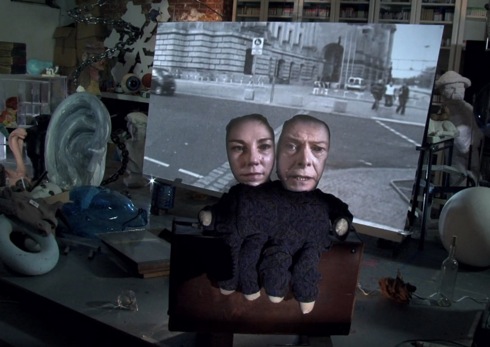
Bowie and soulmate as one cuddly toy: their faces are projected onto the puppet-like dummy, Berlin’s Reichstag in the city tour is projected behind them during Tony Oursler’s video for Where Are We Now? (© Iso/Columbia)
The news broke at 5am in the UK (midnight in New York) on his 66th birthday, and the world’s media suddenly received the good news like a shot in the arm. No, Bowie had not retired, laid low after heart surgery in 2004, but was back with a bang. By breakfast-time BBC Radio’s flagship current affairs show Today rushed a critic into the studio to enthuse about the new ballad as legacy from Bowie’s so-called Berlin Trilogy of albums, 1976-79, produced by Tony Visconti, as is the new album. The veteran anchor John Humphrys empathised with a “weariness” he detected in the voice.
By 3pm the single was topping the British iTunes chart and by midnight the next day’s national press were trumpeting their finest prose stylists in spreads devoted to the last of the godlike popstars who define their era. This is the sizzle The Thin White Duke still generates. If Mr Humphrys thinks Bowie was sounding his age, in The Times Caitlin Moran thinks the song shows every year of Bowie’s age beautifully…
THE FOXED VOICE
➢ Caitlin Moran in The Times says Bowie arrived out of retirement overnight, like unexpected snow
“It is a worn voice, a gentle voice, a voice with small burn-holes, slight foxing. Of all the things, it most reminded me of David Attenborough narrating some extraordinary murmuration of starlings, or a thaw. A voice that has a superior grasp of how large the universe is; a voice that has come to appreciate the value in simply being alive.”
THE LIVING POET
➢ Poet Alan Jenkins blogs at The Times Literary Supp and shares his elation at the arrival of a masterpiece
“Almost from the first and unfailingly ever since, Bowie has been a byword for musical boldness and invention. His instinctive power as a lyricist has perhaps been somewhat overlooked – his characteristic note a combination of the shy and portentous, of confessional detail and unembarrassed declamation, of raw truthfulness and authentically barmy allegorizing. Where…? takes us haltingly into personal history and personal mortality, distilling from its simple, beautiful progressions an atmosphere of bewildered sorrow that is not entirely dispelled by the tender-stoical declarations of the final moments.”
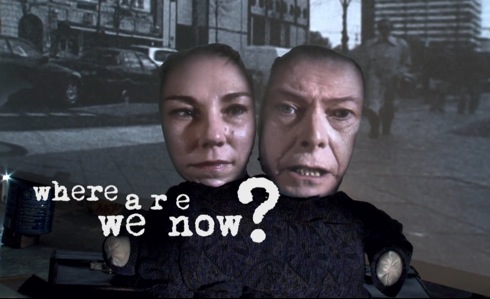
Quavering voice and unflattering close-up: pension-age Bowie ruminates on the passing of time in his stark yet tender lyrics (© Iso/Columbia)
THE RETRO MUSIC
➢ Neil McCormick in the Telegraph declares the perfect comeback
“Lush, stately, beautifully strange, weaving resonant piano chords, decaying synths and echoing drums around a simple chord progression and a weary, tenderly understated, quietly defiant vocal, the ageing Starman reminisces about days in Berlin… It is to the slightly wonky, retro-futuristic ambience of late Seventies rock electronica that Where Are We Now? returns … It was a musical style influenced by one-time collaborator Brian Eno and once heralded for its icy futurism, but now it sounds familiar enough to be instantly accessible yet oddly contemporary. Retro synths are all the rage once again, early electronica deemed to have a quality of human warmth often absent in hi-tech digital pop.”
THE SELF PROMOTER
➢ Alexis Petridis in The Guardian on an object lesson in record promotion
“The main reason it’s created such a fuss is simply because no one knew. It’s incredible that, in an era of gossip websites and messageboard rumours, one of the biggest stars in the world, presumed retired, can spend two years making a new album without the merest whisper of it reaching the public. But somehow he did it… Whatever The Next Day sounds like [the album due on March 11], he’s turned it into the biggest release of 2013 by the simple expedient of doing absolutely nothing other than make an album. Furthermore, he’s managed to maintain the myth and mystique that was always central to his stardom and his art in a world where rock and pop music has almost no myth or mystique left.”
THE WHISPERING SAGE
➢ At the Quietus Chris Roberts asks: After a decade of artlessness Bowie is back. So why are so many clowns complaining?
“The delicately-sung single, Where Are We Now?, is not “instant”, or flash. It is not a sad by-numbers attempt to recapture old glories. It is very much Bowie, but it is a quivering ghost of a Bowie song, the imprint of his fabulous past gently laid over a forlorn, elegiac yet life-affirming drape of meditations and reveries about missing the old Europe and, possibly, youth. It is becoming of the man, and of the star. And it is becoming obvious that, after all this time, he wouldn’t have let it out of the house if he didn’t believe it would add to his body of work and polish his mythology. It is spectral, frail, yearning without chest-beating, candid in its few, clipped phrases and sighs concerning the heart’s filthy lessons. The crooning peacock is now a whispering sage.”
BOWIE’S BERLIN SIGHTS DECODED
➢ Helen Pidd, The Guardian’s former Berlin correspondent, helps identify key Berlin landmarks in Bowie’s video
“In the 20s Potsdamer Platz was the place to be, full of sexy lesbians in smoking jackets and the sort of boys Christopher Isherwood fancied. Then we bombed it. After the war, the East Germans built the Berlin Wall around it, placing it in a no man’s land. If you’ve seen Wim Wenders’ film Wings of Desire, you’ll remember the old man sitting on a sofa in what purported to be the deserted Potsdamer Platz…
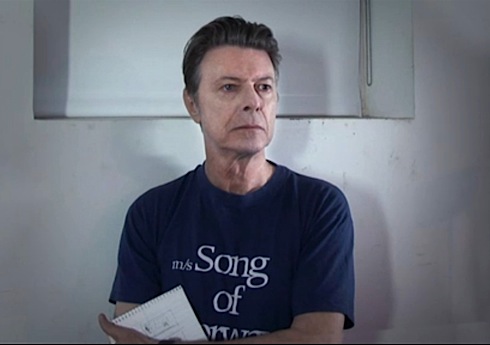
Bowie as art student: ironic coda to the video when he looks in at the auto repair shop beneath the Berlin apartment where he once lived (© Iso/Columbia)
“The archetypal Berlin art studio-cum-squat: This is a modern cliche of the German capital. Bowie, in his enigmatic slogan T-shirt, looks like any other foreign immigrant who has come to Berlin to “do my art” (read: go to Berghain and get an asymmetric haircut). Like many of the city’s young pretenders, he is carrying a notebook and no doubt tells people at squat parties he is a writer.”
ECHOES OF EXTRAS?
❏ And in lighter vein… More than one fan has noticed that parts of the new melody bear a resemblance to Pathetic Little Fat Man, Bowie’s improvised tribute to Ricky Gervais in his BBC sitcom Extras in 2006 (above)
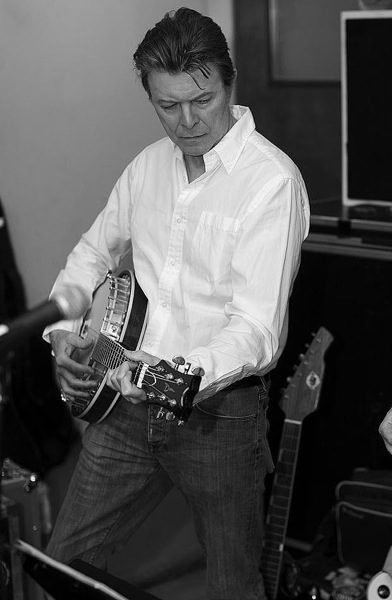
Banjo-man! Exclusive birthday photograph (Jimmy King )
➢ Future plans and memorabilia at the newly rejuvenated official Bowie website










 ➢➢ Shapers of the 80s ➣➣