
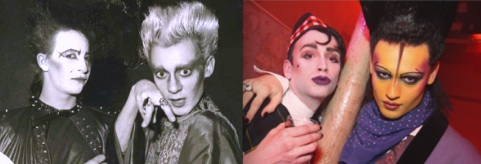
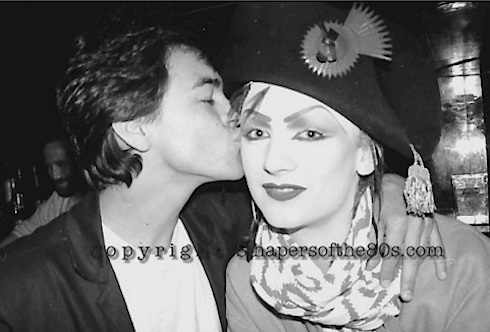
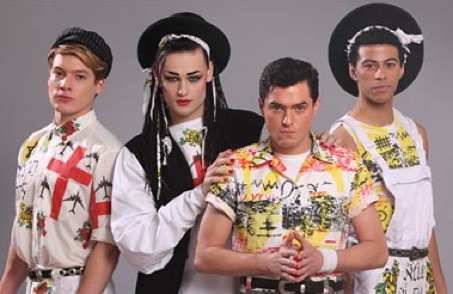
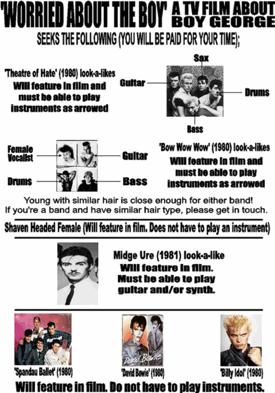
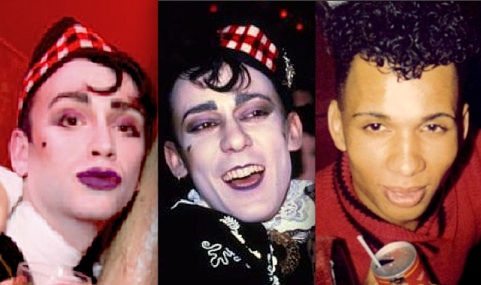
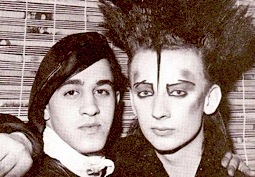
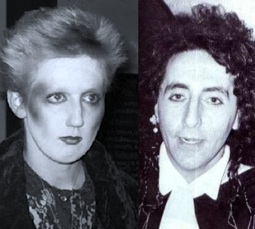
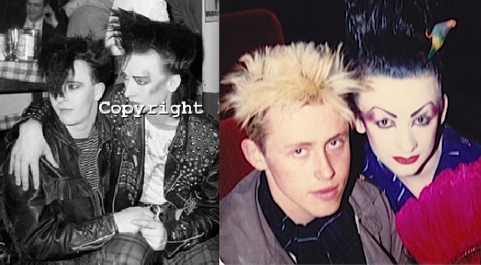
Real Blitz Kids versus the TV version: George’s boyfriend Wilf and Stephen Linard in 1979 (picture, Andy Rosen)… Daniel Wallace as a Linard lookalike and Douglas Booth as Boy George in Worried About the Boy, 2010 (BBC)
SHAPERSOFTHE80S ASKS THE ORIGINAL BLITZ KIDS:
HOW CONVINCINGLY WAS THE BLITZ CLUB OF 1979–80 RECREATED IN THE BBC DRAMA ABOUT BOY GEORGE’S TEEN YEARS?
Text © 2010-2015 Shapersofthe80s.com
 Christos Tolera, ex-Blitz Kid, singer with Blue Rondo à la Turk, today an artist – “Sadly the whole thing was a missed opportunity to show why the Blitz scene was different from what had gone before. Instead it was a series of caricatures based on what the makers see as archetypal club culture. Bear in mind that when the Blitz opened in 1979 I was 16, Steve Strange was 19, George 17, Julia 19, Chris Sullivan, Bob Elms, Melissa Caplan etc all teenagers.
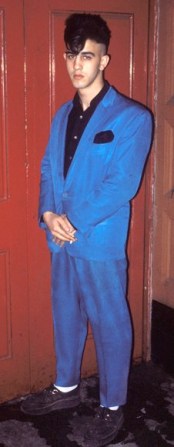
Christos Tolera in Soho, 1980, photographed © by Derek Ridgers
“People didn’t fawn over Steve. Even though I grew to like Steve (he could be genuinely funny and you have to be likeable one way or another to run a club) others did ridicule him at worst and put up with him at best. It was always an act for Steve… one that he took too far sometimes, but essentially an act.
“It was a missed opportunity to show that this was the first time a scene which had such a far-reaching effect on the cultural landscape had been born of itself, and took care of its own business. There were no Svengalis, no McLarens or other impresarios, and to try and make Steve into one reeks of a lack of understanding. He was one of us. That was the whole point. This was the true ethos of a punk culture put into practice. This really was DIY at its finest. All in all, I felt the film let us down and trivialised something much more radical than appears on screen.”
ON BOWIE’S VISIT TO THE BLITZ – “The Bowie scene left me speechless! We were not publicly full of reverence for anybody. We were full of ourselves in the way only youth can be, we were our own stars and our own audience. I remember being with Chris Sullivan and Philip Sallon and George actually refusing to pander to Bowie upstairs – it was all so embarrassing. The making of that video [Bowie put four Blitz Kids in his video for Ashes to Ashes, as in the header to this website] was the death knell for the Blitz and in my mind for Bowie as an innovator. It was my first peek beneath the veneer of public perception and its contrast with reality. Bowie was actually a pilferer and a follower stylistically – finger on the pulse but a follower nevertheless. I think that was the day we grew up and left Bowie behind. It was like leaving home.”
➢➢ VIEW – Worried About the Boy on BBC iPlayer
➢➢ A limited edition ‘Worried’ DVD & CD of Culture Club hits will be released by Universal on July 12
☆ ☆ ☆
Robert Elms, ex-Blitz Kid, now writer and broadcaster – “The play was pretty good and the Blitz nicely seedy. It seemed too much like a gay club, but then that fitted the story. Steve Strange became the pantomime villain whereas I remember him in much fonder terms. But overall not bad despite the obvious tendency to overplay the drama-queen elements. I was there when Bowie arrived and most just shrugged.”
☆ ☆ ☆

Written out: Philip Sallon partying with blue-faced George in 1980. Photographed © by Paul Sturridge
Philip Sallon, George’s bestest friend of all time, ever – “The TV show was awful. He was portrayed in such a horrible way as this vile, obnoxious person. He rang me in the middle of it on Sunday night and asked me what I thought and I said, ‘It’s just vile, it’s just awful’. George has been clean for a while now. He gets really moody when he’s on drugs and he’s not moody at the moment.” (Daily Mirror, May 18)
SO NASTY! – “I see I’ve been written out of history. The film-makers must be anti-Semitic. And why did they make everyone so nasty and bitchy?”
☆ ☆ ☆
Derek Ridgers, photographer of the punk and New Romantic eras – “Was Worried About the Boy an accurate depiction of those times? Not in my view, no. But I think it would have been a whole lot less coherent or believable if it had been. I think some element of the hedonistic spirit of the times was captured. Real people were creatively re-imagined but the timeline was well out on some things. When George shows his dad the article in i-D magazine, that would have been in the autumn of 1980. By that time, the Blitz Kids had already been all over every national newspaper including a big spread in The Sunday Times. And George himself had already been featured in a two-page spread in the Daily Mail, about Bowie Night at Billy’s, in 1978. Marc Warren as Steve Strange was brilliant. As a bloke who had Steve Strange’s icy hand of refusal held in my face many times, Marc Warren’s depiction was uncanny.”
☆ ☆ ☆

Judi in the Ashes to Ashes video © 1983 Jones Music / EMI Records
Judith Frankland, picked for the Bowie video, designer of Steve Strange’s Fade to Grey outfit, and Ravensbourne graduate – “Several costume errors on the night Bowie visited the TV Blitz: Steve Strange was wearing my wedding dress and a Stephen Jones veiled head-dress that night and Bowie did see George but as I remember he was wearing his big leather jacket look that night. I don’t know who made up that scene with people charging the Bowie limo. I certainly don’t recall it. Can you imagine the likes of the amazing Chris Sullivan or the fabulous Kim Bowen acting in that desperate manner? I think not!
“Much as I guess I was flattered to be in the video, I also really needed the money. After filming at the seaside, we went straight on to Hell. Steve brought one of the labourers from the bulldozer site with him, dressed him up in a Modern Classics suit. The poor guy was disturbed by it all to say the least, HA! Oh, I just remembered a funny tidbit involving a chicken…”
☆ ☆ ☆
Chris Sullivan, St Martin’s fashionista, later singer and serial club host – “Contrary to the accepted myth, it wasn’t all frills and eyeliner. The club for the most part resembled the canteen of MGM studios, c 1952, a motley crew of extroverts: 50s bikers, Little Bo Peeps, swashbuckling pirates and even the odd Pilgrim Father. And it wasn’t just the gay blade that attended. A good 80 per cent of the male clientele were dyed-in-the-wool working-class heteros: former punks who had fought the teddy boys in 1977.” (The Times, May 15)
AND FOR SHAPERS: – “As an approximation of the Blitz, give or take a minor detail or two, the film was very well done and caught the ramshackle, do-it-yourself, sexually permissive, at times sordid, at times sleazy, surreal world in which we lived, where pretty much anything seemed possible . . . and was.”
‘paced for a sedentary audience’
Alison Hay, Crocs regular and ex-wife of Culture Club guitarist Roy
“If you’re making a drama about a period in time peopled by characters who are still very much alive, by necessity events will have to be an amalgam of many details, so in that sense I feel the makers of Worried About the Boy did a reasonable job of portraying the gist of the emotional discourses and confrontations. The danger in that is taking information from one source, or at least a narrow range, and presenting too much of a generalisation regarding the exploration of key personalities.

Alison Hay: missed the buffoonery
“By dint of having to condense a great deal of background information into a few hours, of course something gets lost in the mix and the best that can be hoped is that a sense of the mood of the time comes across. For outsiders to do this was probably more than we could have hoped for.
“I’m aware that a work such as this has many inputs, chiefly the writer, director and the actors themselves, but wherein lies the responsibility for accuracy? With the script, research or the actors themselves to do their homework? Articles have it that Mathew Horne met Jon Moss during the course of the filming, so I have to say that although he did a fair job of inflection, he failed to capture Jon’s restless physical energy and quick mind. I also felt that an altogether softer and slower-spoken George made the cut too, as if he’d been dampened down and paced for a sedentary audience.
LACK OF CHEMISTRY – “I missed the whiplash humour and missed bite in the conflicts. Moreover, there was a dearth of humour per se to all the band interaction; it’s not as if, in their case, there is a lack of film evidence to draw from, if one is going to portray the band at all. If so, get it right. To see Mikey Craig almost lambasted as an eager geek with a distinct lack of style especially jarred, being diametrically opposed to who he was and is.
“As an aside, personally I think an opportunity to insert a least an iota of Roy’s joyful insanity and buffoonery was missed, but focus had to be concentrated on the key characters, of course, even at the expense of chemistry within the band, which certainly existed.
“It’s always unsettling to see one’s memories inhabited by strangers but the costuming and details (such as backgrounds, instruments, vehicles, propping) were superb and the editing innovative and engaging. I managed, just, to block out Marilyn’s voice in my head which I imagined to be yelling, “I’m much prettier than that!” And, he is.
☆ ☆ ☆
Paul Sturridge, inveterate clubber, today soaraway businessman – “The Blitz scenes were probably as good as it gets and they caught that slight seediness of the whole scene very well. They were a bit harsh on Steve Strange, and George was FAR bitchier in real life than he was portrayed. They missed out quite a few important characters but I suppose the programme was about the Boy. All in all, a thumbs-up – it could have been far worse.”
☆ ☆ ☆
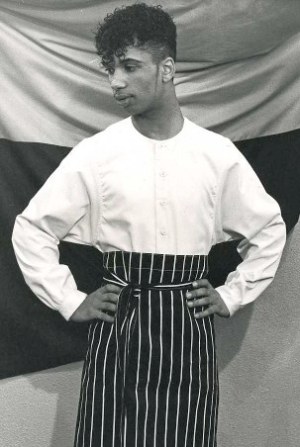
Andy Polaris photographed © by Neil Matthews
Andy Polaris, ex-Blitz Kid and singer with Animal Nightlife – “This was a drama about George’s complicated love life and the rise and fall of Culture Club. The Blitz was a supporting player. The influence of creative gay people on the whole club scene would have been airbrushed out if it were not for total world domination by Culture Club – the pearl being Boy George. Peacocks parade was George, Steve Strange, Marilyn, Philip Sallon, Martin Degville, Stephen Linard, Stephen Jones, Judy Blame, David Holah et al. They were DIY glamour 24/7, not part-time posers squeezing themselves into Cinderella ballet pumps. It was an evolution not an overnight sensation.
“I actually enjoyed the TV performances although the squeezing of pivotal people into one character and the total absence of others didn’t work very well. The physical interior of the Blitz did: it was a cramped place. I caught what was supposed to be lip service toward anyone non-white in the crowd and every part of that scene. The blessing by David Bowie was nearly accurate and also the jealousy between George and Steve Strange but it’s a shame Steve came across with no redeeming features at all.”
‘whole thing done on unemployment benefit’
Gary Kemp, songwriter with Blitz house-band Spandau Ballet, today ditto
“They got it really well. Marc Warren who played Steve Strange did a good job – but he was too old. Steve was 19 when he was running this club. No-one had done that before, taken a club and given it its own identity one night a week. This was the beginning of lots of things that changed culture as we know it. What last night did capture was that the Blitz was this petri dish of ideas. Even though we were dressing up in am-dram clothes, we all had this sense of responsibility to the future. All of us thought we are going to place ourselves in this decade that was coming, and drive it. We all spoke about it while we were there.”
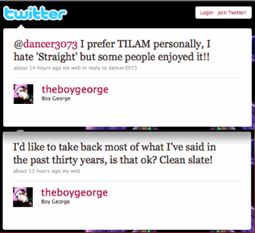
ON GEORGE’S TWEET THAT ‘WORRIED’ LACKED HEART AND SOUL – “Lacking heart and soul is a good point. That’s probably a modern bias, looking back to the 80s, that we were somehow all surface. But we were real people, most of us were poor, the whole thing was done on a student grant or unemployment benefit.” (Kemp on Richard Bacon show, 5Live, May 17)
☆ ☆ ☆
Princess Julia, ex-Blitz coatcheck girl and goddess, today an international club deejay – “This biopic could have quite easily turned in some sort of fancy-dress parody but actually they pulled it off! The make-up from Donald McInnes was thoroughly researched, in fact he went into great depth to recreate the looks of George, Marilyn and Steve Strange and based many other looks on the real-life characters involved at the time, including myself.
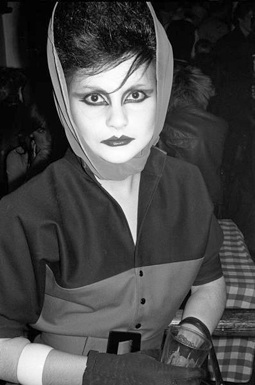
Julia at the Blitz in 1979, photographed © by Derek Ridgers
“The banter and rhetoric may or may not have been authentic, but remember artistic licence. It was a camp time, perhaps slightly exaggerated here! There was an element of competition between George and Steve but I think the underlying friendship and understanding between them became apparent in the play as in real life.”
ELEPHANT IN THE ROOM – “Perhaps there was more of a sexually straight element in the club… there were some gorgeous boys around, but this film is fundamentally George’s story. If anything, the real Blitz was more asexual, because dressing took up most of our time and speed or blues were readily available.”
ABSENT FRIENDS – “I would have liked to have seen Philip Sallon portrayed as he was pivotal to George’s coming out in London, having been part of the punk scene and notably the Bromley Contingent. A friend of Siouxsie Sioux and Bertie Berlin, Sallon has been and is an inspiration. These were people we looked up to and who most surely inspired George to create such wonderful looks with so much attitude.”
GOOD INTENTIONS – “Interestingly, George visited the film set, as did Jon Moss. I also spoke with one of the producers about the lighting and ambience of the Blitz club itself, and got the feeling that they were approaching the subject with a sense of reverence. The New Romantic movement really did get a knocking in its day and only recently has it gained recognition in creative terms.”
‘Nice to see kung fu slippers’
Graham K Smith, retired fashionista turned TV playboy – “Pretty good. I thought the Blitz stuff worked, music was great especially Memorabilia by Soft Cell, Light Pours Out of Me by Magazine, Empire State Human by Human League. The reactions to Bowie’s visit to the Blitz were a little OTT – I remember people being excited, but still cool! The details of hair and make-up and clothes were pretty good – nice to see George wearing kung fu slippers. I spent a lot of time in those, bought from the martial-arts shop in Leicester Square. It’s still there! So great to see how free and brave we were to wear that stuff, it makes today seem really straight and boring.”
☆ ☆ ☆
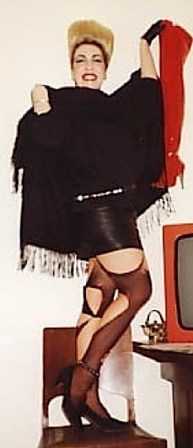
Tracey Rivers in Mud club days: great trip down Memory Lane
Tracey Rivers, Blitz Kid and fellow squatter with George – “I did actually live in Carburton Street with George et al and really enjoyed watching Worried About the Boy. All said and done, it was a great trip down Memory Lane, although re-worked to make it better for TV. I honestly don’t think anyone could recreate living in a squat convincingly. It wasn’t glamorous and when we all lived there we didn’t think ‘Hey, we are living with a potential superstar’ so it’s difficult to explain.
“For me, personally, there was a lot of nostalgia and although the lesser persons’ names were changed, the essence was there for me. OK, the TV squat was far more palatial than it was in real life and (for the record) we would never have had a washing machine as we didn’t have any proper running water – and a fridge??? But how do you explain that to a teen these days? Also, a guitar lying in the hallway? Marilyn would have sold that for drugs in a second! (Sorry Marilyn, but you know it’s true).
“No, I don’t know what character I was and neither do I care. It wasn’t about me. I did think Steve Strange came across a little harsh. He wasn’t that mean – a pussycat really. And maybe we could have delved so much deeper into the mind of our dear George but what came across to me was the boy that was and is so deeply misunderstood, so deeply wanting and willing to give love and be loved. Was this his ‘downfall’? We can all speculate. I am deeply protective of my real friends and I think that it was a pretty fine piece of entertaining TV. I think George was pleased with it and to be honest that is all that I am interested in.”

☆ ☆ ☆
Stephen Linard, Blitz god and St Martin’s fashion graduate (first class)
A MONEY-MAKING VENTURE – “The film had a great sense of period, especially the music which dovetailed with events beautifully. One big discrepancy was the way they showed Steve Strange selecting people at the door of the Blitz: he never held up a mirror to wannabes. It was Mark Vaultier who did that at Taboo six years later! In fact, Steve was never that vicious on the door. The Blitz was after all a money-making venture and on a quiet night anybody could get in. Only if it was busy could he be more fussy. Normally he’d be handing out free drinks tickets to everyone.”

Stephen Linard in the rabbinical outfit that caught Bowie’s eye in July 1980
THE TALENT BEHIND THE BLITZ – “The big thing the TV film ignored was the circle of fashion friends George mixed with in the squats – me and Kim and David and Julia and Melissa and Stephen – because we were his influences. What this play missed completely was that the Blitz was an art students’ club. The fact that some straight herberts got in is beside the point – they were always a year behind the curve.
“The place was choc-a-bloc with artists: Brian Clarke, Zandra Rhodes, Molly Parkin, Antony Price, Duggie Fields, Kevin Whitney and us because it was halfway between Central School and St Martin’s. People who said “Oh you Blitz Kids don’t DO anything” were talking rubbish, because WE all did. We were the ones with our work in the glossy magazines long before the herberts. As for that character Christopher on TV who looked like me, well, as you know, I would never have worn the same outfit two nights running!”
THE BOWIE VISITATION – “The night Bowie turned up was ludicrous in the TV version. Nobody ran to the door screeching. Initially, he actually sat at the bar next to my sister Bev, with me on the other side of her and I told her “Don’t look. Be cool.” So of course she looked, she was only 17. So did I. I was only 21. I was in all my Jewish rabbinical gear and his PA Coco asked if I would be in the Ashes to Ashes video, but they wanted us up at the crack of dawn and were only offering £50! Anyway, I was on a warning at St Martin’s over attendance, so I had to say No.”
NICE CUPS OF TEA – “The other discrepancy was drugs: you never saw any dealing at the Blitz, because we didn’t have the money. We all took some blues before we went. There was a lot of tea-drinking at the Warren Street squat for exactly the same reason. Money. Seriously. Pubs were only open for limited hours and you couldn’t buy drink in supermarkets. But we didn’t drink alcohol at home because we couldn’t afford it, always mugs of tea. When George in this film fished a used teabag out of the bin to make a cup for Kirk, that was probably one of my teabags, because HE never bought anything.”
☆ ☆ ☆

David Holah and Julia photographed © by Sue Tilley
David Holah, ex-Blitz Kid, co-founder of BodyMap, still setting trends – “I have a terrible memory but thought they captured the club atmosphere well. The front of the club looked quite authentic, and I remember dancing like that to Kraftwerk, great make-up and fashion looks. The Steve Strange character was very funny and remarkably accurate!”
☆ ☆ ☆
Alice Shaw, ex-Blitz Kid aka Alice From The Palace – “All in all, a beautiful snapshot of an exciting time… and although I didn’t think the lead looked anything like George, he played him with integrity. Don’t think Steve Strange came off to well – a little harsh? But the guy who played Maz got the voice spot on didn’t he? It was uncanny!”
☆ ☆ ☆
Kathryn Flett, Blitz clubber, today a journalist – “It’s so good that you can practically smell the hairspray and feel the sweat slide down your Pan-stuck cheeks as you head towards the dancefloor.” (The Times, May 15)
‘Reminiscent of Grange Hill’
Graham Smith, ex-photographer and stand-in deejay at the Blitz for two weeks while Rusty was on holiday, today art director – “Enjoyable if a bit cringeworthy at times. I found George and Marilyn well cast but the Steve Strange character harsh and definitely toooo old. Don’t recall him being a complete despot on the door, simply Quality Control. Thought Philip ‘The godfather’ Sallon would be there as he would be so ripe for parody.
“The Warren Street fight scene between George and I presume Wilf (very strange casting of squaddy/Fred Mercury stereotype) was rather embarrassing with everyone chanting ‘fight, fight’, more reminiscent of Grange Hill.
“Bowie scene simply wrong. I remember deliberately not even turning round when told he was there (though did secretly regret it). However do recall him turning up at Hell a few weeks later, strolling round the club as a regular punter checking it all out and no one batting an eyelid.”
☆ ☆ ☆
Tim Dry, ex-mime artist with Shock, and now writer – “Actually I thought it was pretty authentic (unlike Ashes to Ashes, the TV series) in terms of recreating clothes, hair and make-up. And the actor who played George was pretty and damn good. And The Blitz actually looked very close, although I seem to remember there being just one big room and the cloakroom at the back. Hard to believe it was 30 years ago now. I’m amazed we have any braincells left! How dull things seem today by comparison.”
➢➢ OOPS! THERE’S RUSTLING IN GEORGE’S DOVECOTE OVER THE PRESS COVERAGE OF ‘WORRIED’

London’s Blitz nightclub recreated for Worried About the Boy, 2010: George with his fictionalised circle of friends, Marilyn, Christopher, Sarah, Mo and Dawn © BBC
➢➢ Princess Julia, Robert Elms and Gary Kemp review ‘Worried’ on Richard Bacon’s show, BBC 5Live, May 17
➢➢ The Daily Mirror, May 18, asks ex-Blitz Kids whatever happened to you all?
➢➢ In The Times, May 15, ex-Blitz Kids recall the era captured in the BBC’s TV version of the New Romantics antics


 Itself dubbed “the world’s best-dressed magazine”, The Face broke with mainstream complacency by actively inventing or giving focus to entire movements that combined clothes, music and attitude. Many came to define the 80s – from The Cult With No Name which was eventually rechristened New Romantics, the Hard Times ripped Levi ensemble, the Burberry-loving Casuals, and the “bad boy” Buffalo silhouette created by Ray Petri and Jamie Morgan. This, if any, became the urban male uniform of the mid-80s, and was celebrated only last winter by an issue of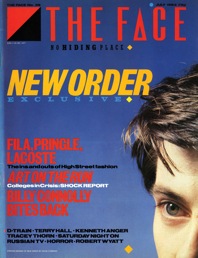








 ➢➢ Shapers of the 80s ➣➣