

Beyond director Claire Lawrie, centre: with some of her garrulous cast answering questions after a screening at Central Saint Martins college last year. Andy Polaris in red. (Photo by Shapersofthe80s)
❚ AFTER A STREAM OF EXCLUSIVE SCREENINGS for a poignant and edgy short documentary about growing up black and queer in Seventies Britain, everyone can now view it online. Titled Beyond “There is always a black issue Dear”, the 34-minute film explores black LGBT identities and the ways in which they have influenced the collective history of London’s alternative club, fashion, fine art, dance and music scenes. The cast of ten are long-standing friends of director/photographer Claire Lawrie who helps tell their personal stories when these fans of soul and disco, punks and Blitz Kids found each other’s company in underground clubs.
Over the past year Claire has won a fistful of film-festival awards and, prompted by the coronavirus lockdown, she has posted the full version online, and repeat viewings reward with deeper appreciation.
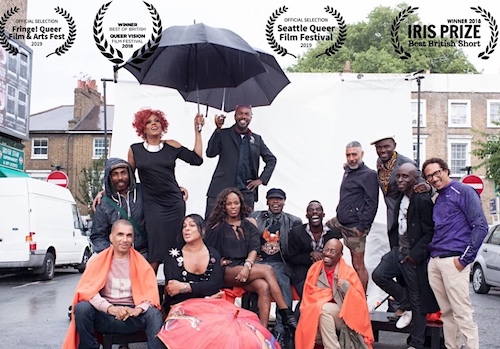
Photo that inspired the movie Beyond – Click pic to view the film in another window
“To me it’s important now that people
realise that black people were there,
because a lot of the time they
tried to paint us out” – Andy Polaris
Onetime Blitz Kid Andy Polaris is part of the project and he recalls its origins in this extract from his own website Apolarisview. . .
“ A 2013 exhibition at the V&A museum in London titled Club to Catwalk was instrumental in bringing the collective creative talent of Eighties fashion stalwarts and club luminaries together for a preview party that summer. It was a splendid event, one of the last memorable social events with such a vibrant successful crowd. Among the assembled were Judy Blame, Princess Julia, Andrew Logan, Zandra Rhodes, Body Map, Antony Price, Chris Sullivan and it was the last time I saw Steve Strange (who along with Rusty Egan) had brought us all together at the Blitz Club in 1979.
The visual artist Claire Lawrie was at the V&A and pondered on the omission from the exhibition of gay black talent whose influence had permeated Eighties club culture. Although Jeffrey Hinton’s brilliant cave of projected nightlife photography did feature some of us, Lawrie echoed some of her friends’ frustration that their experience was not reflected in the exhibition. She set about organising an open-call photograph to celebrate a contingent of black talent and arranged for the gathering to be filmed by her friends, Emile Kelly and Kim Mnguni. This was the genesis of something deeper and her award-winning documentary, Beyond “There is always a black issue Dear”, emerged from that event with her as director.
Click any pic of the Beyond interviewees to enlarge all in a slideshow:


Continued: “ Over the next year Claire arranged interviews with ten of the candidates who were filmed on a shoestring. Contributions of archive footage were given by a long list of talented artists, people who, over the years had collaborated with and who wanted to show their respect and love for the cast. These included Pam Hogg, Dick Jewell, Dave Swindells and Nicola Tyson as well as John Maybury, Derek Ridgers, BodyMap, Devon Buchanon and Rankin.
The film adjusts the colour settings of the standard view of black creative lives when telling the story about club culture and its impact in the UK. Featuring ten black queer voices from the diaspora, born in the late Fifties and Sixties in the UK, Guyana and New York, the documentary delves into personal stories of discovery and eventual self-acceptance, looking back at struggles with identity and family and the wider world. The cast features stylist Frank Akinsete, transgender model Winn Austin, international model Roy Brown, make-up artist Kenny Campbell, choreographer Les Child, clubland pioneer Kenrick Davis and his mother Velma “Vee” Davis, nightclub host Nicky Green, gender-fluid performer Lanah Pellay, composer Robb Scott and myself as an original Blitz Kid turned pop singer.

Roy Brown in 1985: poster boy for the Barbican’s recent exhibition on Masculinities. (Photo: Rotimi Fani-Kayode)
In the mid-Seventies and Eighties the UK’s attitudes to both race and gay issues were particularly brutal, endorsed by the anti-gay policies of Thatcher’s government and tabloid sensationalism regarding anything queer, especially later with the arrival of the Aids epidemic. The Seventies were marred by stereotypes of both marginalised groups, joining the sexist and misogynistic tropes in light entertainment and films which set the tone for how the world viewed us and how we viewed ourselves.
This lack of representation and role models forced us to create our own image during our teens, which in some cases was defiantly camp. Instead of allowing bullies to mock us, we accentuated certain behaviour, not just as a direct challenge to the heteronormative majority but against the conservative oppression in society.
Music and fashion were an escape from small-mindedness and even as early teens we were exploring alternatives and the fashionable disco and punk clubs were our laboratories of choice. . . ” / Continued at Apolarisview
➢ All about the making of Beyond “There is always
a black issue Dear”
➢ Interview with director Claire Lawrie: “These were
people that I looked up to and admired”
➢ On video – Beyond Q&A by RankinFilm after
the July 2019 screening at his studio






 ➢➢ Shapers of the 80s ➣➣