Tag Archives: Video

2010 ➤ Grace Jones turns her back on London ;-)

❚ GRACE JONES WAS TRULY IN THE PINK tonight for a one-off concert at London’s Royal Albert Hall as a long-awaited top-up to last year’s Hurricane tour. The video above gives a taste of her finale to the old Piaf song La vie en rose, shot by yours truly. See if you can spot the colour of her… lipstick.

Grace Jones, London, 2010, Hurricane

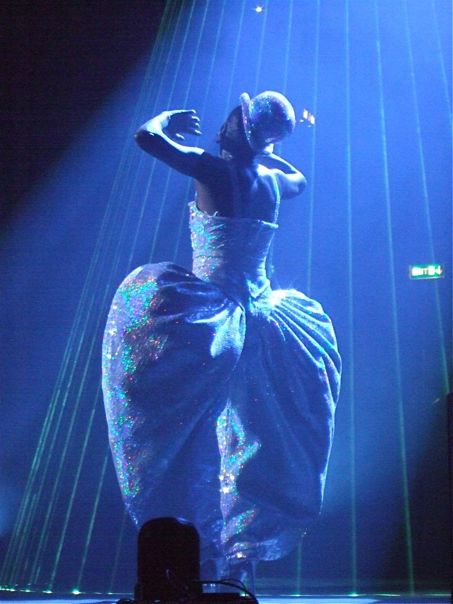
Hurricane 2010 at the Albert Hall: Grace Jones becomes the title track from her album. Photographed © by Shapersofthe80s

Grace Jones, London, 2010, © Shapersofthe80s.com

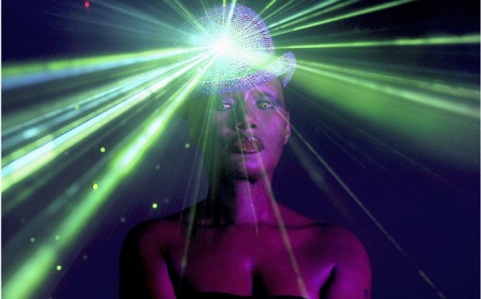
Love is the drug: Grace as a shimmering silver heart imprisoned by lasers

❚ “HEADS ARE GONNA ROLL!” declared Grace Jones over her headset, backstage at the Albert Hall. “WHERE is my mannequin?” Last summer in Hollywood when she sang her opening words to Astor Piazzolla’s nuevo tango classic, Libertango, “Strange, I’ve seen that face before / Seen him hanging round my door”, ice-cool Ms Jones glided onstage dancing with a lifesize bust – of herself. Instead, sans mannequin, in London she had to embark on a solo tango, pleading for one of her entourage to join her and “drag me across the floor”. This video, again shot by yours truly, catches the improvisation.

Grace Jones, Mark Moore

Awww, look who got to go back stage – photo courtesy of himself © Mark Moore

❏ The Grace Jones Hurricane collection of costumes created by the Japanese designer Eiko Ishioka were all photographed © by shapersofthe80s.com during her London concert, 2010

This slideshow requires JavaScript.

➤ For two weeks, Grace goes on dazzling

Grace Jones, 2010, Chris Levine, Vinyl Factory , London

Grace Jones in 3-D: you can play with this lenticular print online © by Chris Levine

❚ FOR TWO WEEKS ONLY, Grace Jones can be viewed in a groundbreaking show of 3-D holographic portraits by light artist Chris Levine, titled Stillness at the Speed of Light. The work is for sale at this free immersive multimedia exhibition which involves lightboxes, lasers, video and a specially commissioned soundscape at The Vinyl Factory in Poland Street, London, from April 30 to May 14. This show also launches Grace’s new video Love You To Life, which Levine directed.

FRONT PAGE

2010 ➤ Rich List puts George Michael top of the popstars from the un-lucrative 80s

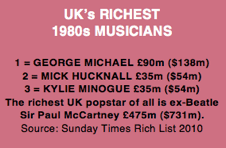
❚ ONLY THREE MUSICIANS FROM THE 1980s are included in the annual Rich List of Britain’s top 50 music millionaires, published today by The Sunday Times. The richest musician of the decade who holds his own amid the older gods of rock is singer-songwriter George Michael who is worth £90m ($138m) today. He sits at No 25 in the ST’s top 50. George is pictured above in Wham!’s Club Tropicana video (where “the drinks are free”). His group’s “pure pop” epitomised the sybaritic style which by 1983 was signalling the divide in British music between electronic earnestness and full-on hedonism.

Rich List, 2010The other two richest stars from the 80s are each estimated to be worth a relatively puny £35m ($54m). They are Lancastrian Mick Hucknall of Simply Red (their summer tour climaxes with a farewell concert on Dec 19 and is booking now), and pop diva Kylie Minogue who found fame in the UK through the Australian TV soap, Neighbours. The Sunday Times justifies Kylie’s presence in this UK list, as someone who often seems “more British than the British”. She herself has regarded the UK as “my adopted home” almost since 1988 when her debut single, I Should Be So Lucky, went to No 1 and set her on the path to becoming the most successful female artist in the UK charts. She was honoured by the Queen with an OBE in 2008.

Mick Hucknall

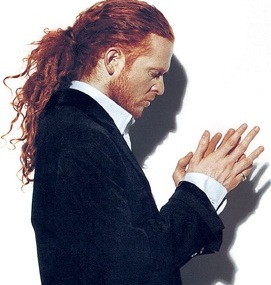
Simply Red’s Hucknall: a December farewell

Since the 2009 Rich List, three 80s stars have dropped out from the top 50 musicians: Annie Lennox, Simple Minds vocalist Jim Kerr and Sade – though her sensational album comeback this year is likely to be reflected in next year’s list. Astonishingly the creative genius behind Kylie and the huge stable of Stock Aitken and Waterman acts – Pete Waterman – last appeared in the Rich List in 2007.

Should we assume creativity does not equate to profitability? From a musician’s perspective the 80s have been the least lucrative decade in pop history, apart from the Noughties from which only TV impresario Simon Cowell emerges as a multi-millionaire (£165m). Inevitably, older musicians have had longer in which to sell records and accrue proceeds, so the 1960s yield 20 musicians in the Rich List who are still millionaires today, led by Sir Paul (£475m, $731m), Sir Mick (£190m) and Sir Elton (£185m). From the 1970s there are ten in the top 50, with Sting way out in front (£180m).

Among the richest artists from the 90s is Victoria (“Posh Spice”) Beckham (£145m whose fortune the ST oddly entwines with her footballing husband’s). Robbie Williams is now worth £85m and Gary Barlow £35m – both started out in boyband Take That. The Gallagher brothers of Oasis are worth £55m, and Jay Kay of Jamiroquai £35m.

Kylie Minogue, 1987, Lucky

Getting lucky in 1988: Kylie went straight to No 1 and never looked back. Photograph © by PAL Productions Ltd

The Rich List names 13 moguls ruling the UK biz, led by former songwriter and Warner Music Group chairman, the American Edgar Bronfman who has made his home in London, and is worth £1,640m ($2,522m). The ST reports him as being “well placed to snap up the beleagured EMI”, effectively Britain’s last homegrown record company, founded in 1931.

Leaders among the younger British businessmen are Simon Fuller (£350m, $540m), the former Spice Girls manager who struck gold as creator of TV’s Idol franchise which has been sold worldwide during the past decade, and Jamie Palumbo (£150m, $231m) who founded the Ministry of Sound clubbing empire.

➢➢ Summary of The Sunday Times Rich List Musicians 2010

FRONT PAGE

2010 ➤ What a tear-jerker! McLaren mashes up his own musical ‘Requiem to Myself’

LISTEN TO MCLAREN’S REQUIEM
EXCLUSIVELY AT SHAPERS OF THE 80S

Hitchcock , Vertigo, The Mekons,

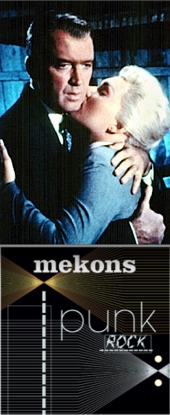
Romance and anguish: James Stewart and Kim Novak in the psycho-drama Vertigo (top), and the post-punk Mekons

◼︎ TWO UNEXPECTED RECENT VIDEOS have acquired poignant new life in the wake of Malcolm McLaren’s death, Svengali of punk that he was. Few people could have guessed that the soundtrack to one of last month’s Paris ready-to-wear fashion shows [in the video above] would be McLaren’s final creative achievement.

It was completed after his diagnosis of cancer and possibly in acceptance of his own mortality.

What seduces the listener is the overwhelming melancholy McLaren evokes, in what suddenly amounts to a Requiem to Myself. It was commissioned by Dries Van Noten – to set a deliberately discomfiting mood for his runway show amid the gilded opulence of the Hôtel de Ville in Paris on March 3.

After McLaren’s funeral, his partner Young Kim described the piece to Shapers of the 80s as “quintessential Malcolm McLaren – an entirely original and powerful, elegant but punk collage”. She gave us permission to run the full 13-minute mash-up in clean mp3 format, featuring the Vertigo theme, Mekons, Roxy, Raincoats and Burundi Beat.

➢ CLICK HERE for the full McLaren/Dries Van Noten soundtrack and background report on its creation on our inside page

➢ The Raincoats perform The Raincoats for Don’t Look Back in London, May 20, 2010, at The Scala in London

➢ More at Shapersofthe80s: Svengali of Pistols and punk remembered by those who knew him

++++++++++++

McLaren on how to fail brilliantly
in this ‘karaoke world’

◼︎ “THIS WORLD WE LIVE IN TODAY is no more than a karaoke world, an ersatz society, which provides us with only the opportunity to revel in our stupidity… A karaoke world is one in which life is lived by proxy.” So said Malcolm McLaren last October, only days before he discovered he was unwell. He was presenting a keynote speech to 1,000 delegates in London at the Handheld Learning Conference 2009 about the future of learning and education.

➢ Details from the Learning Conference also on our inside page

FRONT PAGE

1985 ➤ Nnnnn-na-na-na, nnnnn-na-na, Nineteen

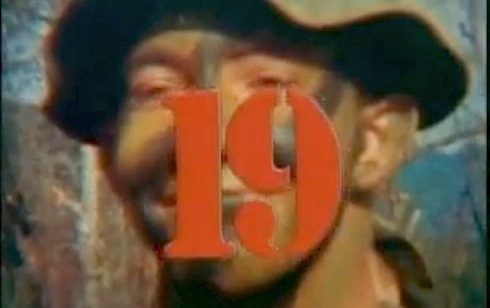
Paul Hardcastle, Nineteen,pop video

Vietnam conscripts: their average age was 19

◼ IN 1985 THE LONDON MUSICIAN Paul Hardcastle stunned Europe with his hynotic anti-war hit, 19, which spent weeks at No 1 in the charts. It was effectively a rap sampled from the voiceover to the Emmy-nominated documentary Vietnam Requiem, which made the shock claim that “In World War Two the average age of the combat soldier was 26. In Vietnam he was 19.” This year, Hardcastle was watching a documentary about British soldiers serving in Afghanistan when he heard an officer say: “I looked at my men. The average age was 19 — my God, I’m taking boys to war.” For the 25th anniversary of his hit Hardcastle updated and wrote a new version of 19 called Boys To War which was released yesterday in the UK.

Sadly, the infinitely more visceral original from 1985 knocks spots off the languid new version, while this stark Tribute To Vietnam Vets achieves its own stomach-churning effect.

Paul Hardcastle, Nineteen, Vietnam war, video

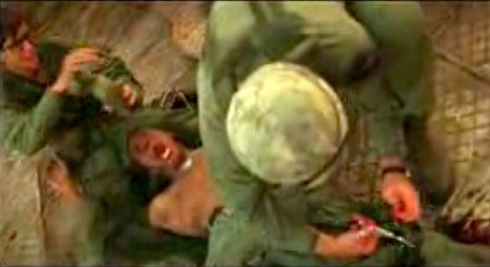
The grim truth: field surgery for a teenage Vietnam combatant

FRONT PAGE

2010 ➤ Ex-jailbird George takes his first trancey steps on the path to sainthood

Boy George, 2010, Amazing Grace, Ana Lains

Breakfast outing: Boy George’s comeback on GMTV with Ana Lains, March 24, 2010

❚ THE SON OF A BOXING CLUB MANAGER, camp, skinny, loud-mouthed George O’Dowd was one of the most towering egos among the original Blitz Kids in the London of 1979. He famously worked as cloakroom attendant at the Blitz club where he has since happily admitted “rifling through pockets and handbags” while he was about it. His catchphrase was “Buy us a drink, then.” If you declined, or somebody otherwise offended him, he was likely to unleash all the vitriol his tongue could muster, on friend and foe alike. If they stood up to him and lashed back verbally, he occasionally awarded them an ounce of respect.

Because he was younger than many, he was virtually the last out of the Blitz stable to put together a band and win a recording contract in 1982. It was then a slow burn before Culture Club eventually hit No 1 with Do You Really Want to Hurt Me? in the UK and No 2 the next year in the US.

They soon became one of Britain’s international “pure-pop” supergroups with a blue-eyed reggae sound led by Boy George’s impressively soulful voice. The band won a Grammy in 1984. At his peak, George was Britain’s second most globally recognisable fashion icon after Princess Di. At home his unthreatening brand of androgyny had endeared him to mainstream audiences and he made himself every grannie’s favourite popstar with his line about liking “a nice cup of tea” in preference to sex. It was nevertheless a long time before he confirmed the obvious: that he was gay.
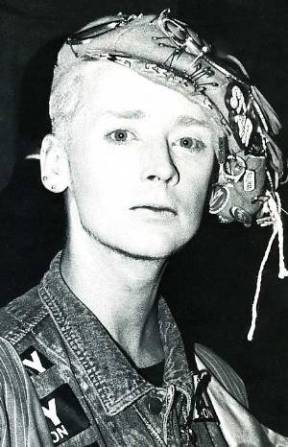
Boy George, 1987, Gabor Scott

“Junkie George”: Gabor Scott’s © 1987 photograph

The glory was all over effectively by the third album.

George was developing heroin addiction and his romance with drummer Jon Moss fell apart. Grim headlines recorded the deaths of two friends from drugs and before long the tabloids reckoned that “Junkie George” had eight weeks to live. Culture Club broke up in 1986 and the singer’s life swung between unedifying extremes as it pretty much went off the rails for the next 20 years.

These were defined substantially by his drug habits, precipitating repeated encounters with the law, a community service sentence sweeping the streets of Manhattan, and the non-release of many new recordings. He turned instead to deejaying. One small highlight came in 1995 at the ripe old age of 34 with publication of his, for many people, shockingly frank autobiography, Take It Like a Man. This week he admitted: “Nowadays I probably would have said less. The new me would not have gone as far as I did.”

His fortunes hit their lowest ebb last year when he was sentenced to 15 months in jail “for falsely imprisoning a male escort by handcuffing him to a wall and beating him with a metal chain,” as reported in The Guardian. “The judge told the 47-year-old former Culture Club front man, whose real name is George O’Dowd, he had left the escort ‘shocked, degraded and traumatised’ by the ordeal… Passing sentence… Judge David Radford said the singer’s offence was ‘so serious that only an immediate sentence of imprisonment can be justified’.” After four months, George was released on home detention curfew wearing an electronic tag.

None of which was recycled of course in this week’s principal TV interviews as he returned to the commercial pop spotlight with a new dancetrack, Amazing Grace, the first release by a new label, Decode Records. They have boosted George’s vocals with luminous support from Portuguese singer Ana Lains.
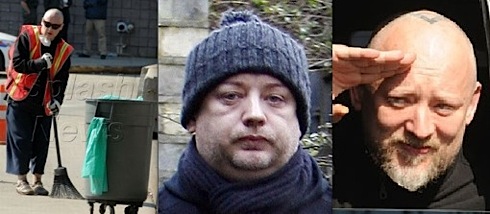
Boy George, 2006, 2009

ID parade: George on community service, New York 2006; before being jailed in Britain, 2009, and on the day of his release. Credits: Splash News, Pacific Coast News, Rex Features

In a cosy breakfast sofa chat for GMTV today, there were chill echoes of those other insouciant jailbirds, the former politicians Jeffrey Archer and Jonathan Aitken, when George showed little sign of remorse for the offences that landed him in jail. Neither did the airhead presenter Lorraine Kelly raise the issue. At least in his grilling by CNN viewers online somebody called Hillary asked: “What do you think the meaning of your life is?”

Later on Monday, George did allow one glimpse of reflection onscreen: “The biggest change for me in past two years was getting sober. I went into prison sober, with a completely clear head, in a very Zen frame of mind. I was a totally different person by the time I went to prison. It was a challenge. I discovered it was like being back at school.”

On the genesis of Amazing Grace, he said: “The song is about realising I have the best job in world. In my life there have been so many moments when I’ve been in amazing places and haven’t really been there because I’ve been arguing with someone. I’ve been at the Taj Mahal or the Grand Canyon having a row about something really petty. So what I try to do now is be present in everything I do, however mundane or however exciting… It’s also about searching for some sort of grace. It’s a spiritual song.”

There’s hope yet, then. Might we expect George, born into the Catholic Church, to follow the path of the saintly Aitken by discovering one god or another and some contrition? Let us all pray.

Boy George performs his comeback single, Amazing Grace, this morning on GMTV… and beforehand George talks about his future
At CNN on Monday George reflected on reinventing himself
before and after jail
Ladypat’s trippy video of Boy George’s Amazing Grace, featuring Ana Lains

++++++++++++

Boy George calls the press ‘sanctimonious’! What can a remorseless thug expect?

Nick Duerden in The Independent this April gets the measure of the man jailed for assault on a younger man: “One thing he didn’t do inside jail was ponder the crime that had landed him inside in the first place. ‘No I didn’t. Why? Was I supposed to?’ ”

Patrick Strudwick on the vile diminishing of Boy George’s crime (The Guardian last December): “We still cannot seem to take crimes of sex and violence against men seriously. The response of the authorities to female victims of rape and domestic violence is often lacking. The response of the public to male victims is one of disbelief, apathy and even humour.”

Which spurs us to reread Alan Franks’ very thorough interview from The Times last October: “What should he feel about the crime that got him jailed? Remorse, surely. Isn’t that what we want to hear before we too can move on from it? The good humour vanishes from his eyes and he says tartly: ‘I’m not going to talk about that.’ ”

FRONT PAGE