Tag Archives: Harold Pinter

2023 ➤ Witnessing the performance of Gambon’s life as his tribute to Pinter

Tributes, theatre No Man’s Land, Michael Gambon, Harold Pinter, David Bradley,

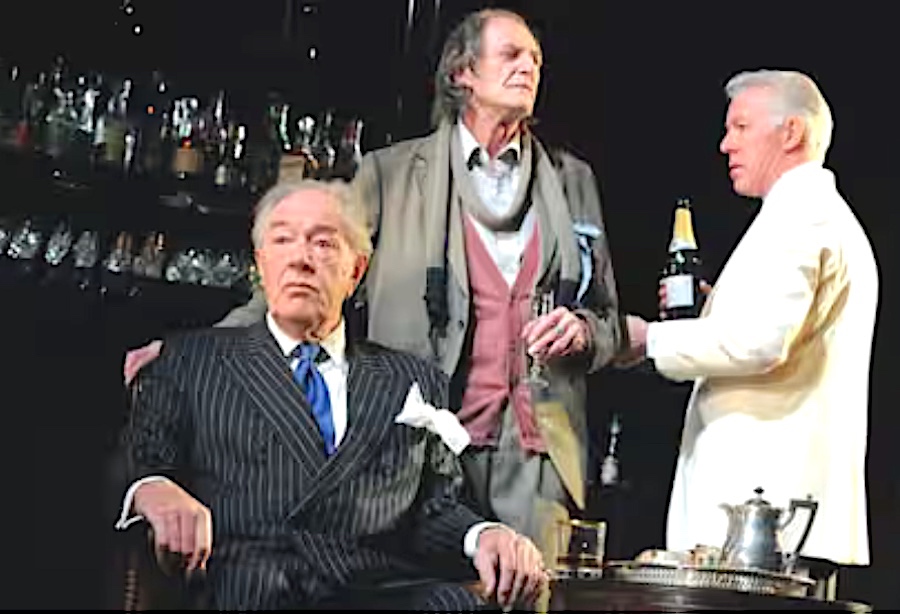
Duke of York’s, 2008: Michael Gambon, David Bradley and Nick Dunning in No Man’s Land. (Photograph: Tristram Kenton)

❚ MICHAEL GAMBON WAS UNDOUBTEDLY Britain’s greatest living actor for much of his career and remained so until his death this week. So, indeed, Harold Pinter had also become our greatest playwright by the end of his life. In the week of Pinter’s death at Christmas 2008, Gambon was playing in the West End in this, one of the master’s most enduring plays, No Man’s Land, and on Boxing Day he marked the theatre’s loss in ways I shall never forget.

That day, on Radio 4’s World at One, Michael Gambon promised to give the performance of his life, so I determined to go and see again the performance I’d already enjoyed the previous month in one of the Pinter’s most haunting masterpieces about two men in their maturity reflecting on their tenuous – or had it been non-existent? – friendship. As Michael Billington had written in his Guardian review: “Every new production of Pinter’s tantalising, poetic play yields new meanings.”

I’d seen it premiered in 1975 with those grandees John Gielgud and Ralph Richardson at the Old Vic and again when transferred to the Lyttelton in 1977 – several times. The great air/earth partnership of Gielgud/Richardson undoubtedly brought compassion to the roles of Spooner and Hirst, yet when Pinter himself played “the Richardson role” at the Almeida in 1993, opposite the sprightly Paul Eddington, the author turned his second act opening almost into a two-handed farce that had us aching in our seats with continuous laughter and subsequently wondering whether he’d always longed for our two greatest actors to loosen up a bit in the original production.

By the time this day’s greatest living actor Gambon put on the mantle of Hirst, a litterateur haunted by dreams and memories, in this new production at the Duke of York’s, we had learnt to laugh heartily at the humour in Pinter, yet now both Gambon and David Bradley as Spooner were also suffusing the prose with more poetry which the renowned “Pinter pauses” punctuate than I could recall from the past.

Tributes, theatre 
No Man’s Land, Paul Eddington, Harold Pinter,

Almeida theatre, 1993: Paul Eddington and Harold Pinter in his own play No Man’s Land. (Photograph: Tristram Kenton)

A month earlier, I’d been caught short by the intensity of Gambon’s stage presence as he made his demons all but tangible before us. Then on Boxing Day, after the hilarious Act 2 recollections of the men’s seemingly shared past, Gambon suddenly changed gear and dropped timbre to whisper the crucial “Good Ghost” speech about the passing faces in his photograph album with an ethereal beauty and clarity of Shakespearean proportions. It was an unparalleled moment to witness.

Following the curtain calls, the cast paused to pay brief onstage tributes to Pinter. Gambon told us that, after rehearsals, the playwright had asked him if he would read the Good Ghost speech at his funeral (which indeed he did only days later). Suddenly for the second time this night, Gambon delivered the speech again there and then. Alas the words lost something of the ineffable truth they had touched when, minutes earlier, Gambon had been in character and had delivered them “trippingly on the tongue”.

Without doubt, the actor brought greatness to the role of Hirst this night – in fairness, all the cast were on the balls of their feet too. More satisfying, in the fleeting moments of live performance, fresh glimpses had been revealed of Pinter’s bleak insights into memory and ageing. All in all, the essence of theatre.

➢ Billington’s review of No Man’s Land in The Guardian, 2008
➢ Michael Gambon’s obituary in The Guardian, 2023
FRONT PAGE

➤ 75 Ballet gigs later, Gary Kemp tackles serious theatre but denounces its obsession with class

Homecoming, Harold Pinter, Gary Kemp, Jamie Lloyd, Gemma Chan, Trafalgar Studios, interview, theatre, London, reviews

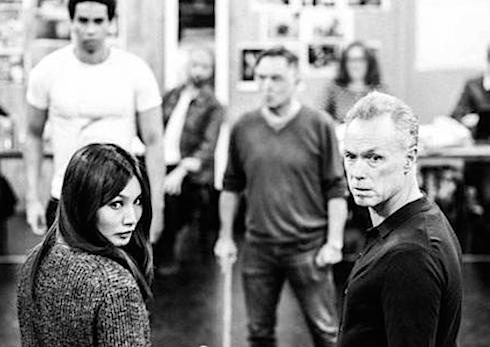
Gemma Chan as Ruth, with Gary Kemp as Teddy, rehearsing for The Homecoming at Trafalgar Studios in London. Photograph by Matt Humphrey


➢ Gary Kemp interviewed by Nick Clark in The Independent, 10 Nov, before he opened this week in Harold Pinter’s The Homecoming at Trafalgar Studios:

The play, set in 1965 was written when working-class people didn’t cross into celebrity, or cross classes. Kemp can empathise with the character who left his working-class roots and found home alien upon his return. “I went to grammar school and things became different, more middle class. My parents were definitely working class. My dad was a printer.” He said: “I get that thing about coming home and having a different language to your parents and sometimes using it against them and sometimes feeling terrible because of that.”

Today, he feels class restrictions remain visible, particularly in the acting world. It is, he said, “utterly class orientated. It’s ironic really because it’s incredibly liberal but underneath that facade there lies this need for Oxbridge, a need for the understanding of literature and a need for received pronunciation. Working-class actors are condemned to sitcoms and soap.” He pointed out that the production’s director Lloyd is working class. “That’s as rare as hen’s teeth” . . . / Continued at The Independent online

➢ The Homecoming runs at the Trafalgar Studios, London (0844 871 7632) until 13 February

UPDATE: REVIEWS OF THE HOMECOMING

➢ Michael Billington in the Guardian, 23 Nov:
Fifty years after its London premiere, Harold Pinter’s play continues to puzzle, astonish and delight. Far from treating it as a revered theatrical specimen preserved in aspic, Jamie Lloyd’s excellent revival offers a fresh approach to the play without in any way violating the rhythms of Pinter’s text. . . The Homecoming retains its hold over our imaginations. It can be seen as a Freudian play about sons filled with subconscious Oedipal desires. It can equally be seen as an ethological study of a group of human animals fighting over territory.

Homecoming, Harold Pinter, Gary Kemp, Ron Cook, Jamie Lloyd, Gemma Chan, Trafalgar Studios, interview, theatre, London, reviews

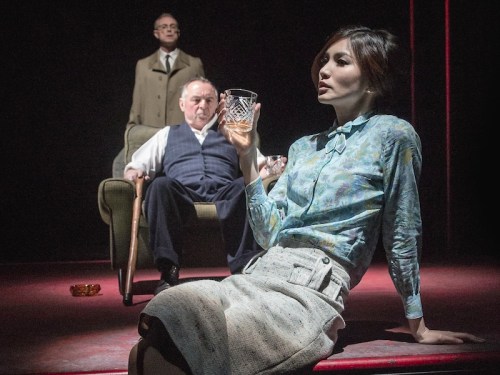
Gemma Chan as Ruth, with Gary Kemp and Ron Cook, in The Homecoming at Trafalgar Studios. Photograph by Marc Brenner


➢ Dominic Maxwell in The Times:
Half a century after it first put Harold Pinter at the forefront of British drama, this 1965 play can still leave audiences provoked, puzzled and, finally, pleased. With its stark but colourful expressionist staging, its swirling bursts of Mod music and its sharp Sixties threads, this is Pinter goes Kafka, domestic drama goes haunted-house horror.

➢ Dominic Cavendish in The Daily Telegraph:
Welcome back to Pinter-land, a world of inescapable disquietude which, in Jamie Lloyd’s stripped-back 50th anniversary revival of The Homecoming, is more Hades than Hackney. The gender politics of the play make it Pinter’s most problematic major work. It’s not constructed to invite “debate” – you’re meant to submit to its strange, atavistic logic. . . In broad terms, Lloyd delivers an evening that is intense, committed and often – because of the dialogue – darkly funny.

➢ Quentin Letts in the Daily Mail:
Those with a taste for bleak, absurdist, sexist fantasy will find their needs adequately catered for by the latest Jamie Lloyd production at London’s Trafalgar Studios. . . Pinter’s language is always to be savoured, his patter of lower-middle class cliches so astute. References to Humber Snipes and jam rolls and London Airport and flannel vests evoke an era. Was he ahead of his time in envisaging a career woman liberating herself from a lifeless marriage? Or was bedhopper Harold working off a little fantasy about a woman too free with her favours? I incline to the latter view.

FRONT PAGE