Tag Archives: David Bowie

➤ 14,000 words on Bowie’s album – responding to Bowie’s own 42 words telling what it’s all about

❚ AND YOU WON’T STOP READING THEM! A novelist asked David Bowie to explain his comeback album. In his own way, Bowie uttered his first public words on the subject: 42 of them.

Rick Moody,reviews,David Bowie, The Next Day,pop music,Britishness

Rick Moody photographed by Seamus Kearney … and a salute from Bowie at 66

“Never has an album been quite as resistant to interpretation as The Next Day,” writes Rick Moody, the 51-year-old American author, tipped by New Yorker magazine as one of its “20 writers for the 21st century”. So he asked Bowie for some clues! We offer a few teasers here to entice you in, but no spoilers. The original piece is so rewarding, you won’t regret setting aside half an hour of your time to devour it… Moody talks of cocktail napkins, albatrosses, a sequence of ghosts and the pressure to be à la mode … of chanson, of papal indulgences, of hatred of rhyme, the ancient temple in Rome, quintessential Britishness, rethinking certainties and the world at war…

SHAPERS OF THE 80S OFFERS AN EXTRACT
FROM HIS MONUMENTAL ANALYSIS

➢ Rick Moody dissects Bowie’s new album with the help of its creator in 14,000 words published yesterday. Read the full essay at the pop-cultural web platform, The Rumpus

BY RICK MOODY: I am writing these lines because The Next Day, the album by David Bowie, is the unlikeliest masterpiece of the recent popular song, the best album by an otherwise retired classic rock artist in many, many years. It kicks the shit out of that recent spate of albums by Neil Young and Crazy Horse, it is better than anything the Stones did since Tattoo You … [etc etc etc]

It’s a remarkable and completely unpredictable masterpiece by a guy in his later sixties, an album that doesn’t sound like anything else happening in 2013, except that it sounds, in some ways, like a lot of the very best work David Bowie has done … [etc etc etc]

In the environment of Taylor Swift and Justin Bieber and One Direction, David Bowie sounds like a titan, like a behemoth of song, but it’s not only because of his context, it’s because he made a great album, which has more passion in each composition than most people manage in entire albums … [etc etc etc]

I wanted to understand the lexicon of The Next Day, and so I simply asked if he would provide this list of words about his album… and yet astonishingly the list appeared, and it appeared without further comment, which is really excellent, and exactly in the spirit of this album, and the list is far better than I could ever have hoped.

David Bowie, The Next Day, Where Are We Now?,video

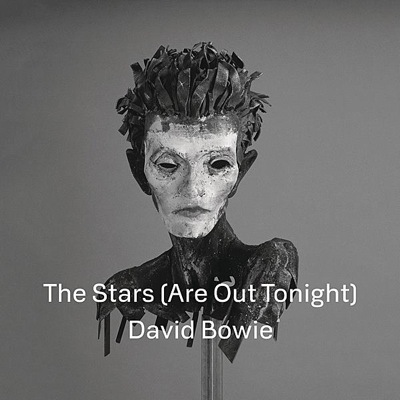
Having asked Where Are We Now? in his first comeback single this year, Bowie’s second posed other enticing questions in a sexually ambiguous video for The Stars (Are Out Tonight) (ISO Records)

BOWIE’S LIST

Effigies

Indulgences

Anarchist

Violence

Chthonic

Intimidation

Vampyric

Pantheon

Succubus

Hostage

Transference

Identity

Mauer

Interface

Flitting

Isolation

Revenge

Osmosis

Crusade

Tyrant

Domination

Indifference

Miasma

Pressgang

Displaced

Flight

Resettlement

Funereal

Glide

Trace

Balkan

Burial

Reverse

Manipulate

Origin

Text

Traitor

Urban

Comeuppance

Tragic

Nerve

Mystification

It’s a great list, and it has the word chthonic on it, and this is one of my very favorite words, and you have to admit, additionally, chthonic is a great word, and all art that is chthonic is excellent art, and art that has nothing chthonic about it, like, let’s say, ‘Don’t Worry, Be Happy’, that is art that’s hard to withstand
➢ Rick Moody continues at The Rumpus

POSTSCRIPT VIA IAN HUNTER

+++
❏ Rick Moody: They have no idea how easy it would be to stop. Still, this neglects the loss you would feel about retirement… Ian Hunter, the British singer-songwriter and Bowie’s acquaintance for whom he once wrote All the Young Dudes, had a song on this subject, on his comeback album called Rant (2001), the song being Dead Man Walking (What am I supposed to do now?/ Crawl down the hole of monotony?/ The silence is deafening/ The phone never rings)

FRONT PAGE

2013 ➤ Remembering why Mick Ronson’s talent deserves to be celebrated

David Bowie, Mick Ronson

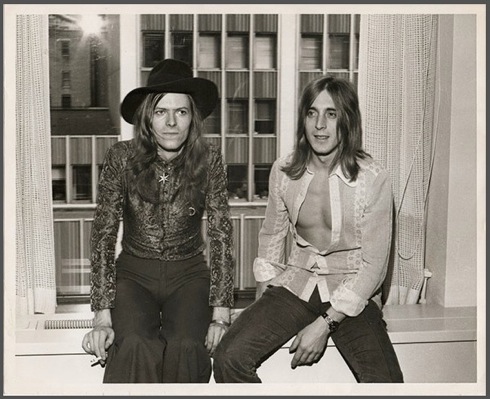
The day they signed to RCA, 1971: David Bowie and Mick Ronson in New York

➢ Tonight April 1: Songwriter Gary Kemp marks the
20th anniversary of the death of “the man who rode shotgun to Ziggy”– 10pm, BBC Radio 2, then on iPlayer

“That’s my Jeff Beck” – David Bowie after hearing
Ronson playing in The Hype, 1970

❏ Mick rose to fame as lead guitarist and music arranger on David Bowie’s albums, the missing link in creating the Bowie sound – those signature riffs. “As a guitar god, Ronno inspired a whole generation of guitarists,” says Spandau Ballet’s Gary Kemp. Mick was a born collaborator and all-round nice guy, and his amazing ability for interpreting and arranging songs soon found him in demand from some of the biggest names in rock, starting with Lou Reed on his album Transformer. Another outstanding Ten Alps documentary (worth hearing over a hifi system) sees a stellar cast of musicians including Chrissie Hynde, Tony Visconti, Ian Hunter, Trevor Bolder and Woody Woodmansey explaining why Mick is such an important figure in British rock’n’roll, while Kemp narrates… In 1992, diagnosed with cancer, Mick produced Morrissey’s album, Your Arsenal. The same year, Ronno’s final live performance was playing All the Young Dudes at The Freddie Mercury Tribute Concert.

FRONT PAGE

➤ Bowie as the human equivalent of a Google search

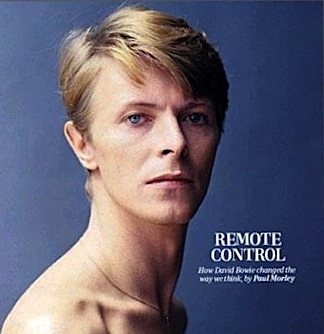
➢ David Bowie’s role was an unlikely form of education for a teenager in thrall to the Zen-master popstar – Paul Morley recalls his influence in The Telegraph Review, March 2, 2013

Telegraph online,David Bowie ,Paul Morley,

Today’s Telegraph Review cover

When I was a 15-year-old David Bowie fan in 1972, Bowie was for me a kind of teacher, so much more inspiring and motivating than my real teachers. In the middle of a mundane, mainstream world that limited possibility, his explosive mind and the way he represented it through sheer otherness suggested everything was possible.

He was the human equivalent of a Google search, a portal through which you could step into an amazing, very different wider world – if he mentioned in an interview, or referenced in his work, someone like Andy Warhol, Jean Cocteau, Antonin Artaud or Marcel Duchamp, I would immediately want to find out what he was talking about. He flooded plain everyday reality with extraordinary, unexpected information, processing the details through a buoyant, mobile mind, and made intellectual discovery seem incredibly glamorous. He helped create in my own mind a need to discover ways of making sense of both the universe and the self by seeking out the different, the difficult and the daring… / Continued at Telegraph online

➢ Riddle of the train Bowie could not have taken in
Where Are We Now?

➢ 2013, The Bowiesconti proxy has spoken – Shapersofthe80s translates revelations from the Visconti interview

➢ David Bowie is the enigmatic title of a retrospective exhibition drawn from Bowie’s personal archive. Opening March 23 it has been extended to August 11, 2013, at the Victoria & Albert museum, London SW7 2RL. Book online, in person at the museum, or by phone +44 (0)20 7907 7073 where you will spend a lifetime on hold.

FRONT PAGE

2013 ➤ Bowie’s psychodrama The Stars mocks the rockiness of godliness

[Video NSFW]

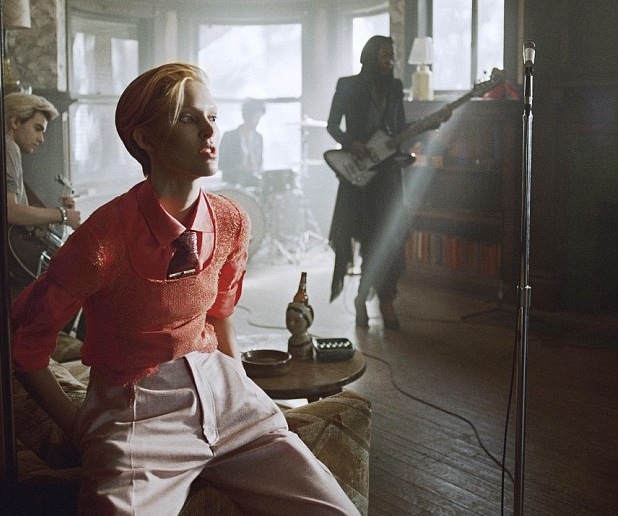
❚ WHAT A FRISKY, UNSETTLING VIDEO David Bowie has created for this year’s second single, The Stars (Are Out Tonight). It’s hard to tell who’s doing what to whom in this sexy Rocky Horror homage on the theme of celebrity stalking.

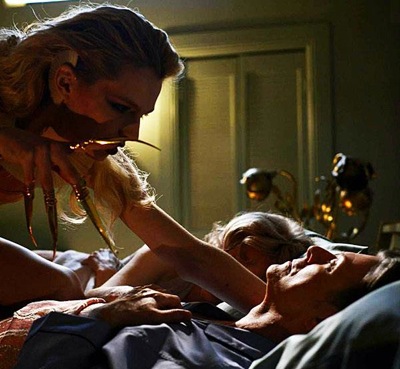
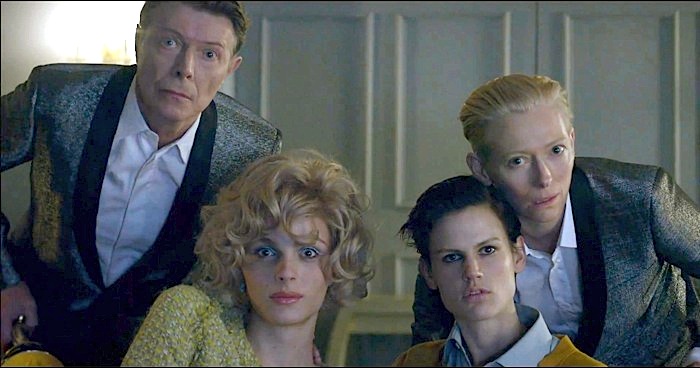
The souls of a happily married suburban couple are haunted by the neighbours, a tantalising pair of godlike and androgynous celebrity sirens played by supermodels Andrej Pejic and Saskia De Brauw, who have been cast from Bowie’s 70s character moulds. The story sees wifey, played by  Tilda Swinton, morph into another early Bowie lookalike, which has often seemed to be her destiny. Dave himself ends up in mindless zombie mode despite his protective bemused face, the me-looking-at-me double-take, first clocked in his 2003 Vittel TV commercial.

David Bowie,The Stars (Are Out Tonight),video,Floria Sigismondi, Andrej Pejic

Waiting to make their night-time moves: Andrej is about to plonk one on David in the video for The Stars. © 2013 ISO Records

Even today, it’s brave that gender-bending role-play is the medium for The Stars’ saga of corruption, depicted with a cold eroticism appropriate to the zeitgeist. That we’re led astray by ambivalent naked body parts in a pseudo-Hitchcockian psychodrama is eye-popping. On top of which, this absorbing, elegant mini-movie by Floria Sigismondi makes flesh of a rocking melody and an intelligent song, delivered with classic Bowie vocals. (Here, musically, is another echo from 2003’s album Reality, which was widely under-rated.) The weirdo video for The Stars is all of a piece: it’s tongue-in-cheek, it’s creepy and it’s funny.

Also: Dave is sporting a proper set of glam teeth and NO evidence of a turkey neck at 66. So unfair.

David Bowie,The Stars (Are Out Tonight),video,Floria Sigismondi

Gender-bending confusion: “Brigitte, Jack, Kate and Brad”, according to the lyric for Bowie’s The Stars. © 2013 ISO Records

➢ The Stars on sale at iTunes

➢ 2013, Shock and awe verdicts on Bowie’s born-again masterpiece – Shapersofthe80s rounds up verdicts on Where Are We Now?

1970 ➤ Where to draw a line between glitter and glam:
naff blokes in Bacofoil versus starmen with pretensions
— analysis by Shapersofthe80s

FRONT PAGE

➤ Bowie’s first album for a decade is beautiful, obsessive and deliciously cruel

EAGERLY AWAITED REVIEWS OF THE NEXT DAY,
BOWIE’S 30TH STUDIO ALBUM, DUE ON MARCH 11
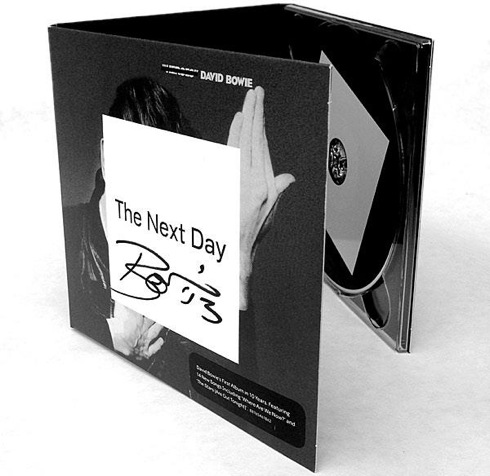
The Next Day ,David Bowie,albums,pop music,Tony Visconti ,reviews ➢ An absolute wonder that’s bold and baffling, writes Neil McCormick in the Daily Telegraph, Feb 25:

It is an enormous pleasure to report that the new David Bowie album is an absolute wonder: urgent, sharp-edged, bold, beautiful and baffling, an intellectually stimulating, emotionally charged, musically jagged, electric bolt through his own mythos and the mixed-up, celebrity-obsessed, war-torn world of the 21st century.

Musically, it is stripped and to the point, painted in the primal colours of rock: hard drums, fluid bass, fizzing guitars, shaded by splashes of keyboard and dirty rasps of horns. The 14 songs are short and spiky, often contrasting that kind of patent Bowie one-note declarative drawl with sweet bursts of melodic escape that hit you like a sugar rush. Bowie’s return from a decade’s absence feels very present, although full of sneaky backward glances… / Continued at Telegraph online

➢ Despite the lyrical density, the album’s success rests on simple pleasures, writes Alexis Petridis at Guardian online today

The Next Day offers what you might call an index of Bowiean obsessions… The mutual respect between Bowie and Scott Walker is well-documented – an effusive 50th birthday tribute from the elusive former Scott Engel famously reduced Bowie to tears live on Radio 1 – and it’s Walker’s latterday work that much of The Next Day resembles, at least in that the lyrics are so dense and allusive you occasionally feel in need of a set of York Notes to get through them.

Producer Tony Visconti has suggested that The Next Day is of a piece with 1979’s Lodger and, as on that record, Bowie spends a lot of The Next Day experimenting with his vocal delivery, offering, among other things, a peculiar nasal drone on the title track and a doomy, tortured lowing that recalls Walker – him again – on the closing Heat… [This is] an album that’s thought-provoking, strange and filled with great songs… / Continued at Guardian online

➢ In the FT, Ludovic Hunter-Tilney perceives an album thick with visions of ageing, death and violence

Bowie’s vague but vital sense of terror is one of the most provoking and enigmatic aspects of his first album in 10 years… The visions of ageing, death and violence that run through the album… climax in You Feel So Lonely You Could Die, an unsettling kiss-off to a would-be suicide (I can see you as a corpse hanging from a beam), incongruously played as a ballad. Bowie’s idea of terror, an existential dread, follows Burroughs’ “frozen moment when everyone sees what is on the end of every fork” – a sentiment that Bowie rephrased in his Queen duet Under Pressure: It’s the terror of knowing/ What this world is about. / Continued at FT.com

The Stars (Are Out Tonight),David Bowie,vinyl , singles,pop music,Tony Visconti ,reviews

Another single release: The Stars is scheduled for a limited edition vinyl 7inch 45 Record Store Day release on April 20, 2013. Backed with Where Are We Now? Before that, on April 1, the album will be released as a 180 gram, 17-track double vinyl set

➢ More mystery than any other living singer,
asserts Chris Roberts at the Quietus:

Fortunately, [the album]’s great. I mean: it’s not just good, it’s great. No wild pioneering sonic experiments here: it’s primarily a “rock” album with plentiful twists, with the closest sibling being Scary Monsters… I sometimes found myself pining for more ballads or tangents to break up the album’s mid-section run of half a dozen roaring thumpers. Yet it starts with six mercurial wonders that have you grinning because he’s pulled this comeback thing off big-time. They tease, tumble and twirl, referencing his past in flashes but refusing to relinquish their own personalities and identities. Moreover, it closes with two mind-blowing, show-stopping, grandstanding epics: one as baroque as Rock And Roll Suicide ONLY MORE SO; one as frazzled and sinister and ticking as Scott Walker’s (ok, The Walker Brothers’) The Electrician.

So more than half the album is fantastic, and the rest is very, very strong… Every Bowie biography from now on is going to have a lot more cod psychology to do. And even after all these years, all these artistic statements, we don’t know what’s a confession and what’s a character. The interface between the two (substance and style seduce each other, Miller and Monroe in one misfit) affords Bowie more mystery than any other living singer, still… / Continued online at Thequietus

The Next Day ,David Bowie,albums,pop music,Tony Visconti ,reviews ➢ In the NME dated March 2, Emily Mackay says the in-your-face pace of The Next Day rarely slackens

It’s the sheer vibrancy of the new album that strikes you hardest. In contrast to Outside or Earthling, there’s no sense that it’s the need for another radical reinvention that has pulled Bowie back to music-making. These songs feel like stories that insisted on being told, bright and aggressive and poppy. The title track sets the tone. A cocky strut seething with rage… it boils with lust, paranoia and megalomania… This album is about songcraft… it absorbs his past and moves on, hungry for more… / Continued in the NME, along with an exclusive five-pager on the making of the album

➢ Bowie is in masterful voice and his band are at full throttle,
says Simon Price in the Independent, March 3:

The strangely artless artwork (the “Heroes” cover blanked out with a white square and the title in pseudo-Helvetica). The teaser single Where Are We Now?, wherein this Englishman in New York reminisced about old friends and Old Europe. Now it’s here, and it’s clear: The Next Day’s primary concern is the delicious cruelty with which the past haunts the present. Just walking the dead, indeed.

This album is not David Bowie’s first overtly nostalgic work, the first to reference his own career, nor the first to feature meditations on aging, but it repeats those tricks with immense style. On Love Is Lost, he brutally commands you to “say goodbye to the thrills of life … wave goodbye to the life without pain”. On How Does The Grass Grow?, amid Fifties ya-ya-ya-yas and snatches of Bond theme, he daydreams If the clocks could go backwards, then the girls would fill with blood and the grass would be green / Continued at Independent online

➢ We’re told Bowie made his first album in 10 years because “today he definitely has something to say”. In the Huffington Post (March 3) Michael Hogan says it’s up to us to ask, What is he trying to say?

You get the sense, from the music but also from the video [for The Stars Are Out Tonight] with Tilda Swinton, that Bowie has ambivalent feelings about his distance from the cultural tide. There was a time when he defined it, followed by a long period when he tried but perhaps failed to steer it in more esoteric directions; now all he can do is remind us how much he did to shape it – and impart a few lessons to those travelling in his wake.

Like so many ageing artists before him, it seems, Bowie has learned the Big Lesson: no matter how much money you make, how many sex partners you corral, or even how many masterpieces you produce, we’re all riding a one-way conveyor belt into the furnace of oblivion. Does that mean everything we’ve done is meaningless? Not really, Bowie seems to suggest on Where Are We Now?, As long as there’s sun / as long as there’s rain / as long as there’s fire / as long as there’s me / as long as there’s you . / Continued at Huffington Post

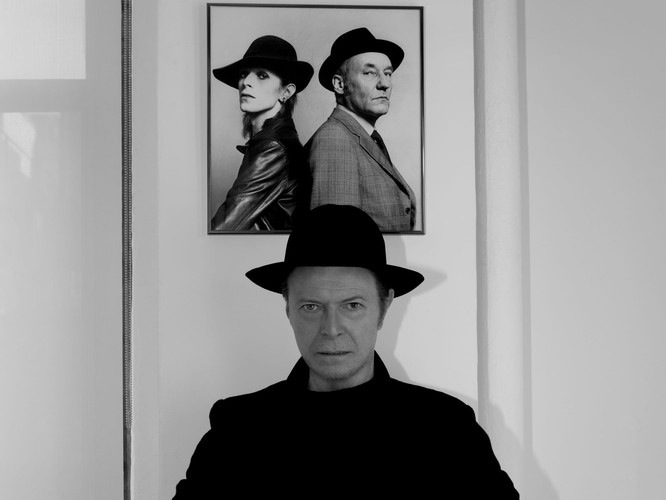
David Bowie, portraits, Jimmy King, William Burroughs

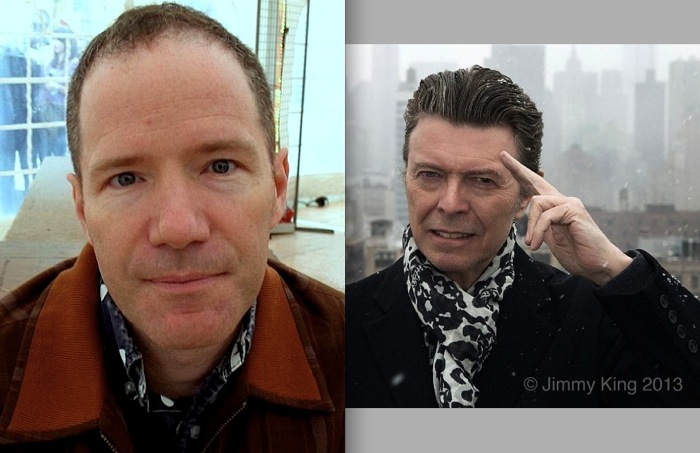
Freeze. And freeze again: Let’s not forget the shadow of Burroughs and his “frozen moment”. One of this year’s few official portraits of Bowie, taken by Jimmy King

➢ The Stars single reviewed: Bowie’s psychodrama mocks the rockiness of godliness

➢ Riddle of the train Bowie could not have taken in
Where Are We Now?

➢ 2013, The Bowiesconti proxy has spoken – Shapersofthe80s translates revelations from the Visconti interview

➢ 2013, Bowie officially not “devastated” as fab retrospective show goes ahead at the V&A

FRONT PAGE