Tag Archives: Art

➤ Classics of 80s graffiti revived by campaigning collective in New York

graffiti, Subway Art History,Joan of Arc, Hand of Doom, Martha Cooper ,Henry Chalfant

Joan of Arc at a warehouse along a Brooklyn canal: the graffiti collective Slavery is paying homage to a 1980 work that read “Hand of Doom”. © Robert Wright for The New York Times

[From the New York Times, October 26, 2010]

❚ ANYONE WHO HAS BEEN LOST in the last few weeks around the southern reaches of the Gowanus Canal in Brooklyn could be excused for experiencing a powerful Koch administration flashback. On the wall of a brick warehouse there, a huge mural unfurls itself, a loving, seemingly spray-by-spray re-creation of one of the more infamous pieces of graffiti ever to ride the subway: a 1980 work by the artist known as Seen that covered the length of a No 6 train car with the ominous phrase “Hand of Doom”.

It is the work of a newly formed collective of (mostly) former graffiti writers in their 20s and 30s, who have embarked on an unusual citywide campaign to summon 50 or more of the most famous pieces of old-school graffiti out of the history books and back onto the streets. The project, called Subway Art History, is unusual not only because the artists are making the pieces with the permission of businesses, schools and other perhaps nostalgic owners of blank vertical space, but also because of the nature of the pieces themselves. They are expressions of homage in a subculture that has almost always been defined by fierce competition, intense striving for originality and a kill-the-elders attitude toward the past.

“In graffiti it’s like a teenage thing: No way am I going to become my father, no way am I going to make anything that looks like anyone else’s. — Then, of course, you become your father,” said a 32-year-old former graffiti writer who helped form the collective.

➢ Read Graffiti of New York’s past, revived and remade
— in the New York Times

❚ View video — 25th anniversary of Subway Art, bible of the graffiti movement, by Martha Cooper and Henry Chalfant:

➢ The book: Subway Art, bible of the graffiti movement

FRONT PAGE

➤ A second squadron of high-octane British artists zaps the Saatchi space

❚ TODAY’S NEW STARS OF BRITISH ART are quieter and more thoughtful than the YBAs in the Sensation survey of 1997 — this was the progressive critic Waldemar Januszczak’s verdict in June on Part 1 of the millionaire Charles Saatchi’s latest survey when it opened in London. “A rousing exhibition, Saatchi’s best for many a year,” he wrote. Part 2 of Newspeak, British Art Now, opens to the public today and it too proves to be another sprawl of hits and misses, yet the hits do unsettle and send a tingle through your aesthetic nerve. Shapersofthe80s has chosen a dozen of the more hyper-intense images for the gallery below.

This slideshow requires JavaScript.


For the sake of balance, let’s give the caustic old traditionalist his turn. Even after he “walked sickened away” from the 1997 Sensation show, Brian Sewell has actually conceded that “Saatchi did more for British contemporary art and the economic blossoming that it engendered than all the Tates, the Arts and British Councils put together.” Yet faced with the 2010 selection, he pronounced Newspeak Part 1 to be “Oldspeak rather than new, and we have seen it all before… The Newspeak group are hardly new kids on the block, for all have substantial exhibition histories, many of them international, yet very few have reached further than the low levels of skill, aptitude and common sense demonstrated every year in exhibitions mounted by students in the benighted art schools up and down the land.”

He concluded: “Newspeak is at best cliché, kitsch and the ironic subversion that is the joke so often played by the post-postmodernist… One might reasonably conclude that British art is dead.”

Shapersofthe80s sides with Januszczak in finding more experiment and curiosity than indifference at Newspeak. Januszczak identifies the Saatchi touch thus:
“What Saatchi has always done, and what Tate Modern can never do, is back hunches with cash. The Tate doesn’t have any FU money. Its investments are our investments. Which is why it remains so chronically and conspicuously image-conscious. When it comes to rewriting agendas, the Tate is a scaredy-cat. Saatchi, on the other hand, is not.”

Of Newspeak, he concludes: “[The] clash of new and old, scientific and irrational, experiment and belief, is typical of the show’s prevailing mood.”

❏ Newspeak: British Art Now — Part 2 runs at the splendid new Saatchi Gallery in Chelsea, October 27-Jan 16, 2011
➢ “One might reasonably conclude that British art is dead” — Brian Sewell’s review of Part 1 in the Evening Standard, June 3, 2010
➢ “Britain still has talent” — Waldemar Januszczak’s review from the Sunday Times Culture, June 6, 2010

FRONT PAGE

➤ A step up in the world for graffitist Eine, thanks to Potus and lady friends who shop in high places

❚ “I WAS IN MY STUDIO CUTTING OUT A STENCIL, Friday night about 10 o’clock and the phone rang… It was Anya Hindmarch and she said ‘Samantha Cameron’s a big fan of your work’, and I kind of thought, Yeah right, and she said ‘David is looking for a painting to give to the most important man in the world, I can’t say his name but think America. Would you be interested?’ I was like, Yeah!”

Eine Signs,21st_Century_City, Obama, David Cameron, Potus, art

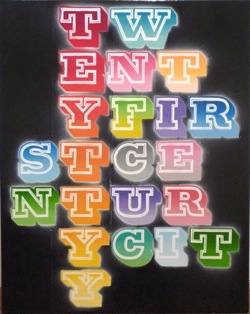
21st Century City by Eine: spray paint and black gloss on canvas, 39x27 inches. © Eine Signs, London

So now we know. Today a new video reveals that the go-between who helped fix the official gift of “hoodie art” from the British prime minister to Potus, leader of the Western world, was handbag designer Anya Hindmarch. We discovered in July during David Cameron’s first trip to Washington as PM that the gift was a painting titled Twenty First Century City, by a graffiti artist whose adopted tag is Eine, and who is regarded in the East End of London as one of the founders of Britain’s street-art movement, alongside Banksy. More important, he was said to be one of the PM’s wife SamCam’s favourite artists.

Yes but, no but … OK, we discovered then that the 39-year-old graffitist’s real name was Benjamin Flynn who’d spent his teens as a hooded tracksuit gang member, had a racy record of convictions for criminal damage and had taken a year to complete 200 hours of community service.

Anya Hindmarch,LootTote,

Hindmarch Loot tote bag in canvas, decorated by Eine, aka Ben Flynn, £145. It is claimed that “Eine is doing for letters of the alphabet what Banksy did for rats and smiley policemen”

Even so, what hasn’t really been spelt out is that much earlier Flynn had collaborated with Anya Hindmarch to design a spring collection of trendy tote bags that drew on his street-cred. The bags feature prominently among the luxury accessories illustrated on the Hindmarch website, and as Eine he had even painted the windows of her upper-crust Sloane Street store during March. Just his luck that Anya turned out to work in the same upmarket retail sector as the PM’s wife, who was also a friend.


The nice irony is the clash of classes. Not only is SamCam the daughter of an 8th baronet, raised on a 300-acre Lincolnshire estate, but Hello magazine also reports that she is the great-great-great-great-great-great-great-great granddaughter of Charles II and his mistress Nell Gwyn. The Sunday Times Rich List compiler Philip Beresford has put the “combined family wealth of David and Samantha Cameron at £30m plus”. Ben Flynn on the other hand, was so hard-up two years ago that he had to move home from London to Hastings with his wife Joanne and three children, Spike, 5, Sunny, 2, and Story, 2. On top of which the millionaire Camerons expected him to donate his chosen painting, valued in the marketplace at £2,500.

“Cameron seems quite a positive kind of guy and Obama’s a dude. I would probably have had issues if it had been for Bush” — graffitist Ben Flynn

Still, the compensation for Flynn was overnight global fame, which has brought him a string of commissions, several trips abroad, and enhanced price tags on his work. In the video by Anthony Austin and Charlie Inman, Flynn’s verdict is direct: “My phone didn’t stop ringing for about a month — interviews and television. It changed my life. David Cameron, I love him.”

➢ Ben (Eine) Flynn’s online gallery
➢ Revealing interview with Flynn by blogger Ashley Morrison

Middlesex Street, London,graffiti, Eine

Alphabet City, Middlesex Street, just up from Petticoat Lane, London’s famed Sunday market: artist Eine spent months persuading shop owners to allow him to spraypaint their shutters. Photograph by Steve Cotton

FRONT PAGE

➤ Slashed! Wallinger’s knife demonstrates a 25% cut on a Turner masterpiece

Reckless ,Mark Wallinger, The Fighting Temeraire, Turner ,National Gallery, arts cuts, petition, protest

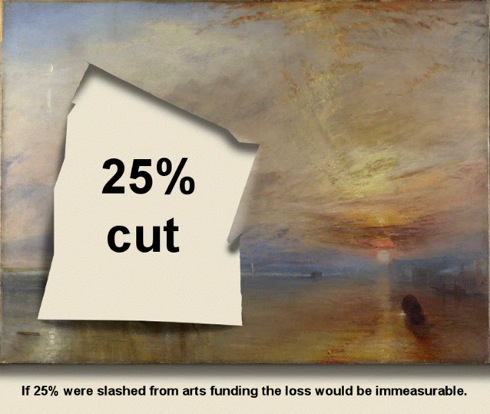
Reckless by Mark Wallinger. Thanks to Jed Butterfield and Bob Pain at Omni Colour http://www.omnicolour.com and Nicholas Penny at the National Gallery

❚ A NEW WORK BY TURNER PRIZE-WINNING ARTIST Mark Wallinger is released today as part of a campaign supported by more than 100 leading British artists against the government’s proposed funding cuts of the arts.

Mark Wallinger’s work shows a copy of the masterpiece, The Fighting Temeraire, 1839 by Joseph Mallord William Turner, in the collection of the National Gallery in London. A slash in the painting carries a notice “25% cut” and beneath it a caption reads: “If 25% were slashed from arts funding the loss would be immeasurable.”

Turner refused ever to sell The Fighting Temeraire — depicting the final journey of the 98-gun ship which played a distinguished role in Nelson’s victory at the Battle of Trafalgar in 1805 — until he finally donated it to the National Gallery. When the BBC asked the nation to nominate the greatest painting on show in UK museums and galleries, this came first with 25% of the votes.
Turner’s concern was to evoke a sense of loss as the great battleship was towed to the breaker’s yard.

The title of Mark Wallinger’s new work is Reckless. He explains: “I describe the cuts as a reckless adventure. In fact temeraire means reckless in French and by removing the obsolete ship from the scene I am rendering the painting wreckless.”

➢ Click for full petition details at 

savethearts-uk.blogspot.com

FRONT PAGE

2010 ➤ Spider-woman Bourgeois created her art as meditations on sexuality

◼ LOUISE BOURGEOIS, THE FRENCH-BORN SCULPTOR, who lived in a 15-foot-wide town house on West 20th Street, Manhattan, died today at the age of 98 following a heart attack. She was largely unknown until 1982, aged 71, when she became the first woman to have a retrospective at the Museum of Modern Art. Time art critic Robert Hughes has called her “the mother of American feminist identity art” and declared that “[Louise’s] influence on young artists has been enormous”.

Raimon Ramis, sculpture, Louise Bourgeois

Louise Bourgeois in 1990, behind her marble sculpture Eye to Eye (1970). Photographed © by Raimon Ramis

On the occasion of her 1982 retrospective, Bourgeois published a photo essay in Artforum magazine that revealed the impact of childhood trauma on her art. “Everything I do,” she exclaimed, “was inspired by my early life.” Born in 1911, Bourgeois grew up in provincial France, and aged eleven, she witnessed her father’s betrayal of his wife and three children when he initiated a ten-year affair with their live-in English tutor. Bourgeois also attended to her mother, who had succumbed to the Spanish Flu after the First World War.
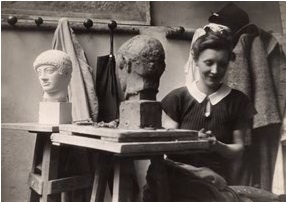
Louise Bourgeois, Brassai, 1937

Bourgeois photographed by Brassaï in Paris, 1937, where she studied under Fernand Léger. (Louise Bourgeois Archive)

This familial triangle of sexual infidelity and illness cast the young artist in the most inappropriate of roles — as voyeur, accomplice, and nurturer — the combination of which left her with life-long psychological scars, including insomnia. Bourgeois’s diaries, which she has kept assiduously since 1923, indicate the tensions between rage, fear of abandonment, and guilt that she has suffered since childhood. It is through her art, however, that she has been able to channel and release these tensions.

Many of her works are today instantly recognisable, especially the giant spiders created for the opening of Tate Modern in London in 2000. Only last month she shared the following thoughts with Jonathan Jones for The Guardian on the 10th anniversary of that commission…

From The Guardian, Tuesday May 4, 2010:
“ Bourgeois no longer gives interviews, so the fact she’s even speaking to me proves how much the first Turbine Hall commission meant to her. The twisted steel legs of her giant spider Maman, alongside a sequence of fabulous, hellish towers, gave the brand-new Tate Modern an instant visual signature, and made the then 89-year-old French-born New York artist a household name. Until then, Bourgeois had been revered by a small world of contemporary art fans; did this sudden popularity surprise her? “No,” she says modestly. “The space is so beautiful – anything placed inside it would cause a strong reaction.”

Louise Bourgeois, sculpture, Spider, Maman

Bourgeois’s sculptures: Maman in the turbine hall at Tate Modern in 2000, photographed by Ray Tang. Spider and Maman in the Large Courtyard of the Winter Palace, St Petersburg, 2001

As an artist, Bourgeois dwells on the strange and darkly remembered interiors of her childhood; the intensity of her meditations on sexuality and power easily filled the colossal space. Maman turned the surrealist obsession with the male psyche on its head, creating a haunting image of motherhood — a spider carrying her eggs.

Before this, Bourgeois says, “I made a series of small sculptures with mirrors and chairs. They were about looking and being looked at. To continue these concepts on a large scale was an opportunity I could not pass up.” What mattered to her most about this installation was the audience’s engagement with it. Her towers were designed to be ascended, paving the way for subsequent participatory installations. “The towers were meant to be an experience. If you did not experience all three towers in sequence, then you did not get the piece.”

Did Maman affect future work? She says not, beyond the opportunities afforded by scale. As she points out, her work is relatively immune to outside influences: “It has an internal logic all its own”.

➢ “Need for nurture in a frightening world” – The New York Times obituary
➢ “Known for her primitive, female forms” – The Guardian obituary
➢ “A tension between quintessentially male and female forms” – All you need to know about Louise Bourgeois at Artsy, the website with a mission to make all art accessible

FRONT PAGE