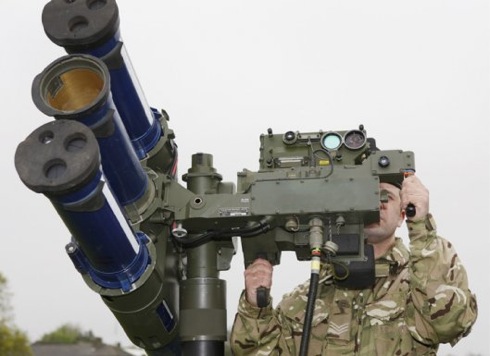
Rocket systems: six London sites have been strategically selected as the best spots from which to protect the Olympics
❚ TWO WEEKS BEFORE the Olympic Games begin, London’s threat level on the government’s official five-point security scale is set at the mid-point, “Substantial” – which means that a terrorist attack is a strong possibility. Hence this week’s anger with G4S, the private company tasked with providing 10,000 security personnel, for failing to fulfil its contract. With the Olympic Village in Stratford opening in east London on Monday and Heathrow Airport saying this will be its busiest day for the arrival of athletes, 3,500 troops are being drafted in – some fresh from action in Afghanistan – to plug gaps in staff ranks and meet the shortfall to protect 100 Olympics venues.

Helicopter base: HMS Ocean negotiates the Thames Barrier en route to Greenwich
The Ministry of Defence has already mobilised the biggest peacetime security plan ever in the UK, designed to meet worst-case scenarios. The policing operation is costing up to £600m, and plans to secure venues and other Olympic sites a further £553m. The military deployment has now been raised to 17,000, the majority performing security roles on venue gates. Others have specialist roles as bomb disposal squads and special forces and manning the controversial London missile sites.
On Friday the Royal Navy’s largest aircraft carrier HMS Ocean passed through the Thames barrier to anchor at Greenwich and provide a base for helicopter operations and Royal Marine snipers (while also being open for public visits). Typhoon fast jets will also be on alert at RAF Northolt, ready to use “lethal force” at short notice if the Olympics are threatened. Airspace restrictions around London and south-east England came into effect yesterday.
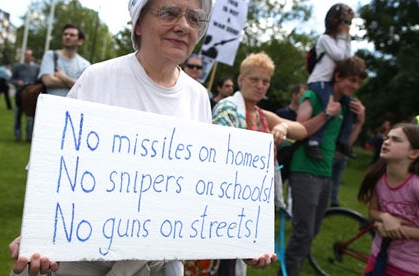
No, no, no: Residents protest against government plans to station missiles on the roof of the Fred Wigg Tower in Leytonstone. (Photograph by Andrew Cowie)
Last week the Army began installing surface-to-air missiles on the roof of a 17-storey tower block in east London. It is one of six sites around the capital from which Rapier and other high-velocity systems can be launched. Residents of Fred Wigg Tower in Leytonstone had taken legal action to stop the security measure, saying it would make them a terrorism target. However on Tuesday the High Court ruled in favour of the Ministry of Defence, agreeing that a tower block was a suitable site for the missiles.
Londoners have lived with continual acts of terrorism since the first explosions set by the Irish Republican Army on March 8, 1973. Nevertheless, our capital remains possibly the world’s most vibrant city and probably the world’s most open city. With more than 300 languages spoken by its 7.8m population – the French community alone makes us France’s fifth city by population! – London presents a snapshot of Britain’s rich cultural masala. This place can certainly claim to be, in the words of our former mayor Ken Livingstone, “the world in one city”.
Nobody in their right mind grows blasé to the terrorist threat, but life goes on, and today, Radio 4’s topical drama strand, From Fact to Fiction, responded nimbly to the comedic and tragedic potential of the fortified tower-block. With 38 of literature’s greatest plays to plunder, you can’t go wrong with a Shakespeare pastiche in times of national drama. Two poets, W N Herbert and Clare Pollard, have written a piece of cod Bard titled Surface To Air. It imagines the residents of a fictional tower block with a missile on the roof, while a soldier sent to man the weapon considers his role defending all the Olympics stand for.
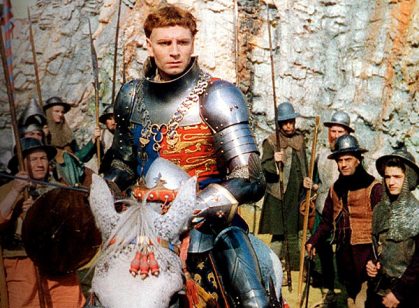
Olivier rallies the troops in his 1944 film of Henry V: today Radio 4 conjures up a pastiche drama inspired by the spirit of Shakespeare
➢ Surface to Air – the 15-minute drama is available for catch-up on BBC iPlayer for one week
❏ Sam Troughton plays the soldier, “the universal Atkins”, posted to Gaunt Tower in east London, his posting in Helmand fresh in the memory. His words and his name of Harry all derive from familiar Shakespearean lines pregnant with history. As he encounters a variegated cast of your actual East Enders, he rues this “nest of ingrates” while wrestling with his conscience:
Shall England be one stream of petty tears
As though its coastline were its cradle,
And all the world its old rejected toys,
And it a royal baby beating with its tiny fists
Against the frame of heaven?
He is a Bardish marriage of Ariel with Chorus, Henry of Agincourt with Old Gaunt, sent forth to deliver that little touch of magic:
I think I am a prophet new inspired
So will I pluck this spectre from the sky,
Dash it against the soil of jubilee,
Defend these others, Eden, hemi demi-paradise:
That park designed for sports perfections
Against defection and the hand of war.
That happy team of mates, that little state,
That precious stadium set in Stratford’s ring
Which serves it in the office of a wall,
Or as a moat defensive to a house
Against the envy of less happy lands,
That blessèd plot, that earth, that realm, IS England.
FRONT PAGE









 ➢➢ Shapers of the 80s ➣➣