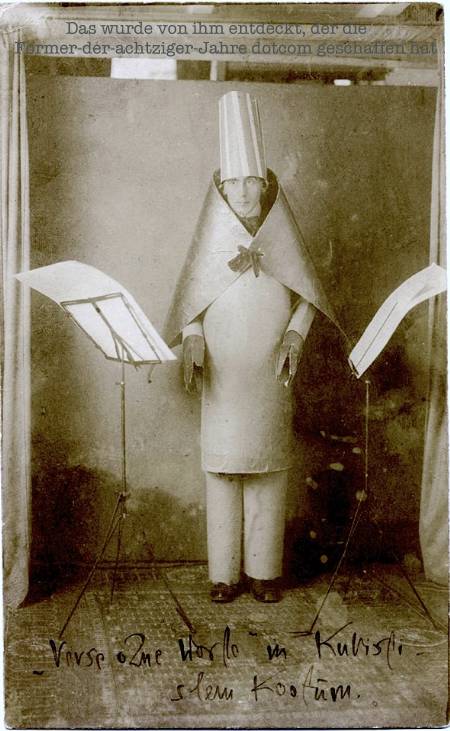
Hugo Ball, the exiled German playwright, pictured on Saturday February 5, 1916, when he co-founded the Cabaret Voltaire, a club-night named after the French philosopher and held in a back room of the Holländische Meierei tavern at No 1 Spiegelgasse in a seedy quarter of Zürich (Lenin was living at No 12). It ran for six months as refugee artists from all over war-torn Europe besieged the place. Here on June 23, 1916, Ball created “verses without words” dressed in a cubist cardboard suit – as the inscription says: „Verse ohne Wörter“ in kubistischem Kostüm. The text of one of his “sound poems” called Karawane was placed on music stands. His performance began “slowly and solemnly” but soon became a chant reminiscent of the Catholic liturgy as it climaxed: “Blago Bung Blago Bung Bosso Fataka!” With sound poems he hoped to do away with “the language devastated and made impossible by journalism”. On July 14, 1916, came a historic soirée at the Waag Hall, rented for one night only. Ball read out his own version of the Dada Manifesto amid other wild antics and absurdist chaos. Thus, was officially launched the anarchic art movement which sought through unorthodox techniques, performances and provocations to shock society into self-awareness
 ➢➢ Shapers of the 80s ➣➣